I’m very excited for the release of Relics, a short story set in the same universe as Threading the Needle.
When I originally conceived of a story that included a replica of Charlton Heston, I didn’t know any of the following things: Charlton Heston was Chuck to his friends. He and Toshirô Mifune were also friends, despite a language barrier. Heston said that if Mifune would have spoken English he’d have been one of the greatest actors of our time. Ironically, Mifune served in the Imperial Japanese Army aviation division during WWII and Charlton Heston served as a radio operator and aerial gunner in the US Army Air Service and would have taken part in Operation Coronet, the planned invasion of Japan. That gave me chills.
The thought of would-be enemies developing a friendship that lasted for the rest of their lives even with an ocean between them and despite the cultural gulf that also must have been there has its own appeal. This story is my tribute not just to that idea (ideal?) but to two of my favorite actors, Charlton Heston and Toshirô Mifune themselves.
AIs don’t go rogue. Everybody knows it. Especially SAIs. Which never really made sense to me. They’re supposed to be people just like you and me, and people—flesh and blood humans such as yours truly—are sapient and we go rogue all the time.
But you never know.
Digital citizens were one of the first truly sapient AIs. Who knows what happens after a couple of centuries of rattling around, especially when you’ve been designed and built as an anachronism to begin with. Maybe they can’t handle change. If there’s one thing that the last three centuries have proven it’s that some people just can’t handle the world as it is, so why wouldn’t “digital citizens” lose it and go rogue?
To be honest, I was surprised to find out that these digital fossils were still around, although with the rise of Nostalgism, maybe I shouldn’t have been. The Commonwealth tolerated the movement because it helped move the, shall we say less-than-desirable, off-world. That much I knew.
A leggy brunette with doe eyes, ruby-red lips, and an hourglass figure—some things remain classics even in this screwed-up century—led me into a wood-paneled office and “He’ll be right with you Mr. Elliott,” rolled off her tongue with a distinctive twentieth-century lilt.
Given that this was a museum, her accent and the throwback design of the office shouldn’t have surprised me, although I’d figured the front—a replica of the historical Grumman Theatre—had been strictly for show and expected the back to be, well, a little bit more twenty-fourth century.
The desk was wood, the chair leather, and what had to be a mid-twentieth century television set complete with antennae was tucked neatly into a corner. No computers, no tablets, no holographic interfaces of any kind, at least not that I could see. Two couches fronted the desk, facing each other across a low table—also wood. A couple of books, huge ones, held it down, their covers sporting images from a cinematic golden age almost five centuries gone.
I picked up the top volume only to find that while indeed it was made of paper, the pages were blank.
“You’ll find us in compliance with the law.”
Setting the book back down, I turned toward the commanding voice. Like the human who’d shown me in, the SAI in the doorway wore twentieth-century attire—in his case, a suit and tie. It looked a bit odd on his tall and broad but clearly synthetic frame.
The pixelated membrane that covered the android skeleton mimicked human skin to an uncanny degree, one that immediately gave me chills. The face too did a remarkable job of emulating skin and coloring, placed as it was over a bone structure that must have been true to the original human—strong but not overpowering jaw, slightly curved nose, steely blue eyes. I’d seen images of SAIs of course, but never met one. It was the eyes that gave them away. They weren’t orbs inside sockets and didn’t move as such.
“I’m not a cop anymore,” I said a bit defensively, I don’t know why.
“But you are still required to report violations, are you not?”
A smirk found its way onto my face before I could stop it. “I don’t make it a practice to inform on my clients. Tarnished I might be, but not that much.”
He gave me a skeptical look and extended his hand. “Call me Chuck. I insist.”
What a throw-back custom.
Awkwardly, I shook his hand. Room-temperature like a corpse. While it emulated skin right down to the veins and calluses on his hand, there was no accompanying texture. Images of hairs were overlaid over images of veins. The calluses were as smooth as you’d expect a pixelated surface to be. Ironic, no? He was an image on a screen, just as he must have been when his original had been alive.
When I was creating (handwaving into existence) the donai, I didn’t expect the “rule of cool” concept of “ooh, genetically engineered samurai” to lead down the rabbit holes that it did.
One of those rabbit holes had to do with age disparities in a long-lived species and how to deal with the ick-factor brought on by the so-called “creepiness formula” which states that a person can only date/marry someone who is at least half their own age plus seven years.
What that means is that if you’re 30, the formula says that you shouldn’t date someone who is younger than 22. Why 22? Because (30)(.5)+7=15+7=22.
Even though it’s a made-up world, we have to deal with two things.
The first has to do with suspension of disbelief which is dependent on things making sense. And the more you know, the harder that is. (Trust me on this. I’m quite ignorant when it comes to historical fashion which is why I can enjoy The Tudors more than my friends who know a lot about fashion history.)
The second has to do with social mores or acceptance of certain practices and it’s a lot more ingrained than one would expect.
Case in point, the number of people complaining about Edward being so old as compared to Bella in Twilight. Ridiculous really, since it was dealt with up front.
“How old are you?” “Seventeen.” “How long have you been seventeen?” “Awhile.”
The idea of vampires being static, i.e. not aging, not maturing, being anachronistic because they are frozen in place, etc. is a trope of the vampire genre (and some others as well).
Edward may have come across as too mature for a contemporary seventeen-year-old boy, but that too was dealt with. He was an artifact of his own time, the turn of the 20th century, when a 17-yo was a man, not a boy. He grew up in a world and in circumstances where a 17-yo was far more mature than the 17-yo of today.
The very same people (the ones who have a problem with this) have no problem with a science fiction story where some guy goes on ice (stasis or cryogenic suspension) and then boings a girl/woman who could easily be his great-granddaughter. Yet the same situation applies, a stasis or developmental pause that is not just physical but mental. And it makes sense in both situations. If vampires don’t age it stands to reason that their brains don’t age either, which is why they’re not grumpy old men yelling at clouds or at kids to get off their lawns.
But it still presented a problem for my worldbuilding, and not because I figured some might object. It was one of those things I had to figure out, if only for myself.
So I started off by looking into how generations were defined. I had always assumed (been taught?) that generations were twenty years. Well, there are generations and then there are generations. Obviously I’m not talking about the “Gen X” type of generation, i.e. a group of people born in a certain decade.
I reached out to one of my doctor friends, as one does, and got quite an education on the more scientific definition. Long story short, generations are determined by how long a woman is fertile.
Menarche typically occurs between the ages of 10 and 16, with the average age of onset being 12.4 years.—NIH The menopausal transition most often begins between ages 45 and 55.—NIH
Oh no! We’re in girl cootie territory again! Surely this can’t have anything to do with “real science fiction.”
Sure it does.
So let’s go with 50 as the end of fertility and 15 as the start of it (because of the lack of regular periods at the onset of 12.4 years) which gives us a nice number like 50-15=35. (Or if we go with 55, we get 40; either way that’s much longer than the 20-yr span I thought it must be).
Keep in mind now, this is for handwavium, for a made-up world, so don’t waggle your finger at me about how a real biologist might do this. I’m using this as a launching pad for my handwavium. My handwavium may be crunchy, but not so crunchy that it’s no longer handwavium.
Now, this period of fertility is obviously dependent on life span as well, so if you live at a time when 30 was your expected life span, it would be 30-15=15 and then also factor in that percentage body fat is a factor so girls who don’t live in industrialized first-world countries or who lived when they couldn’t accumulate enough body fat by age 12, would have later menarche-onset dates. It’s entirely possible that at one point in history, the fertility period (generation) was between 18 and 30 due to limits of body fat percentages and life expectancy, so 12 years.
Apply the creepiness formula to that and you can see why a 30-yo man paired with a 22-yo woman wouldn’t make sense or be typical, but a 30-yo man paired with a younger woman makes far more sense. And then factor in the number of deaths due to childbirth on top of that. If you’re not glad that you’re living today instead of way back then, you should be. (Backwards time-traveling heroines notwithstanding).
This is why we shouldn’t judge the past by our own distorted modern lens. Things happened for reasons (usually) that have everything to do with rules imposed by nature, not because of The Patriarchy (TM) or whatever the hate-on is for today.
Once you start looking at things with an eye towards impositions made by nature, the world-building gets rigorous, i.e. your scifi elements aren’t just a thin skin or veneer for your fiction.
For the donai, this meant that I could not use generations at all. When the women that are able to have babies are an anomaly due to errors in genetic coding and only have a handful of fertile cycles, then there is no concept of generations. There can’t be.
But it’s not enough to just say and handwave it away. It should be, but it’s not. You need more because of that issue of “aging” in terms of maturity, i.e. old man yells at cloud. The social derision for an older partner comes from the objection that a mature person is taking advantage of an immature one, even if the immature one is 22 and well into being considered an adult whose choices we shouldn’t question due to agency, respect, blah-whatever-blah. Having it both ways, aren’t we?
I see this derision all the time, especially when an older man is dating a much younger woman. We all assume she’s the poor victim and he’s taking advantage of her. Less so if the older partner is a woman for some reason. Now, there’s some sexism for ya!
So how to deal with it in-world for Ravages of Honor?
It turns out I already had a built-in answer, one I didn’t even think of when I created them.
Since the donai can live for centuries (How many? I don’t know yet and won’t until I have written it.) and their nanite symbionts keep them in a semi-perpetual middle-age1 for most of their lives, it follows that we have that “stuck at seventeen” or static stage of life like vampires where the character doesn’t transition to the old-man-yelling-at-cloud phase, i.e. senescence.
Being aware of potential objections made by readers is very helpful, maybe even key, when it comes to rigor. Yes, it means that you can’t just write what you want, and there are certainly times when you’ll want to ignore such “objections” (I certainly do) but it works oh-so-much better when you can head them off with something that makes sense.
For the record, in RoH, Syteria is, I would say, in her early twenties (or the in-world equivalent) with Darien being about ten years older (chronologically), which makes him very young for a donai. He is not even in that middle-age phase yet. If you were to do an apples-to-apples comparison, as in judging a human by human standards, and a donai by donai standards, she’s “older” than he is because humans age AND mature faster, whereas donai do not.
By the way, I was stunned to learn that 20-30 is considered young adult and that middle age as we define it is 40-50. I guess when you don’t start being an adult until you’re 26 that makes sense, but it was still a shock. In my world (IRL), you were expected to act and function as an adult at about 13 and by that I mean in terms of responsibility and maturity, and not by being sexually active. Yes, I’m very Old World. Go figure!
Now that I’ve started RoH4 and it’s looking like a story where Lady Neria Bhanot and Lord Dobromil (Darien’s father) are going to be forging a new world order, the “May/September romance” question kicked in hard since he is much older. But it doesn’t matter for in-world reasons. People are free to screech about it of course, but that’s not really my problem.
[crossposted to Substack]
Side notes for writers:
This kind of thing is also why I’m glad I resisted the urge to explain, that practice of dumping information into the story when there really is no need for it other than for the author to masturbate on the page and show you how much thought she’s put into it. In fact, I have no less than three deleted scenes over the last three novels where I gave in to that urge and then in going back over it, ruthlessly cut myself out of it. It saved writing myself into a corner, and one of the reasons I continue to love close/deep point-of-view.
Word of caution. The scientific rigor is what throws such stories out of the Romance genre. Once you start making your story about the worldbuilding or the handwavium rather than the romantic relationship you have crossed into romantic subplot. You’re going to end up overplotting it (for a Romance) because in order for it to make sense you’re going to have to dramatize the “science” to the reader.
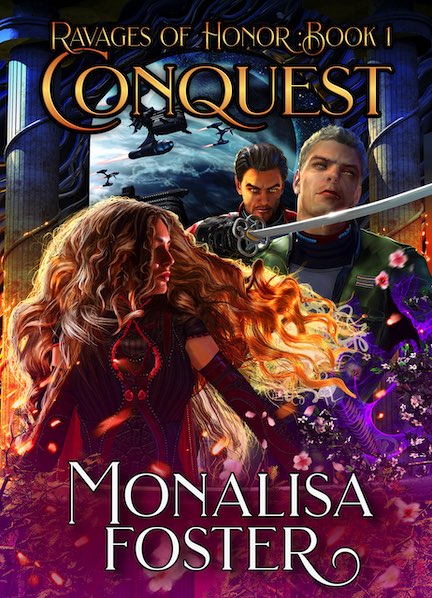
Cover for Ravages of Honor: Conquest (Book 1)
Cover for Ravages of Honor: Ascension (Book 2)
Cover for Ravages of Honor Lineage
Cover for Dominion: A Ravages of Honor Novella
Cover for Featherlight: A Ravages of Honor Novella
Yesterday I wrote up quick piece for another flash fiction contest and I was going to post about it and share the last piece of flash I wrote. That’s when I realized that my last piece of flash, Collective Responsibility, wasn’t on my website. I guess it got lost when I ported the domain, so I decided to reshare it here.
I don’t write much flash because I prefer depth and it’s hard to get depth in flash. One thousand words is just me warming up, plunging the reader into the depths of character and milieu. Most of the scenes I write are more than a thousand words, but when flash does work, it looks like this. Like a lot of my work, it was inspired by actual events. Get a hanky ready.
This was the place. Police cars. Crowd held back by yellow tape and a few uniforms who looked like they didn’t want to be here — yeah, guys, me too. Reporters trying to push their way past the tape, earning scathing rebukes. Such language! I was envious. As a professional specializing in children, I’m not allowed to use such words. That doesn’t mean I don’t want to. Right now, I really want to.
In the two minutes it takes me to verify that I’m in the right place, the crowd has doubled and the media vans have managed to block off the fire lane. For the vultures, all that’s missing is a red carpet — the buffet has been set and they are ravenous. Those poor badges. Thankless job.
Time to go inside, do my duty. It’s an upscale place, brand new by the look of it, but my gown and tiara are still completely out of place. Stupid wardrobe department! A fireman’s costume would have at least fit in, or maybe a superhero costume — a cape and a cowl are more my style.
I joined the gathering inside. Beautiful decor, an elegant setting ready to be enjoyed. I drifted past the crystal chandelier, the baby grand piano. Snags and snippets of conversation, some shouted, some whispered, some choked out between varying jags of emotion, trail behind me.
“I’m telling you, that’s not how it happened! Look…” A responsible, pillar-of-the-community type of gentleman.
“We were playing just a few minutes ago…” Nice teenager, the kind you know is going on twenty-one in spite of just having turned thirteen.
“She was just here! I saw her!”
“I thought you were…”
“…Right there. In the front. That was the last place I …”
“But it was your turn…”
“…No, no, it couldn’t happen. We were all watching.”
Commotion in the backyard caught my attention. I slipped through the glass door, somehow managing not to snag the dress. Tulle! Who wears tulle anymore? Really! As if the stupid tiara wasn’t bad enough.
Rain was the norm here, even this late in the year and everything was still wet from the last storm. At least my shoes wouldn’t be ruined — glass slippers, it turns out. I found Sarah sitting alone, past the boundary of just-laid sod, sitting, humming to herself. She was the reason I was here, dressed like a fairy princess. We made quite a pair. A leotard christened with cookie dough and icing, a tulle skirt that had seen better days, a pillowcase drafted into service as a cape, hair in adorable little pig-tails drowning in mismatched gossamer ribbons, red patent leather booties of the most fashionable kind worn on the wrong foot of course — a formal ensemble that only a three-year-old could get away with.
I joined her, sitting cross-legged on the freshly turned ground. Mud squelched out from under me with an audible squirt. It occurred to me that this was excellent use for tulle. Sarah was humming the alphabet song, and I was tempted to join in, it — along with a number of songs made famous by a variety of princesses and cartoon dogs — being part of my repertoire.
“You cold?” I asked.
She shook her head, still humming, legs kicking back and forth, dangling over the edge. It wasn’t very deep. I guessed the neighbors were splurging on a basement — an expensive indulgence in this part of the country.
That odd sound, more felt than heard: a generator kicking in. It was time. Floodlights came on, illuminating the yard, casting unnatural shadows.
“Time to go sweetheart.” I held out my arms.
“Can I say goodbye to Mommy?”
“Of course you can.”
We stood and her fingers wrapped around mine.
“Who’s been taking care of you, Sarah?”
She shrugged. “Everyone.”
I lifted Sarah into my arms, carried her back inside, parting the crowd that had gathered by sheer force of will.
Mommy was seated on the couch inside, staring with unseeing eyes, numb, surrounded by loved ones, utterly and completely alone, her hands clutching a stuffed animal because her daughter’s body was lying cold and lifeless at the bottom of a water-filled trench.
“We were all watching her. It wasn’t your fault.” The words fell on deaf ears. I don’t know who spoke them. I didn’t care because it didn’t matter. The only piece of comfort that would ever matter to this woman was in my arms and once my work here was done, Sarah would no longer be part of this imperfect world, where everyone and no one mean the same thing.
Sarah leaned forward, kissed her mother’s head. “I love you, Mommy.”
The John Carter (2012) * movie with Taylor Kitsch somehow almost missed me. Retrospectively we know that Disney killed the box office success of this movie and the reasons for that have been documented elsewhere and will not be rehashed here. (If you’re curious, here’s a video I found very informative.)
Given my history with Edgar Rice Burroughs‘* works, I can’t help but wonder if this excellent film (yes, I said it) would have been something I would have bothered with when it was released. They say that you never get a second chance to make a first impression, but I did nevertheless give this character a second chance.
Some background:
First, so you understand where I am coming from, I was never a 13-year-old boy or a young man for that matter. I don’t think I was ever the intended audience for this and not just because ERB published this in 1917 and the writing is so dated that the story is painful to read. And I know that it inspired a lot of people. That does not change that it is dated, and I’m not talking about the prose.
But I loved the movie and a friend’s post on Facebook got me thinking about why the movie spoke to me in a way that ERB’s writing never could. I will admit that while Taylor Kitsch is easy on the eyes I do in fact consistently reject eye-candy-based movies if they are poorly done. And while the production design and special effects were excellent, again, plenty of other movies with the same window dressing fail to make my list.
“Oh, Gary-Stu, you saved me!”
So, I subjected myself, once more to ERB’s writing, confirming, once again, that it was his writing that did not appeal. Now, when we speak of writing, we are talking about two things. One is prose. The other is everything but the prose, i.e. the characterization, pacing, description, and so on. (And please don’t rail at me about giving the book another chance; I’m a writer with limited time and since what I’m reading can have a detrimental effect on my own writing, that is not a bullet I’m willing to take for you).
It is the characters in the book that are lacking. This review of ERB’s version is right on:
Amazon review
ERB’s John Carter is a Gary-Stu, an infallible character, a piece of animated cardboard lacking in depth. And I also realize that for some people, that is the appeal. Why else would Hollywood and Disney be tripping all over themselves for the last decade or more to bring us the female version of Gary-Stu, the Mary-Sue character? (If you’re one of those, you may want to stop reading here because I’m about to piss you off.)
Here is the one time that Disney took something and made it better. And then they squandered it.
Why the movie is so much better:
So, what made it better? What did Disney do right? Well, for one they made the Powell character an adversary (in the book he was Carter’s mining partner). By doing so, the movie reset the tone to one of high stakes and character complexity. As I said, I couldn’t make myself re-read all of ERB’s story, but I did re-read this part and it struck me as an excellent move in revamping the characters.
The other thing they did was make John Carter a real person, not someone who struts around thinking about how (or showing off how) utterly perfect he is. And I admit a prejudice against such characters, whether ERB’s or not.
To wit… One of the things that absolutely makes me put a book down is the Retief character (Laumer’s BOLO series.) Laumer’s character is fresher in mind than John Carter (I had to re-read him more recently) but I remember thinking of John Carter when I read Laumer and just groaning when Retief takes out an alien using some clever method that only he knew but didn’t reveal until it was time to congratulate himself for being oh-so-clever.
Let me be a bit more explicit here with an example:
Gary-Stu, our intrepid hero finds himself at the bottom of a pit. The author actually has Gary-Stu going “Oh no! However will I get out?” Gary-Stu may or may not have more thoughts about how incredibly high the walls are, or how dangerous it is for him to remain here. Then the author leaves us hanging.
So off we go, waiting a whole week for the next installment, or the next chapter, or like today, it’s just a matter of turning the page. And when we do, Gary-Stu flexes his muscles and just leaps out of that pit like he was planning on doing all along, because he knew he could do it (he is Gary-Stu after all) so him wondering “Oh no! However will I get out?” wasn’t a genuine thought at all, but the author jerking off on the page.
And if you just went, “Ewww….” then you know exactly how I feel every time I read one of these contrived gotchas, and then how I feel when I have to read the vomit-inducing follow-up that includes some self-congratulatory drivel started by some other character. “Oh, Gary-Stu, you’re my hero. Thank you for saving us.” or better yet, “Oh, Gary-Stu, you’re my hero. I’m all yours. Take me. Take me here, take me now.”
It’s always about characters:
By making John Carter a widower who had lost his wife and child, who had lost his soul, whose outlook of life and humanity was grim, Disney took ERB’s Gary-Stu and made him into a relatable, likable character who could be progressed. At the end of the movie he is a different person and it was that arc that made the movie John Carter someone I liked and want more of. The book John Carter would have been just as shallow, no matter the special effects or casting because he would still be a Gary-Stu, ready to go on his next adventure where he remained the same shallow Gary-Stu he was at the start.
I’m not going to talk too much about the rewriting of Dejah Thoris since I couldn’t read far enough into ERB’s text to do a fair comparison. I suspect that movie Dejah is very much unlike book Dejah, a female character written for 13-yo boys reading in 1917. I didn’t find the movie character to be a Mary-Sue. In fact, I liked her very much. She had both strengths and weaknesses, had a great character arc, and she and John working together to win is very refreshing in a world where many franchises take the male title character, gut and castrate him, and then have the female character be the real “hero.”
If you’re willing to suspend disbelief and accept that this is not the Mars we know today and was never meant to be the Mars of today, but a fantasy (rather than sci-fi) Mars, this movie is well worth your time. It has action, adventure, and romance, albeit a Disney-level romance. I loved the Tars Tarkas character (“Your spirit annoys me”), the Sola and Kantos Kan characters–all of it. The only thing I did not love about this movie is the fact that they didn’t make a sequel and that there is no Woola plushie.
Cover for Ravages of Honor: Conquest (Book 1)
Cover for Ravages of Honor: Ascension (Book 2)
Cover for Ravages of Honor Lineage
Cover for Dominion: A Ravages of Honor Novella
Cover for Featherlight: A Ravages of Honor Novella
It’s been almost a month since I’ve checked in. I’ve been busy, both with writing and with things associated with writing. Also, CorgiSan
Writing
My WiP (work in progress) is at about 40K words and I’m eyeing it with some trepidation for several reasons.
The first is that my goal is 120K words (and yes, it really does need to be about that length; this is actually short for a novel for me) yet I’m definitely in the middle of the story. I’m trying something new, working from a kind of outline.
What does a kind-of-outline look like? Imagine that you’re trekking across Europe and rather than pantsing it (which means that you’ll figure it out as you go) you have an itinerary that specifies the stops. In other words, you know you’re going to be in the UK for a week and have a checklist of things that you must/should do while there. Then you know that your next stop will be France and you’ll be there for a week as well, and so on. So while the specifics for each country may be vague, you do know that you can’t leave early or late but must be there for the full week.
I don’t usually write with this much planning–the result tends to focus far too much on hitting the right plot points rather than the emotional or character-development beats–but it is being done with intent as I wanted to see where it would go and how it would work.
The result (so far) has been mostly typing rather than writing–thank you Algis Budrys. Budris wrote about typing vs writing in his book, Writing to the Point*, and it’s one of those things that I really took to heart. Writing has depth. Setting is active when you write. Writing evokes emotion. Typing consists of dialogue, passive setting, and “he did this, then he did that, so she did something else.”
Active setting* in particular is what gives me my world-building chops and leaves readers with the impression that my books aren’t that “big.”
It’s not that big a book, but it has a lot packed inside. Massive world building, intense characters, and deep plots keep things interesting.
Making intense characters adds another layer of depth, one that is on the other end of the writing spectrum from typing. It’s what makes for compelling characters like this one, even when limited to a few thousand words:
The most compelling character is the deposed princess, who is stripped of both her ignorance and innocence as the harsh realities of war and treachery bear down…”
Library Journal
Active setting turns out to be a lot easier when you can make it all up (one of the main reasons I love space opera). It’s a tad harder when you can’t let your imagination run wild and must restrict yourself, at least somewhat, to a setting that is Earth-like. If you’re interested in looking at what I’ve been perusing for this, here is my Pinterest board for the project.
Not writing
After a consultation with a marketing person, I decided to change the font on my covers for the Ravages of Honor novels. I’ve like the Abaddon font ever since I ran across it on The Hu’s* covers and in particular because it has the brushstroke feel of Japanese calligraphy, i.e. it says “this is a warrior’s font” to me. But apparently it’s hard to read. So I replaced it with the same font I was using for my name.
And since CorgiSan (who says “I regret nothing. I learned nothing. I’m not a bit sorry”) was in the emergency vet for a few days and I couldn’t concentrate on actually writing, I decided to take advantage of the peace and quiet and record the audio for Pretending to Sleep. It’s a project that’s been on hold for about six months because it was so daunting. Now, before someone jumps in with, just hire a narrator, yeah, it’s really not that easy, and this is one that I’ve been told (by Dave Farland no less) needs to be in my own voice.
The reason this project has been so daunting (besides CorgiSan) has been the sheer scale of it. Recording it. Learning how to process the audio, including new software that is far more sophisticated than what I need it for, and so on. It’s just a very steep learning curve and even with some of the help that I got, there really are some things that don’t lend themselves well to “virtual” consultation. Uploading to Findaway Voices. Ugh. What a PIA.
I am now at the “removing” the clicks phase of the project. I have a feeling some segments will have to be re-recorded (I never hear these clicks when I’m recording).
I’m also preparing for LibertyCon by rehearsing for my expanded (2-hour) class on viewpoint. If you’re attending LC34 and are a writer (or thinking about becoming one) you need to come to my class, Point of View: Get it Right. It’s going to rock your world.
When Stephen Lawson* asked me to be part of his new Baen* anthology, Robosoldiers* an anthology about augmented soldiers and military robotics I wasn’t sure what I was going to end up writing. Unlike all the militarily credentialed co-authors in this anthology (some of these guys are real heavy hitters) I am the fork-and-knife school variant, if even that. I don’t have any military service or credentials. Country of origin did matter in the mid-1980s when I was still a cadet and aspiring to be more. The more was out of reach for many reasons, including the peace dividend that came out of the fall of the Berlin wall, a good thing.
My experiences have been on the other side of conflict–the civilians, the refugees, the collateral damage. I was born and grew up behind the Iron Curtain. I didn’t realize just how meaningless those two words had become until recently when a clerk asked me where “the incident” took place and I said “behind the Iron Curtain.” Without batting an eyelash she asked me the date and address so that she could request the medical records. I guess she was thinking it was a night club or something and maybe an ambulance or hospital was involved because she certainly gave no indication that she actually understood what she was asking for. When I related her request to close friends they suggested I give her the address of Ceaucescu’s grave or perhaps that of the Sighetul Marmatiei Memorial Museum for Communism Victims. I maintain that it would still be lost on her (and her ilk).
Stephen did jokingly tell me what he didn’t want (I am first and foremost a romance writer, whether that means romance or Romance) which is always helpful. So for those of you who read me primarily for my romances, know that Resilience* is not a Romance or a love story, although I could not resist working in a slight romantic angle at the end.
Readers and fans of mil-sf, like readers and fans of all other genres, are always clamoring for something new. For something different. So I gave it to them. In case I haven’t said it, Stephen, thanks for affording me this opportunity because you knew going into it that it was going to be different and let me play anyway.
What doesn’t kill you makes you stronger. Or so they say.
They are full of shit.
But then again, philosophy has never been my strong suit.
Shrug.
My scars are the first thing people notice about me. Even as they avoid noticing, looking anywhere but my face, the scars define me in their eyes.
Not my rank—Sergeant.
Not my name—Engel, Karlie.
Not my uniform—Air Force.
It took me awhile to get used to the locked gazes, the way people’s eyes would unwaveringly lock onto mine because eyes are supposed to be safe.
“It’s not your fault.”
I know it’s not.
One of the more annoying things about my PTSD implant (or my anti-PTSD implant as the doctors would like me to think of it) was the way it—oops, I’m supposed to think of the intelligent agent as “she”—talked to me. It wasn’t its fault. It was the way “she” was programmed. She goes by Nicki. It’s supposed to be a “she” because female rape survivors are paired up with female counselors. Something about trust.
Like so many sailors, soldiers, marines, and airmen—I was never really alone in this—I was a casualty of war. Wrong place. Wrong time.
As far as billets went, a military air traffic controller in Germany was about as safe an assignment as possible. I wasn’t going into a war zone or into combat.
Unfortunately no one told the bad guys. And they wouldn’t have cared. I was alone and unarmed. I hadn’t even been in uniform. Just another tourist as far as they were concerned. That is, until they found my ID.
“Ground yourself in the present,” Nicki said. Her voice was always calm, hypnotic, meant to be soothing, and supposedly tailored just for me.
I took a deep breath, held it, and then let it out slowly to a count of four, my belly rising, my hand against my chest. It was supposed to be calming, part of a set of coping mechanism that I’d been taught. I did it to shut Nicki down. It—she—always booted up when my hypothalamic–pituitary–adrenal axis kicked into overdrive. I hated that I knew that term. I shouldn’t have to know what an HPA-axis was.
About two years ago, I was recruited for a clinical trial to help test brain implant technology. Never my favorite thing, the MRI was even less so after my month of captivity. The jack-hammer sounds of the magnet were too reminiscent of gunfire, the having to lay still too reminiscent of being bound to a bed, the voices drifting in over the speakers too much like their disembodied voices as I escaped into my head while I lay helpless underneath them.
And having to relive it all so the MRI could map my brain was no picnic either.
“This is a flashback. It’s not real,” Nicki reassured me.
It had been with me for about a year. Nicki controlled the circuitry—fine wires much smaller than a human hair—running through my brain and I had benefited from some of the physical stuff the implant does. Thanks to the mapping done by the MRIs, the implant knows which parts of my brain become active during a flashback. It keeps track not just of my pulse and temperature and respiration, but a bunch of other stuff. I stopped trying to figure it out. All I needed to know was that high levels of certain chemicals were bad and low were good and that the implant stimulates parts of the brain to counteract them. And then Nicki activates.
It—she—is a little bit like the imaginary friend a kid might have: completely real to me, right down to the way she “smells.” There’s a light blue halo all around her, something the designers put in, so that I wouldn’t think she was an actual person I was seeing. Thank God for small favors.
It has appeared to me as different people. I’ll be watching TV and find a character I connect with and poof, Nicki takes on her form, her mannerism, her facial expressions. She sounds like the character too, which bothers me far more than the other things. I think it was the blindfold. They kept it on almost the entire time.
So, I’ve stopped watching television shows or movies. I’d always been more of a reader anyway, but after a few months, she started manifesting as the female characters in my imagination, so she robbed me of that too.
“Where are you, Karlie?” Nicki asked.
The kitchen. I’m in the kitchen.
“What are you doing?”
Boiling water.
Except that there was no longer water in the pot. It was gone and the pot was giving off a metallic smell reminiscent of the way guns smell as they heat up. All that was missing was the sulfur and that too kicked in, a phantom scent courtesy of my memory.
With a trembling hand, I shut off the burner and leaned against the kitchen counter so I wouldn’t curl up on the ground. Once again, I’d become lost in the white-noise of boiling water. The last thing I remembered was standing over the stove, watching the first bubbles form along the pot’s bottom.
Kate Quinn’s writing always seems to draw me. While her works are classified as historical fiction, they are–more importantly–works about characters. And not just any kind of character. Well-developed characters. Her writing is technically excellent and her storytelling is exemplary (at least it has been for everything I have read of hers). I am of the firm belief that readers will jump genres for good writing, good storytelling, and good characters.
Quinn supplements her storytelling with an afterword where she goes into where she took creative liberties for the sake of the story. Prioritizing the telling of a story–as opposed to mindlessly parroting a history lesson for the sake of showing us just how much research she did–is one of my favorite things about her works. She also serves the reader by focusing on just a few characters, not a cast of dozens that serves nothing but to (once again) show us how much research a writer did. Honestly, if we wanted a history lesson we’d go to a history book.
Since I grew up in Ceaucescu’s Romania (that means under the abomination known as communism) there were several things that resonated with me in this.
The first was the fact that the Soviet man was fine with paying lip service to standing shoulder-to-shoulder with the Soviet woman, but he still expected her to cook the meals, do the laundry, and subordinate herself to him. Like every promise made by Communism, equality of the sexes was and is and always will be a blatant lie.
The second was the fact that there was paperwork for everything, notably, filing for recognition/sanction of a sexual/romantic relationship between an officer (a man) and an NCO (a woman). As long as you filed the right paperwork, the Soviets were fine with officers screwing subordinates. All while they were actively fighting at the front, nonetheless. And while she was legally married to someone else. Yup. Pretty much how I remember it too.
The third was the fact that people were reported and shot for defeatism. Defeatism was saying anything that criticized how things were going. It was grumbling about the length of lines, the lack of food, the corruption of the Soviet system, the sexism, the double standards, all of it. It really hit home and it’s alive and well today in what we might call toxic positivity, where only optimism and praise and positive thoughts, feelings, and expressions are acceptable. Anything that is negative, critical, or that questions something deemed as the “in thing” (hype) is not allowed. Spend any time on social media or any kind of group activity and you’ll see it in action.
While I cringed every time Mila, the main character, said “For the love of Lenin” it is probably an accurate portrayal of how Lenin came to replace God in the lives of many people who bought into the poison he and his cohorts were selling. (This is phrase I don’t ever recall hearing but different country, different generation).
Mila is very realistic in that she understood the games that had to be played in the Soviet system–like saying, doing, and parroting the right things (i.e. you know it as political correctness). I did not get a sense that Quinn herself was taking sides in this, because she balanced it out with such things as Mila’s comparative diary entries, “official version” vs “unofficial version.”
Mila is a sympathetic character. She was a mother at fifteen (yes, under the Soviet system which would not punish the much older man who got her pregnant and married her only because her father forced the issue). Mila had to move back with her parents in order to raise her son. Despite multiple attempts to divorce, she was unsuccessful (because, again, the Soviet system was set up in the favor of husbands and fathers who were not required to provide for or be in their children’s lives).
She had to somehow make it while raising her son, working at a factory, attending school, including university, and doing all the right Party volunteering. She had help from her parents, but we’re still talking about being a single mother going to work and school and being a good little communist (which meant waiting in ration lines and doing the other jobs we had to do, the ones that earned us real money not the worthless money they paid us with). Despite these hardships she decided to take up shooting as a hobby, so that she could teach her son. She knew that she had to be both mother and father to the boy. That’s how Mila ended up a sniper in the Soviet Army during WWII.
I really appreciated that patriotism and “love of Lenin and the Party” were not the only things driving her. She had very personal stakes in this–she wanted to protect her son. She wanted to be able to teach him that grown-ups do things by example and she had to be that example in his life. This is something sorely lacking in stories featuring the “Strong Female Character” (SFC) trope which is just a caricature, a man with boobs who just punches things and shoots stuff.
Unlike the SFC, Mila is never the strongest, fastest, smartest, best-at-everything. No, Mila has to struggle and fight and earn the respect of those around her. She is wounded. She makes mistakes (real ones that cost lives). She is actually surrounded by men who are stronger, faster, and smarter than she is. Men she must train and lead into battle. And while she does put on her “respect my rank” attitude initially, she goes on to earn their respect. Unlike in stories where the presence of the SFC requires that all men be automatically weaker, slower, and dumber in order to make her look good.
If there was a fault with Mila (and it’s really not) is that she was a fish who had no sense of being in water. Some of her comparisons with how things were the same in the US as in the USSR really showed this. There’s a scene where she is gifted some diamonds (a necklace, bracelets, and a brooch). She immediately thinks that she should give the brooch to the political officer minding her as a bribe so that he can gift it to his wife or mistress. And then immediately figures it must be the same in the US. No, actually it’s not even though she can be forgiven for thinking this since she was in Washington DC at the time. While DC is corrupt and bribes happen all the time (whether actual bribes of money or the trading of favors) there is no political officer hovering–the IRS, yes, but not a member of the Party. And while you may be fined and jailed for failing to pay taxes on that kind of gift, you’re very unlikely to get shot for it (at least not yet).
The drama with the diamonds was probably inserted to make a point and I do appreciate how well it was handled. I’m not the type of reader to confuse the character with the writer, and that’s why I think that extending the drama with the diamonds to the epilogue worked so well. It’s fifteen years later and Mila is back in the USSR with a new husband whom she must keep safe because his father criticized Stalin and thus his entire family was wiped out. The diamonds go to pay the right bribes to keep him safe. Fish. Water. Well done. I was especially impressed with the balance imparted in the narrative and the fact that she included an epilogue and filled it with all the right things. The main story was over. The epilogue was absolutely necessary–as an epilogue.
Last, I loved, loved, loved that she solved the story problem with my favorite type of gun. Thank you for doing the research on that one and getting it right.
What I didn’t like….
Present tense. It’s horrid, even done by Quinn. Nothing pushes me out of a story faster than something that should have been past tense written as present. There are several present tense entries by Mrs. Roosevelt sprinkled throughout since this story is dual time-line, i.e. we hop back and forth to a post-WWII visit to the White House. I skipped them.
The use of “the marksman” instead of giving us the name of the assassin failed to convey ANY sense of tension. He knew who he was so withholding that information from the reader was annoying. It would have been much more interesting and tension-inducing to know who he was so we could worry when he showed up in Mila’s viewpoint. Instead he was some “anonymous” shadowy figure. Hell, you could even write an omni narrator and say something like “The would-be assassin went by George, but that was not really his name, just the one he was using for the job” and gone with that. Or even used his actual name. It wouldn’t have mattered at all if we knew his actual name. But the attempt to play with the reader here was insulting. And it denied us much needed tension since he was interacting with her and the “big reveal” wasn’t. Not at all.
*As an Amazon Associate I earn from qualifying purchases.
Liberty Island is a website, magazine, and publisher where “readers of a conservative or libertarian bent can find fiction, music, video and graphics that reflect their social values and political beliefs — and readers of all persuasions can find new voices and undiscovered talent. “
I’ve had the pleasure of interacting with Tamara Wilhite (fellow writer, mom, and engineer) both online and at conventions so I was very excited about this interview. Thank you, Tamara, for the opportunity to speak to your readers about my work.
Tamara Wilhite: Congratulations on the release of “Ravages of Honor”. What is the book about?
Monalisa Foster: Thank you. I’m thrilled to finally have it out there. The short answer can be summed up by the tagline: Riveting characters in a gripping tale of interstellar intrigue, love, and impossible choices.
The long answer is that it’s THAT book, the one that we’re driven to write because it’s the story we wanted to read and no one was writing it so we have to write it ourselves.
So, what did I want to write about? Well, I wanted to write about a female character I wasn’t seeing anywhere else. I’d gotten so sick and tired of the stereotypical “strong female character” (SFC) that is the biggest, baddest, smartest person of any room she walks into.
Terra Nova: The Wars of Liberation is a great new anthology edited by Tom Kratman and set in his Carrera series. I can’t say enough good things about the people involved in this project. Tom Kratman put together an elite crew or writers with amazing backgrounds and let us play in his universe [(that’s one of the neatest things about being a writer, BTW: you get to create your own universe(s)].
This great line up includes an AFA-graduate helicopter pilot, a Navy Seal, a genius brain scientist, a West Point artillery officer, a cyber-security specialist, former South African special forces and the Colonel himself. And for some reason, me. 😉
Baen gave us the opportunity to talk about our stories in their recent podcast. Give it a listen. And buy the book.
New stories set in Tom Kratman’s hard-hitting Carrera military SF series “Send us your tired, your poor,” says the inscription at the base of the great statue, “your huddled masses yearning to be free.”
But the future of the colony planet, Terra Nova, and its relations with Old Earth is far more a case of “boot out your tired, your poor, your dissidents and troublemakers. Use us for a dumping ground for all your problems. Go ahead and abandon these here.” This may have been fine, too, but for the UN and its corrupt bureaucracy insisting on maintaining control and milking the new world and its settlers, willing and unwilling both, bone dry.
Contained herein are tales of the history of Mankind’s future first colony, from the first failed attempt at colonization, to the rise in crime, to the rise in terrorism, to its descent into widespread civil war and rebellion . . . and ultimately liberation. As with most of human history, this history is messy, with good men and women turning bad, bad men and women inadvertently doing good, and blood flowing in the streets.
Stories set in Tom Kratman’s Carrera series by Kacey Ezell Mike Massa Rob Hampson Chris Smith Peter Grant Chris Nutall Justin Watson Monalisa Foster Alex Macris Lawrence Railey and Tom Kratman Published: 8/6/2019