It never ceases to amaze me, how some series get all the hype yet fail to deliver on it while others languish without any hype at all. The Cinemax/HBOmax series, Warrior*, (based on the writings of Bruce Lee) was a stunning surprise. It is—dare I say it?—excellent.
During the Tong Wars in the late 1800s, Ah Sahm, a martial arts prodigy from China, immigrates to San Francisco and becomes a hatchet man for the most powerful tong in Chinatown.
–IMDB
There are two seasons available through various outlets (streaming) and according to parade.com it has been renewed for a third season.
While it has plenty of action (including the Hulk!Smash! variety) it also has wonderful characters and a great plot that stands on its own. The fight sequences are fantastic (as you’d expect from something like this) but what really impressed me was that when showing women fighting, we (sometimes) got some real-world physics and consequences. They were not afraid to show us what actually happens to a woman’s body when she goes up against opponents who are bigger and stronger.
Rather than focus on the events/plot, I will focus on the characters and their relationships. I am, after all, a writer who values those things in both what she produces and what she consumes. Rest assured, if you are an action junkie, you’ll like this show. So if all you watch for is Hulk!Smash!, I don’t think you’ll be wasting your time with it at all.
Let me preface my comments with the fact that I have no idea how historically accurate any of this is. Nor do I care. Be warned that there is plenty of gore and violence as well as nudity and on-screen rape (more on that later).
Ah Sahm
Ah Sahm, the series protagonist (played by Andrew Koji) arrives in San Francisco, looking for his sister. He ends up in the Hop Wei tong and while he does find her pretty quickly, beware the plot twist. She is the mistress/concubine of the rival tong, the Long Zii. This immediately sets up a lot of plot and character complexity as these two siblings have to walk a very fine line. It doesn’t help that she turns out to be a real bitch either, all for good reason, making the storyline richer for it.
Ah Toy
Ah Toy (played by Olivia Cheng) is not your typical madam/hooker with a heart of gold. While I’m a little fuzzy on how she (and other women in her sphere) ended up sold into prostitution given their ability to wield a blade, her storyline turned out to be one of the more interesting ones. Actually, it turned out to be my favorite one, for two reasons.
First, we are shown that women are not the physical equals of men, not even when well-trained. In other words, the writers didn’t break their world in order to make women win. Because of that, their victories actually mean something. Their agency means something. It was not handed to them because it was in the script. In other words, it’s not agency if it’s given to you.
Second, the story takes on the issue of rape, sexual assault, and human trafficking in a way that those things aren’t in the story just to score cheap emotional, political, or social points.
Part of Ah Toy’s storyline has to do with freeing women who’ve been forced into prostitution, who’ve been raped and abused. Not just freeing them (which could still result in them being exploited by others) but in providing them with a place to work and live that was actually safe. And I have to admit, that at first, I was concerned that Ah Toy and Nellie Davenport (a wealthy widow played by Miranda Raison) had a dark side to them that just hadn’t been revealed.
In line with the grittiness of the show, the rating is TV-MA. If you don’t want to see rape and torture, then this is probably not the show for you.
Which brings me to an aside about how rape and sexual assault are treated in fiction.
Stop using rape as a gratuitous plot point.
If you're going to use rape or sexual assault as a plot device you must do more than fade to black. I am sick and tired of writers using such a traumatic experience as their kick-the-dog (to show us who the bad guy is) or a pet-the-dog (to show us who the good guy is) and marginalizing it by doing nothing more with it. If you're going to victimize a character for emotional points you need to do more than have her go, "My hero, you saved me." If you don't have the courage to deal with it story-wise at a deeper level (whether or not it's on the page) then make up some other kick/pet-the-dog moment. Do your damned job and stop using rape as a gratuitous plot point.

To paraphrase Chesterton: Stories don't tell us that monsters exist. We already know they exist. Stories tell us that monsters can be killed.
Do more than tell though. Show us. There is a rule of thumb in fiction that if something is important it deserves word-count. If you're going to use rape as something other than a cheap, gratuitous story-telling device, you need to devote some word-count to it. That doesn't necessarily mean have it on the page, but it does mean dealing with it on some deeper level. If you're not prepared to do that, don't use it. Your Gary-Stu and his side kick Joe Ego can stop a purse-snatcher as well as a rape. Have him do that instead if your treatment begins and ends with is "My hero, you saved me."

End rant.
Richard Henry Lee
Richard Henry Lee (played by Tom Weston-Jones) turned out to be one of the more interesting characters. He is an intriguing character because he turns out to be far more racially tolerant than his counterparts. Given his background (he is from the post-Civil War South) this was an interesting twist. He gives us one of the more unique viewpoints on the immigration- and racial-prejudice that is woven into the story’s background. While there are plenty of morally gray characters in this, this one definitely stands out.
Wang Chao
Played by actor Hoon Lee, Wang Chao is a blackmarket salesman with a sophisticated veneer. While he doesn’t get nearly as much screen time as some of the others and his character is a morally gray one, the storyline with his daughter is heart wrenching. I have a soft spot for men who do right by their little girls.
The series overall
It’s really easy for a series to rely solely on the monster-of-the-week or the crime-of-the-week or the conflict-of-the-week to carry it through several seasons. One can hardly blame them–static characters that don’t change can carry fifteen seasons of repetitive programming and everyone cashes in while squeezing blood out of that particular turnip. While a winning formula, it does tend to leave one feeling rather hollow. With only two seasons under its belt, Warrior has not been around long enough to know if it’s going to fall into that same-old-same-old trap. There was enough character progression in the first two seasons to satisfy me. And some of it just outright surprised me. Well done, folks. Keep it up.
*As an Amazon Associate I earn from qualifying purchases.
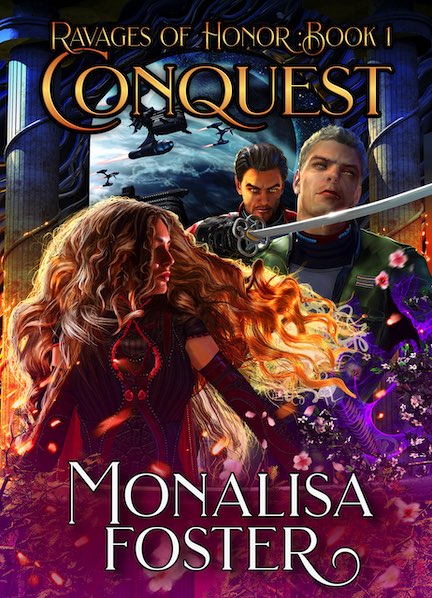
Cover for Ravages of Honor: Conquest (Book 1)
Cover for Ravages of Honor: Ascension (Book 2)
Cover for Ravages of Honor Lineage
Cover for Dominion: A Ravages of Honor Novella
Cover for Featherlight: A Ravages of Honor Novella
I’ve been a huge fan of The Mummy* (starring Brendan Frasier) since it first came out in 1999, i.e. over 20 years ago when I knew little to nothing of storytelling technique or character development or any of the other things that we could point at and say, objectively, this is why this movie/character/plot works so well.
Since this is such an old movie, I’m not going to bother worrying about spoilers. So if that’s a thing for you, you may want to stop here and come back after you’ve seen it.
The Prologue
The movie opens with what is probably one of the best prologues I’ve ever seen. It’s not an info dump or context-less world-building like an article or encyclopedia entry.
First it gives us a hook.
Second it introduces us to some very important characters, the Medjai leader Ardeth Bay (played by Oded Fahr who has a great narrator voice) and the villain, Imhotep (played by Arnold Vosloo). But more importantly it establishes Imhotep as a sympathetic character motivated by forbidden love. This is very important for this story where the villain could easily have been a caricature of evil. Instead we have the perfect villain, the flip-side of the coin for our hero, Rick O’Connell (played by Brendan Fraser). Imhotep is Rick if he were evil and he is perfect because he is motivated by exactly the same things as Rick himself–love. Since Rick doesn’t start out in love, Imhotep’s love story provides a deep emotional resonance right up front in a movie that is far more a funny action adventure than a straight-up romance.
Evie, our heroine
Enter Evie (Rachel Weisz), who is immediately portrayed as a strong FEMALE CHARACTER rather than a STRONG FEMALE character (read as a Mary-Sue caricature of woman, a man-with-boobs, a vomit-inducing example of toxicity that embodies arrogance by being the strongest, fastest, smartest, most kick-ass person of every room she walks into). Unlike Star Wars’* Rae and Marvel’s* Captain Marvel, Evie is the strong character (who just happens to be a woman) that we need and want.
If you're one of those who thinks that a woman is the physical equal of a man, or that women of the past should conform to modern delusions about women's physical prowess, then you may want to stop reading here.
Evie is the brains of the operation as well as a damsel in distress, the driving force as well as the stakes character. She fulfills all these roles so well precisely because she is NOT the strongest, nor fastest, nor smartest, nor most kick-ass person in any room (much less all of them).
Solid roots in the reality of her world
She is a librarian with obvious faults. She is clumsy but doesn’t immediately shed that clumsiness when a combat scene requires it. She is smart, but she doesn’t have to walk into every situation an announce it, via “Hey, everyone, I have a chip on my shoulder about being a woman in a man’s world.” Instead, like Elizabeth Bennett in Pride and Prejudice*, she works within the parameters of her world without having the world broken in order to make her look good.
She is also not a character who revels in ball-busting and the writers didn’t have to weaken the male characters in order to make her look good. Each character–whether Rick or her brother Jonathan–had their own skillset and she recognized this and didn’t strut in to show them that all along she was better at everything. She was never afraid to admit she needed help or ask for it.
Why this movie wouldn’t be made today
I honestly don’t know if this wonderful, well-written, well-acted, fun, interesting, and romantic movie could have been filmed today. (Really, guys, we don’t know anyone’s sexual orientation or preferred pronouns.)
While Evie is stuck in the library because she doesn’t have field experience, she is determined to obtain that field experience. She doesn’t blame it on “The Patriarchy”(TM) or whine about it. Not once. Shocker!
[Disclaimer: I am not and have never been a feminist studies person. I am using the term “patriarchy” and “matriarchy” as a layman to mean power held by men and power held by women respectively.]
Enemies to lovers
Without Jonathan, her con-man brother, the opportunity to get field experience would not have existed, but it is her own drive that turns the opportunity into action. Despite Rick lunging at her through the prison bars and kissing her (without her consent, I might add) she is determined to save him, and does. Even though it means putting up with the lecherous prison warden as a partner.
This sets up the enemies-to-lovers between her and Rick. While not a true enemy, that trope still fits. They start out as adversaries.
On the boat, we learn that Rick is going back to Hamunaptra because of her. He swore he’d never go back but she saved his neck. In other words, we’d have had no story without Evie’s decision to save him.
The fight on the boat
When she is attacked, she defeats the Medjai because he’s distracted by Rick (who came to her rescue). She takes advantage by poking the Medjai in the eye with a candlestick, not by taking over the fight or fighting alongside Rick. The writers did not break the world in order to make her into something she couldn’t possibly be (clumsy librarian, remember?)
What oppression does look like
The writers show us what an actual oppressive patriarchy looks like via the village where they stop to buy camels. Rick and Jonathan joke about trading Evie for the camels. But they don’t because English/American culture isn’t Egyptian culture. And it hasn’t become one since the 1920s either. Take it from someone who spent enough time overseas to know the difference.
At Hamunaptra, patriarchal prejudice is shown again, via the egyptologist, Dr. Chamberlain (played by Jonathan Hyde) who was hired by the American rivals (what I’m going to call the B-team). He’s the one who goes, “They are led by a woman. What does a woman know?” Notice that the Americans are not the ones saying it. Or even agreeing with him.
Soft power is still power
Even when the A-team and the B-team are having their little pissing contest in the tomb, it is Evie who intervenes to break it up. She suggests they dig elsewhere because she figures out it’s the wrong place. No one maligns her for making them back off. And if you don’t think that makes Evie powerful, you’re wrong. Not all power comes from intimidation, from Hulk!Smash! or from “I am woman, hear me roar” speeches.
Logic and reason
We get foreshadowing and necessary background information via Evie talking about mummification and interpreting things for Rick and Jonathan. It is clear she is the driving factor, the voice of logic and reason arguing against superstition and greed.
Proud to be a librarian
When they are attacked by the present-day Medjai, Evie is not involved in the melee. She falls and passes out running away from a man on horseback. Again, it is reasonable that she is not able to outrun a horse or engage in close quarters combat all of a sudden. Later, a bit drunk, she confesses her lack of combat skills and her pride in being a librarian. This time she is the one who asks for a kiss but unfortunately passes out before she can get it.
Opening the sarcophagus
She is the one that figures out the key and how to use it to open the sarcophagus. When they open it and find the moist mummy inside, no one blames Evie and she doesn’t scold or blame them either. It’s like they are adults and the movie is about finding treasure and defeating evil instead of modern political correctness and social engineering messaging.
Smart jabs
Evie does tells the B-team egyptologist how to open the book. That’s a bit of a jab at the man and he deserves it. She then “borrows” the book while he’s asleep. Smart again. She has the key. She knows what to do.
Her faults
And then we are shown that Evie doesn’t know it all. It was refreshing. Her reading from the book wakes up Imhotep. It also sets her up as a driving force again. One that releases the seven plagues. So she is not all-good, all-knowing, all-feeling, infallible woman. She has a fatal flaw: she trusts in logic and intellect more than she should. One might have expected a woman of that time to be more into mysticism than logic and intellect, but it is not outside the realm of possibility given her upbringing. This makes her believable and sympathetic.
Convenience
She does just happen to push up against the “right” stone to end up in the tunnel with Imhotep and Henderson, the unfortunate man with the glasses. Once there, she asks him for help. She doesn’t attack Imhotep. She is afraid, but she does stand her ground as best she can until Rick and the others do come to her rescue. Again.
Evie wandering into that tunnel is what allows the Medjai to rescue Henderson and keeps Imhotep from finishing him off. It is another driving point of the plot.
Calling the shots
Evie actively thwarts Rick’s attempts to pack and leave. That’s a bit of a plot hole. She was lamenting the loss of her books and clothes when the boat sank. But her argument with Rick reveals how hurt she is by being regarded as merely a contract. So she uses her budding relationship with him to advantage. But he’ll have none of it. He is afraid for her. One might argue that there is a patriarchal aspect to Rick calling the shots. But if you do you must grant everything done at Evie’s direction as matriarchal.
When water turns into blood, who does Rick seek out? Evie of course. Because when he is out of his element, he does defer to her. Does this mean that now we’ve switched to a matriarchal calling of the shots?
It is Evie who takes them to the museum director. The museum director and Ardeth, the Medjai leader, argue with her as an equal. They don’t dismiss her. A little hard to believe perhaps, given the culture of 1920s Egypt, but at least on the museum director’s part, he has worked with her and knows that she is capable. Earned respect on that, and the same can be argued for Ardeth as well. He’s seen what she can do too.
Evil, evil patriarchy
It is Evie who says that they must stop Imhotep from regenerating. The guys agree and then lock her in her room. Yes, they did it for her own good. They knew that she had caught Imhotep’s interest, and not in a good way. If you want, you can blame it on patriarchy, evil, evil, patriarchy that tries to keep you from falling prey to a great ancient evil.
And Imhotep is a threat. He gets into her room despite everything. He is delusional, thinking she is his lost love, Anck Su Namun. Once again, Rick (and a cat) save her. Lucky for her that Rick is not a feminist prince that would have let her rot–or worse in this case.
Saving the guys
It is Evie who figures out where the Book of Life is. They need it to defeat Imhotep. In response, Imhotep ups the game, bringing an army of zombies to her door. They run, but are stopped. Faced with a choice–going with Imhotep to be reincarnated as Anck Su Namun or having her friends killed–she makes the decision to go with Imhotep. It will buy Rick and the others time. And she does expect Rick to rescue her. Again. She tells him so to his face, because she is, first and foremost, a survivor. So this is matriarchal oppression, right? I mean look at all the agency she is denying them. Wouldn’t it be better if they just went down fighting? Who is she to know what’s best for them? Shouldn’t she be getting back at them for locking her in that room?
Feminine Wiles
In order to distract Imhotep (again) and save her friends (again) she kisses him. Evie uses physical attraction to her advantage, right up to kissing a man she’s disgusted by in order to distract him and save her friends. She didn’t do it by kicking him in the balls. That would have been a TSTL (too stupid to live) moment that would have served nothing except to make Rae or Ms. Marvel look good at everyone else’s expense. Instead of using physical prowess, she used intellect and (dare I say it?) feminine wiles. Something only a truly strong woman would do, because it’s a personal sacrifice for her. It involves an intimacy. It’s a parody of a kiss, of attraction, and she lowers herself to do it. She knows it’s what Imhotep wants and she gives it to him to take away his power.
Who’s saving whom again?
Tied down on the altar next to Anck Su Namun’s mummy, Evie struggles, but isn’t threatening to do things that she can’t possibly do. It’s like she’s waiting to be rescued again. I know that’s anathema to movie-makers today, but it is perfectly done because it’s the only thing she can do at this point (without breaking the world by suddenly empowering her somehow). It makes sense that she was overpowered and had no choice.
Just before she is to be killed, Jonathan and Rick show up. Jonathan uses distraction to draw Imhotep away and this allows Rick to do his thing–hacking at things. Rick then frees her from the altar. But it is Evie’s intellect that saves everyone. It is her knowledge that allows them how to figure out how to get control of the mummified soldiers and direct them to destroy Imhotep and Anck Su Namun.
Woman vs woman
Evie directly engages physically only with Anck Su Namun’s mummy, i.e a woman of equal size (here the mummies are just as strong as if they were living apparently). This keeps with nature and human biology. Unlike female “heroes” who practice waif-fu, taking on men much bigger and stronger than they are, ignoring the physics of mass altogether as if estrogen were some magical substance.
Victory
The kiss at the end is preceded by Rick saying that he’s not going home empty handed–he has the greatest treasure, Evie herself. What a male chauvinist pig, right? How dare he? (yes that was sarcasm, Karen).
Conclusion
Again and again, Evie solves (and causes) problems via her intellect, not her fists. Evie is a product of her world and she does whatever she can not just within those limits, but the limits of biology. She is not genetically engineering, or a magical creation, or a magician who can call up powers. She is human.
The sequels weren’t as good precisely because they took her character and broke her in order to make her more of a man-with-boobs who prefers using physical violence to solve her problems and suddenly “remembers” being trained to fight against Pharaoh’s mistress. Lame, lame, lame. And this is why we don’t like the sequel, The Mummy Returns* and will pretend that it doesn’t exist.
*As an Amazon Associate I earn from qualifying purchases.
Cover for Ravages of Honor: Conquest (Book 1)
Cover for Ravages of Honor: Ascension (Book 2)
Cover for Ravages of Honor Lineage
Cover for Dominion: A Ravages of Honor Novella
Cover for Featherlight: A Ravages of Honor Novella
I found myself opening A Civil Campaign by Lois McMaster Bujold*, Book #12 of her Vorkosigan Saga*, for a variety of reasons. For one, it’s my second favorite book in the series (Barrayar* being the favorite) and I was also looking at it in terms of material for a class I’m developing.
For whatever reason I also honed in on the subtitle, A Comedy of Biology and Manners, and it struck me–Ha! A Regency in space! They do exist. Another reason I revisit certain books in this series is that Bujold is probably the only other space opera (not just sci-fi romance) writer who writes at close narrative distance. It’s why–for the longest time–Barrayar and Civil Campaign* were my comps for Ravages of Honor, with Barrayar* being the closer comp because of the action sequences.
The other reason I wanted to re-read it is because it’s the part in the series where the protagonist has progressed to the next stage of life. One of the things about series, particularly long-running series (Dresden*, Honor Harrington*, Anita Blake*) is that you can’t afford to progress the character for risk of killing your series. I needed to read something where the protagonist doesn’t just start down the same path again for yet another journey to slay the monster-of-the-week.
It’s notable that next to Babylon 5*, Vorkosigan Saga* is the only other series I can think of where the main character is progressed at something other than a glacial pace. And like B5, there are not just multiple protagonists (Sinclair and Sheridan) across the series and the deuteragonists (Ivanova, Delenn, Garabaldi, et al) have not just side stories but their own arcs and character progressions.
My reviews contain spoilers. Continue at your own risk.
A great beginning
A Civil Campaign* returns us to Barrayar with an older (mid-thirties) Miles Vorkosigan coming home as an Imperial Auditor. This is his terminal promotion. He no longer gets to galavant around the galaxy, and this is a good thing. It opens with Miles deciding that he is going to court Ekaterin in secret–not as in a secret from others; as in a secret from her. Hence the comedy of biology and manners.
In the background we have his cousin the emperor’s upcoming nuptials and Bujold expands on this theme of love and marriage by also introducing sub-plots about Mark’s –Miles’s clone brother’s–romantic endeavors. So we know right away that this will be about matchmaking and courting and not about spies and ships chasing each other and firing on each other and space-battle strategy, and how fast missiles will cross these huge distances (the answer to which is: not at movie-speeds, but at ponderously boring speeds which give the target plenty of time to change their course). In other words, it’s going to be about human drives, not hyperdrives.
Bujold also expands on the “galactic” politics of her world. It’s not really galactic so much as multi-solar-system; IOW, it’s like saying that the regional politics of Texas are global and ignoring what global means. And to be frank, this is one of the things I like about it. I don’t buy into the magic of even something like jump ships being adequate for true galactic anything. It’s why I shake my head at stories that just assume that yes, galactic–and even inter-galactic–travel is just a level up. In many ways this series has harder science than some space-battle/hyperdrive/space-marines type hard sci-fi.
The world-building is fantastic. It’s one of the things that really keep me in the books even when I’m annoyed with Miles–which I often am. I too have progressed in my own life from someone who can identify with Miles to someone who identifies with everyone who has to put up with Miles. And because there are so many viewpoint characters in this who do have to put up with Miles, it works.
As far as characterization goes, Miles was never a Gary-Stu, despite being the protagonist of a space opera. Bujold built him from the start as physically less capable and while I was very upset with this when I first picked up The Warrior’s Apprentice*, he did grow on me and now as a writer, I understand why she did it. I did keep hoping that with “galactic” medicine he would eventually get a new body, perhaps a clone-without-a-brain, a la Sixth Day*, but that didn’t happen.
The Lord Dono / Lady Donna storyline
I loved the Lady Donna / Lord Dono subplot from the start, not just because we saw it through Ivan’s eyes and he is such a shallow person but because of the “science” behind it. Turning (not transitioning) from a woman into a man is the kind of thing you can get done on Beta Colony, and Lady Donna did this in order to inherit the Countship from her brother. That means removing and discarding her lady parts as well as “cloning” the man parts, putting them on, and making changes at the cellular level so that her muscles and bones are that of a man. This particular sub-plot is a great blend of science fiction and social sci-fi.
Be warned that if you are looking for treatises and procedurals on the “science” of completely and irreversibly changing morphology from female to male, you will not find it here. Like me, Bujold is filing for copyrights, not patents and knows better than to bog down a great story with pseudo-sciencey info-dumps.
The ghemlord bastard storyline
We also deal with the politics of lineage via the Vorbretten storyline. What happens when you find out that your grandmother was having sex with a ghemlord (one of the Cetagandan invaders who waged war on Barrayar)? Whether she did it to survive, to ensure her family’s survival, or because she liked him, doesn’t matter. It was war. But it does come to bite you in the ass when you bring “galactic” technology into the picture. How does it change the person in question? None at all, as it turns out, except in the minds of some of his peers. Are we who we are or are we who our progenitors were? Well, it turns out that the sins of the father are still very much a thing to punish people for. Social sci-fi anyone? It’s why I love it.
The love interest
One of the things I really appreciated in this are the things that made Miles attractive to Ekaterin. Unlike a lot of sci-fi romances (which this is not strictly speaking in terms of what that sub-genre has become; think of the “men who’ve lost their shirts” book covers who instead of kilts have blue/green/purple skin/scales/horns instead; also consider that a similar cover, one of a headless woman that emphasized only her physique would be verbotten) we have a physically damaged man whose personality must be the thing that makes him attractive.
Rarely do we see a romance between a widow and a cripple and that is what this is. (Bujold must not have gotten the memo about writing to market and I’m so glad she didn’t). While I have had to read something in what is not known as the non-typically-abled sub-genre, the characters were nowhere near as relatable and the story nowhere near as good. In fact, it was instantly forgettable, despite being a leader in that sub-genre, and that is a good thing.
Ekaterin is a mature woman (despite being young) who is not looking for some young or even middle-aged stud. Male beauty is a strange and many-splendored thing that allows for real men to be attractive to women for different, and sometimes, very practical and realistic reasons like stability, personality, and emotional compatability. One can certainly see why a young widow who was emotionally and psychologically abused by her husband would have absolutely no interest in repeating the experience and would find trust an attractive quality. Which is exactly why Bujold pivots the story by having Miles abuse that trust, lose it, and then have to win it back. This is also why Miles’s life has to stabilize and he has to get that final character growth spurt that will terminally progress him as well.
The mid-point
The turning point (the middle) of the story happens when Ekaterin discovers how and why Miles has been manipulating her and results in that all-important loss of trust that he now must get back. We are half-way through and have not had a single moment of Hulk!Smash! but all the action in the story has been there to up the stakes and move the characters forward, so be warned, if you are expecting a bunch of “action” as in gunfights of space battles or anything like that, this is probably not the story for you.
The butter bug storyline
Like the ghemlord bastard story line and the Lady Donna storyline, the butter bug storyline adds an element of science fiction, a humorous one, kicking this story out of the pure Romance genre and into a romantic space opera. The addition of the sub-plots gives this story too much plot for what one might call a Romance. So, if you are looking for a pure Romance, or even a sci-fi Romance where the future technology is merely window dressing, you will be disappointed. The multiple viewpoints also kick this story out of the Romance definition.
Steam level
There is no on-screen sex in this story. It is very much G-rated.
Burn level.
Definitely slow burn.
Tropes
I was going to say that this has the “beauty and the beast” trope, but it really doesn’t. Nor does it have enemies-to-lovers or second-chance. Since Miles and Ekaterin were not in love before, it can’t be a second-chance romance. And since Miles doesn’t change from beast to hero, I can’t really apply beauty and the beast either. It skirts these tropes, but doesn’t embrace them. It’s not a fish-out-of-water either (for the Lady Donna storyline) because she is not a stranger to the Vor culture, having been born in it, even though for her, experiencing it as Lord Dono does have a bit of that feel to it.
Recommendations
I highly recommend A Civil Campaign*, either as a standalone or as part of this series. There is enough background information to allow you to read it as a standalone. In fact, a series reader, especially one who reads this back-to-back may be justified in complaining that there is too much recap. To them, I must note, that not everyone got to read them back-to-back. Some of us had to wait for years for the books. So judging it for not being written as if the series was complete and unlikely to be picked up mid-stream, is wrong.
For those of you wanting the romance, I will re-iterate the two titles that cater to that: Barrayar* and Civil Campaign*.
For those of you wanting the space opera, the rest of the series is more focused on Miles’s adventures than on anything that would be classified as “Romance.” So while there is an underlying romantic pursuit on Miles’s part of several women throughout the series, the other books focus on political intrigue, mystery-solving, adventure, and so forth. At no time is this a Weberesque space battle type of space opera. If you’re looking for that or space marines, look elsewhere.
*As an Amazon Associate I earn from qualifying purchases.
Cover for Ravages of Honor: Conquest (Book 1)
Cover for Ravages of Honor: Ascension (Book 2)
Cover for Ravages of Honor Lineage
Cover for Dominion: A Ravages of Honor Novella
Cover for Featherlight: A Ravages of Honor Novella
This review is going to be a little different, mostly because this book was, at least in terms of what I’ve come to expect and like about Kate Quinn’s* excellently written (no, that does not mean it’s a navel-gazing book) historicals.
Like The Diamond Eye*, I picked it up because it promised a story about actual strong women rather than the caricature known as “the strong female character.” (You can read my review of The Diamond Eye here.) It promised a story about survival.
My first quibble with this novel was the clear lack of a protagonist. It felt very much like an ensemble movie (think Avengers* rather than Captain America*). It made it much harder to stay in the story and took me far longer to finish than it should have.
Multiple protagonists vs multiple viewpoints
To be clear, the issue is not that the story is being told from the viewpoint of multiple characters. I love multiple viewpoint because (when done right) it allows for a level of tension that is hard to pull off in most single-viewpoint stories. I even like stories with dual protagonists (most Romances tend to be dual protag). But the lack of a clear protagonist, the dilution of the story by having three women narrators, one of which doesn’t come into the story until chapter four and takes even longer to get rolling, affected this story in a negative way.
I’m not sure it could have been done differently, but I was willing to give Quinn the benefit of the doubt. I was just going, “please, no deus ex machina, please, oh please.” A deus ex machina ending is just one of the things I worry about when I see disjointed beginnings with either no clear protagonists or an ensemble cast, or far too many time jumps. I’ve just been burned too many times.
The women
We have Osla who is the debutante type, Mab, the girl from the wrong side of the tracks, and Beth, an autistic girl who just happened to be living in the same house that was ordered to provide lodgings for Osla and Mab. They all end up as decoders of some kind at Blechley Park, the place where Alan Turing cracked Enigma. If you want the backstory on this, may I suggest the movie The Imitation Game* with Benedict Cumberbach. I offer no commentary on the veracity of the events in this movie, just the relevance of it as a backdrop.
Alan Turing is mentioned, but not a character, which is actually fine. I can appreciate that this would have been another story altogether if he was more than a passing reference and that story has been done.
The Rose Code* works very hard to present us with these very different women coming from different walks of life and what it was like to live in England during WW2. If you are looking for a story about generals refighting the war, this is not the story for you. There’s barely any staff meetings in this at all–or speeches, orders of battle, supply lists, or policies and procedure memos disguised as telling (oh so much telling) breaks in the narrative.
The story
Amid the drama of war, we get three distinct characters who become good friends. The first half of the book is dedicated to this storyline. While Osla and Mab are introduced right after each other, it takes us longer to meet Beth. Part of the reason for this is so that we can get to know her through their eyes–she is being abused by her mother who is a religious zealot of the worst kind and ignored by her father who is a useless human being who does whatever he is told. Shy, downtrodden, and meek, Beth turns out to be a genius rather than “slow” like she’s been told all her life. They didn’t have a word for autism back then so that word is not used and we get to deduce what’s happening via Osla and Mab and then Beth as she comes out of her shell.
Worldbuilding
The worldbuilding that Quinn does is — as always — quite excellent. It focuses on the personal stuff first and foremost. It’s why the characters are real and engaging.
This is a world where Beth’s love interest is a Cambridge man of non-Caucasian descent who falls in love with her mind. Truly. He does. It’s not a line, although at first we can’t blame her for thinking it is. But he is married and she’s a “good girl.” She hasn’t had a choice thanks to her overbearing bitch of a “mother” and milquetoast “father.” Yes, I’m bringing modern sensibilities into this, but Quinn does not. At least I don’t think she does. I didn’t get to live in 1940s England so I can’t be sure of some of the sentiments on display, such as…
Zarb (the man that Beth falls for) is married because he got a girlfriend (a barmaid) pregnant and they decided to do the right thing for their son. They will never divorce because of their son, to whom they both feel a duty and not just because he’s in braces due to polio. They have an open relationship, as in the wife takes Beth aside and tells her how happy she is that Zarb has finally found someone he can be in love with and they have her blessing. The wife is in a relationship with a man who is a pilot and she wants her husband to be happy.
This is the kind of responsible, honorable devotion that you just don’t see touted much in fiction (or real life) today. I was pleasantly surprised. It emphasizes personal responsibility (to the child, first and foremost) rather than servicing the idea of consequence-free sex and pleasure-seeking. Now, that is more like the WW2 generation I remember via my great-aunt and great-uncle.
Another interesting relationship is that of Mab and Francis. Mab got pregnant when she was young, had the baby, and her mother is raising the girl as Mab’s sister. Mab’s goal in life is to shed her wrong-side-of-the-tracks upbringing and become the best wife she can be to a man who will treat her right. I was stunned at her thoughts about what it would take to get to that point and her willingness to do what today would be radical things like keep his house, have his kids, warm his bed, and make a good future together. She talks about it in very grown up terms, not silly romantic notions, as an actual adult who sees her own value in those things. She does not see herself as an oppressed, barefoot and pregnant woman forced to be less than she could be. She sees herself as a partner who takes care of him and his needs and is taken care of in return. I was floored. This is not allowed in modern fiction, is it? I know I haven’t seen much of it.
Meanwhile, Osla is dating Prince Philip, the future prince consort of England, and yes, it was very weird reading about him as a fictional character. The point is that all of these women were in very interesting, unconventional relationships. Osla has been working to shed her “dumb deb” (debutante) image, the one where she is nothing but someone who goes shopping, has her hair done, and goes to parties and is “of society.” She wants to be a functional, useful member of society. Again, shocker! Social media would have words for you. It’s all about the likes, baby.
Why I kept reading
It is these types of interesting characters that kept me despite issues I had with the structure, the lack of a clear protagonist (it was Beth; she’s the one that solves the story problem) and the addition of a story frame (the post-war storyline; probably the most accessible example of a story frame I can give you is the Princess Bride; the grandfather reading the story to his sick grandchild is the frame, a story that touches the other story at several points, not just via prologue and epilogue) that complicates an already diluted narrative.
Probably my biggest pet peeve was the withholding of information regarding who Osla’s fiance/husband was at different part of the story. It would have added a lot of dramatic tension to know rather than hold it back for a reveal. Since the character certainly knew who she was engaged to, we should have known too. This trick was repeated with Mab as well and I had to backtrack several times to see if I’d missed something. This is probably why it took me so long to get through it and why I was vacillating between staying with it and finishing it out.
Recommendation
While not as good as The Alice Network* or The Diamond Eye*, I do recommend this book. It has a visceral feel and the research is solid. Quinn goes into what she made up for dramatic effect, and what was part of real history. But most of all, if you’re going to read it, read it for the characters who are not the “strong female character” caricatures. The are actually strong women. Heroes. Survivors.
*As an Amazon Associate I earn from qualifying purchases.
The John Carter (2012) * movie with Taylor Kitsch somehow almost missed me. Retrospectively we know that Disney killed the box office success of this movie and the reasons for that have been documented elsewhere and will not be rehashed here. (If you’re curious, here’s a video I found very informative.)
Given my history with Edgar Rice Burroughs‘* works, I can’t help but wonder if this excellent film (yes, I said it) would have been something I would have bothered with when it was released. They say that you never get a second chance to make a first impression, but I did nevertheless give this character a second chance.
Some background:
First, so you understand where I am coming from, I was never a 13-year-old boy or a young man for that matter. I don’t think I was ever the intended audience for this and not just because ERB published this in 1917 and the writing is so dated that the story is painful to read. And I know that it inspired a lot of people. That does not change that it is dated, and I’m not talking about the prose.
But I loved the movie and a friend’s post on Facebook got me thinking about why the movie spoke to me in a way that ERB’s writing never could. I will admit that while Taylor Kitsch is easy on the eyes I do in fact consistently reject eye-candy-based movies if they are poorly done. And while the production design and special effects were excellent, again, plenty of other movies with the same window dressing fail to make my list.
“Oh, Gary-Stu, you saved me!”
So, I subjected myself, once more to ERB’s writing, confirming, once again, that it was his writing that did not appeal. Now, when we speak of writing, we are talking about two things. One is prose. The other is everything but the prose, i.e. the characterization, pacing, description, and so on. (And please don’t rail at me about giving the book another chance; I’m a writer with limited time and since what I’m reading can have a detrimental effect on my own writing, that is not a bullet I’m willing to take for you).
It is the characters in the book that are lacking. This review of ERB’s version is right on:
Amazon review
ERB’s John Carter is a Gary-Stu, an infallible character, a piece of animated cardboard lacking in depth. And I also realize that for some people, that is the appeal. Why else would Hollywood and Disney be tripping all over themselves for the last decade or more to bring us the female version of Gary-Stu, the Mary-Sue character? (If you’re one of those, you may want to stop reading here because I’m about to piss you off.)
Here is the one time that Disney took something and made it better. And then they squandered it.
Why the movie is so much better:
So, what made it better? What did Disney do right? Well, for one they made the Powell character an adversary (in the book he was Carter’s mining partner). By doing so, the movie reset the tone to one of high stakes and character complexity. As I said, I couldn’t make myself re-read all of ERB’s story, but I did re-read this part and it struck me as an excellent move in revamping the characters.
The other thing they did was make John Carter a real person, not someone who struts around thinking about how (or showing off how) utterly perfect he is. And I admit a prejudice against such characters, whether ERB’s or not.
To wit… One of the things that absolutely makes me put a book down is the Retief character (Laumer’s BOLO series.) Laumer’s character is fresher in mind than John Carter (I had to re-read him more recently) but I remember thinking of John Carter when I read Laumer and just groaning when Retief takes out an alien using some clever method that only he knew but didn’t reveal until it was time to congratulate himself for being oh-so-clever.
Let me be a bit more explicit here with an example:
Gary-Stu, our intrepid hero finds himself at the bottom of a pit. The author actually has Gary-Stu going “Oh no! However will I get out?” Gary-Stu may or may not have more thoughts about how incredibly high the walls are, or how dangerous it is for him to remain here. Then the author leaves us hanging.
So off we go, waiting a whole week for the next installment, or the next chapter, or like today, it’s just a matter of turning the page. And when we do, Gary-Stu flexes his muscles and just leaps out of that pit like he was planning on doing all along, because he knew he could do it (he is Gary-Stu after all) so him wondering “Oh no! However will I get out?” wasn’t a genuine thought at all, but the author jerking off on the page.
And if you just went, “Ewww….” then you know exactly how I feel every time I read one of these contrived gotchas, and then how I feel when I have to read the vomit-inducing follow-up that includes some self-congratulatory drivel started by some other character. “Oh, Gary-Stu, you’re my hero. Thank you for saving us.” or better yet, “Oh, Gary-Stu, you’re my hero. I’m all yours. Take me. Take me here, take me now.”
It’s always about characters:
By making John Carter a widower who had lost his wife and child, who had lost his soul, whose outlook of life and humanity was grim, Disney took ERB’s Gary-Stu and made him into a relatable, likable character who could be progressed. At the end of the movie he is a different person and it was that arc that made the movie John Carter someone I liked and want more of. The book John Carter would have been just as shallow, no matter the special effects or casting because he would still be a Gary-Stu, ready to go on his next adventure where he remained the same shallow Gary-Stu he was at the start.
I’m not going to talk too much about the rewriting of Dejah Thoris since I couldn’t read far enough into ERB’s text to do a fair comparison. I suspect that movie Dejah is very much unlike book Dejah, a female character written for 13-yo boys reading in 1917. I didn’t find the movie character to be a Mary-Sue. In fact, I liked her very much. She had both strengths and weaknesses, had a great character arc, and she and John working together to win is very refreshing in a world where many franchises take the male title character, gut and castrate him, and then have the female character be the real “hero.”
If you’re willing to suspend disbelief and accept that this is not the Mars we know today and was never meant to be the Mars of today, but a fantasy (rather than sci-fi) Mars, this movie is well worth your time. It has action, adventure, and romance, albeit a Disney-level romance. I loved the Tars Tarkas character (“Your spirit annoys me”), the Sola and Kantos Kan characters–all of it. The only thing I did not love about this movie is the fact that they didn’t make a sequel and that there is no Woola plushie.
Cover for Ravages of Honor: Conquest (Book 1)
Cover for Ravages of Honor: Ascension (Book 2)
Cover for Ravages of Honor Lineage
Cover for Dominion: A Ravages of Honor Novella
Cover for Featherlight: A Ravages of Honor Novella
Shadow and Bone* caught my attention on Netflix. Neither a fan of YA nor a big Fantasy reader, this was quite a feat and in no small part it was due to the skill with which the story is written (both by Leigh Bardugo in the book and by the show-runners at Neflix).
Be sure to like and subscribe if you want to be notified of future installments.
I had a lot of fun discussing this and am really looking forward to doing episode two. You’ll notice that Justin and I approach storytelling from different perspectives and that’s one of the things that makes exchanges like this interesting. As a writer I’m always interested on how others “digest” a particular story.
Another reason I enjoy these is that it’s the closest we get to doing panels when we are not at cons. And we do this kind of thing whenever we get together, whether we’re holed up in a hotel room at a con or doing a video chat just because.
I especially enjoy Justin’s commentary because it’s not just vague generalizations like “I liked it” or “This was so neat.” We can have an intelligent discussion about what we enjoyed, what we found lacking, and what we learned.
Cover for Ravages of Honor: Conquest (Book 1)
Cover for Ravages of Honor: Ascension (Book 2)
Cover for Ravages of Honor Lineage
Cover for Dominion: A Ravages of Honor Novella
Cover for Featherlight: A Ravages of Honor Novella
I can see why Leigh Bardugo’s Shadow and Bone* is such a hit. It certainly struck a chord with me and I’m not even the target audience. I’m not a fan of fantasy. And normally I don’t go out and read anything that has been turned into a series because usually it’s not worth my time and I’ve been disappointed more often than I care remember.
Some comments about Shadow and Bone (they were dismissive of its YA roots and ‘simpliciy’ and some reviews even knocked it for using tropes as if tropes should be avoided in fiction) did however prompt me to at least look at it and once I did I was hooked.
The number one reason I can’t get into a story or stay in it long enough to finish it has to do with narrative distance–either the story is written at arm’s length (omniscient, third distant, or present tense) or the writer can’t make up his/her mind who’s head and heart they are in and just decides, screw it, I’m going to head-hop and violate viewpoint whenever I please because I don’t care or don’t know any better. Frank Herbert’s Dune* is a good example of something I just can’t read anymore and the head-hopping is why. The writing is not just clunky but the equivalent of nails on a chalkboard.
Fortunately for me, Bardugo’s writing is the polar opposite. It is well-written, well-plotted, and well-crafted. Yes, the plot is simple (even, dare I say, simplistic) but it has to be. It has to be because it’s a single viewpoint novel. And because Bardugo only shows us Alina’s head and heart, the book is different from the series which (I suspect since I haven’t read the other books) takes material from the other books and weaves in multiple storylines.
So, if you’re expecting a cheap novelization of the series, where some hack has been hired to turn the outside-in script into a thinly veiled outside-in narrative, you’ll be disappointed. Bardugo’s novel has depth and resonance. Bardugo’s novel is about characters. Bardugo’s novel is about relationships and emotions. And yes, some of that definitely comes through in the series, but there are also a few important differences.
One of the ways I knew that I was in for a treat was in the way Bardugo handled the opening. We don’t start in Alina’s head and heart (she is not yet the viewpoint character) but with a properly written (do you have any idea how exceedingly rare that is?) prologue that is not just time a time-skip, but a hook written from a viewpoint not used again, i.e. the author-narrator’s via third-distant viewpoint.
The rest of the novel (the main narrative) is from Alina. Now, I do have to pause here and explain something. Most well-written first-person is first-person retrospective narration. The reason to use first person is because we want the character narrating the past from the future. Gabaldon’s Outlander is an example of properly done first person because it is retrospective. Unfortunately, I see more and more non-retrospective narration because writers are constantly being told that if you’re using I/me you’re writing in first. Not true. If the story is unraveling in real story time, it’s not retrospective and it’s actually third-person. And if you’re using the pronouns I/me you’re actually writing third-person with first-person pronouns. Which is fine as long as you don’t screw it up, and Bardugo does not.
Despite the lack of a retrospective narrator, Alina’s narrative unveils the story in an engaging way that had me reading to the end. She put me in Alina’s head and heart and kept me there. I don’t usually read YA because it’s often too shallow, too poorly-written, too focused on teen angstiness and TSTL (too stupid to live) moments and motivations that I just can’t buy into. That was not the case here.
The reveal for why Alina didn’t remember the grisha testing was also well done. I admit, I was wondering how Bardugo was going to handle that (first-person retrospective would have been excellent for handling this) and she didn’t disappoint. It wasn’t a gotcha, a stupid writer trick I abhor.
The book is also different in how it handles the relationship with the Darkling. One Amazon reviewer complained that it was a romance written for 12-yo. Actually, it’s not a romance at all, for any age. As in there is no romance. There is no chemistry. Not between her and the Darkling anyway. The deeper romance is between her and Mal, but I can see how some people would miss that because (a) we don’t get his viewpoint and (b) the kind of devotion that Alina and Mal feel towards each other given their experiences as orphans is not fleshed out until the end where it’s done via dialogue. A multiple viewpoint novel written in third-close could have done this earlier and better and created additional tension, depth, and characterization.
The series actually gives us more chemisty between Alina and the Darkling than there is the book. Some people have called it an enemies-to-lovers romance, but it’s not. If it could be called anything at all, it’s a May-September romance, for certain values of romance (on the weak side of it). Again, because we don’t get the Darkling’s viewpoint, we can’t know what he feels towards her. He tells us somewhat, but we can’t know what he means and what he does not without being in his head and heart. Knowing these things requires multiple viewpoints done in third-close, something that tends not to lend itself to moviezation (yes, I just made that word up; deal with it).
The other thing I really liked about this story was that the climax depended on inner strength and sacrifice (not Hulk! Smash!). Another criticism of this story has been that it’s boring. Well, if you’re looking for a mindless, Hulk! Smash! action extravaganza, this is not it. Truly. Who’d be expecting that?
Like all well-written stories with depth, the story is NOT about the events (the plot) but about the characters and their relationships. As such the climaxes tend to be at least somewhat internal. The Netflix series did an excellent job in balancing this out and presenting it on screen with a bit more oomph than the book. So for the action junkies in the audience, not all struggle is “action” and not all victories involve knocking your opponent out. Some involve self-sacrifice.
Also well done was the hero/villain duality between Alina and the Darkling. He is the other side of the coin. They are both motivated by the same thing — to make a better world. They just have different visions of it and how to get there. This is quite well done, especially for YA where that type of depth is often missing.
Another layer of depth that I haven’t seen touted, or even acknowledged, is the fact that Alina needed the very thing that enslaved her. Think about it. Why is that not the very thing that is being used to sell this? Well, I think it would be lost on most people, because the story is again, about self-sacrifice and about making hard choices and living with them. Not exactly the kind of thing that makes for great teasers.
The only thing I did not like is the epilogue. It was written in present tense and I just skipped it.
I am going to rewatch the series now and go on to read the second book. I highly recommend Shadow and Bone not only for anyone who wants to read a well-written story, but for any writer who is looking for good examples of how to do it well.
Bardugo has now made in on my must-read list along with Gabaldon*, Pataki*, and Quinn. *
(If you want to learn more about viewpoint and why it’s not about pronouns, click here.)
*As an Amazon Associate I earn from qualifying purchases.
Cover for Ravages of Honor: Conquest (Book 1)
Cover for Ravages of Honor: Ascension (Book 2)
Cover for Ravages of Honor Lineage
Cover for Dominion: A Ravages of Honor Novella
Cover for Featherlight: A Ravages of Honor Novella
Kate Quinn’s writing always seems to draw me. While her works are classified as historical fiction, they are–more importantly–works about characters. And not just any kind of character. Well-developed characters. Her writing is technically excellent and her storytelling is exemplary (at least it has been for everything I have read of hers). I am of the firm belief that readers will jump genres for good writing, good storytelling, and good characters.
Quinn supplements her storytelling with an afterword where she goes into where she took creative liberties for the sake of the story. Prioritizing the telling of a story–as opposed to mindlessly parroting a history lesson for the sake of showing us just how much research she did–is one of my favorite things about her works. She also serves the reader by focusing on just a few characters, not a cast of dozens that serves nothing but to (once again) show us how much research a writer did. Honestly, if we wanted a history lesson we’d go to a history book.
Since I grew up in Ceaucescu’s Romania (that means under the abomination known as communism) there were several things that resonated with me in this.
The first was the fact that the Soviet man was fine with paying lip service to standing shoulder-to-shoulder with the Soviet woman, but he still expected her to cook the meals, do the laundry, and subordinate herself to him. Like every promise made by Communism, equality of the sexes was and is and always will be a blatant lie.
The second was the fact that there was paperwork for everything, notably, filing for recognition/sanction of a sexual/romantic relationship between an officer (a man) and an NCO (a woman). As long as you filed the right paperwork, the Soviets were fine with officers screwing subordinates. All while they were actively fighting at the front, nonetheless. And while she was legally married to someone else. Yup. Pretty much how I remember it too.
The third was the fact that people were reported and shot for defeatism. Defeatism was saying anything that criticized how things were going. It was grumbling about the length of lines, the lack of food, the corruption of the Soviet system, the sexism, the double standards, all of it. It really hit home and it’s alive and well today in what we might call toxic positivity, where only optimism and praise and positive thoughts, feelings, and expressions are acceptable. Anything that is negative, critical, or that questions something deemed as the “in thing” (hype) is not allowed. Spend any time on social media or any kind of group activity and you’ll see it in action.
While I cringed every time Mila, the main character, said “For the love of Lenin” it is probably an accurate portrayal of how Lenin came to replace God in the lives of many people who bought into the poison he and his cohorts were selling. (This is phrase I don’t ever recall hearing but different country, different generation).
Mila is very realistic in that she understood the games that had to be played in the Soviet system–like saying, doing, and parroting the right things (i.e. you know it as political correctness). I did not get a sense that Quinn herself was taking sides in this, because she balanced it out with such things as Mila’s comparative diary entries, “official version” vs “unofficial version.”
Mila is a sympathetic character. She was a mother at fifteen (yes, under the Soviet system which would not punish the much older man who got her pregnant and married her only because her father forced the issue). Mila had to move back with her parents in order to raise her son. Despite multiple attempts to divorce, she was unsuccessful (because, again, the Soviet system was set up in the favor of husbands and fathers who were not required to provide for or be in their children’s lives).
She had to somehow make it while raising her son, working at a factory, attending school, including university, and doing all the right Party volunteering. She had help from her parents, but we’re still talking about being a single mother going to work and school and being a good little communist (which meant waiting in ration lines and doing the other jobs we had to do, the ones that earned us real money not the worthless money they paid us with). Despite these hardships she decided to take up shooting as a hobby, so that she could teach her son. She knew that she had to be both mother and father to the boy. That’s how Mila ended up a sniper in the Soviet Army during WWII.
I really appreciated that patriotism and “love of Lenin and the Party” were not the only things driving her. She had very personal stakes in this–she wanted to protect her son. She wanted to be able to teach him that grown-ups do things by example and she had to be that example in his life. This is something sorely lacking in stories featuring the “Strong Female Character” (SFC) trope which is just a caricature, a man with boobs who just punches things and shoots stuff.
Unlike the SFC, Mila is never the strongest, fastest, smartest, best-at-everything. No, Mila has to struggle and fight and earn the respect of those around her. She is wounded. She makes mistakes (real ones that cost lives). She is actually surrounded by men who are stronger, faster, and smarter than she is. Men she must train and lead into battle. And while she does put on her “respect my rank” attitude initially, she goes on to earn their respect. Unlike in stories where the presence of the SFC requires that all men be automatically weaker, slower, and dumber in order to make her look good.
If there was a fault with Mila (and it’s really not) is that she was a fish who had no sense of being in water. Some of her comparisons with how things were the same in the US as in the USSR really showed this. There’s a scene where she is gifted some diamonds (a necklace, bracelets, and a brooch). She immediately thinks that she should give the brooch to the political officer minding her as a bribe so that he can gift it to his wife or mistress. And then immediately figures it must be the same in the US. No, actually it’s not even though she can be forgiven for thinking this since she was in Washington DC at the time. While DC is corrupt and bribes happen all the time (whether actual bribes of money or the trading of favors) there is no political officer hovering–the IRS, yes, but not a member of the Party. And while you may be fined and jailed for failing to pay taxes on that kind of gift, you’re very unlikely to get shot for it (at least not yet).
The drama with the diamonds was probably inserted to make a point and I do appreciate how well it was handled. I’m not the type of reader to confuse the character with the writer, and that’s why I think that extending the drama with the diamonds to the epilogue worked so well. It’s fifteen years later and Mila is back in the USSR with a new husband whom she must keep safe because his father criticized Stalin and thus his entire family was wiped out. The diamonds go to pay the right bribes to keep him safe. Fish. Water. Well done. I was especially impressed with the balance imparted in the narrative and the fact that she included an epilogue and filled it with all the right things. The main story was over. The epilogue was absolutely necessary–as an epilogue.
Last, I loved, loved, loved that she solved the story problem with my favorite type of gun. Thank you for doing the research on that one and getting it right.
What I didn’t like….
Present tense. It’s horrid, even done by Quinn. Nothing pushes me out of a story faster than something that should have been past tense written as present. There are several present tense entries by Mrs. Roosevelt sprinkled throughout since this story is dual time-line, i.e. we hop back and forth to a post-WWII visit to the White House. I skipped them.
The use of “the marksman” instead of giving us the name of the assassin failed to convey ANY sense of tension. He knew who he was so withholding that information from the reader was annoying. It would have been much more interesting and tension-inducing to know who he was so we could worry when he showed up in Mila’s viewpoint. Instead he was some “anonymous” shadowy figure. Hell, you could even write an omni narrator and say something like “The would-be assassin went by George, but that was not really his name, just the one he was using for the job” and gone with that. Or even used his actual name. It wouldn’t have mattered at all if we knew his actual name. But the attempt to play with the reader here was insulting. And it denied us much needed tension since he was interacting with her and the “big reveal” wasn’t. Not at all.
*As an Amazon Associate I earn from qualifying purchases.
Sometime, in the course of human events, consuming a form of entertainment that is in your favorite genre but it is different in a lot of ways than the works that you usually consume is a good thing. Seriously. Listen, if you read this blog frequently (Hi, Mom!) you know that I usually take my Science Fiction with a huge helping of gun/blaster shots and a heaping side of BOOOOOMMMMMM!!!!! I like that. But let’s face it, not all SF has to be that. That’s a good thing, because not all SF is that. Take, for example, Monalisa Foster’s Ravages of Honor.
Seriously, it’s a good book and there is enough gratuitous violence to keep us all entertained. We get everything from veiled threats to outright carnage. I love the fact that Ravages of Honor has a futuristic setting, but a lot of the weapons are things that Richard the Lionhearted or Tokugawa Ieyasu would have recognized. Some of this stuff is just amazing and it fits. Morgan-Foster does a great job blending old with the new. That in and of itself is a bit of a change (and no, lightsabers don’t count as ancient weapons) but it’s not the one I’m referring to. Don’t get me wrong, a sword wielding donai (what’s a donai? Well, you can either take my word that it’s a genetically engineered person bred for war OR you can read the book and see if I’m telling the truth.) is a lot of fun and not someone I’d want to run up against, but that’s not all there is to it.
Tired of the remakes, the reboots, the “let’s see how much more blood we can squeeze out of this turnip” output of today’s Hollywood? I think you’ll find Passengers* a refreshing change.
If like me, you didn’t rush out to see it in the theatre, it might’ve been because of blurbs like this one from IMDB: “A spacecraft traveling to a distant colony planet and transporting thousands of people has a malfunction in its sleep chambers. As a result, two passengers are awakened 90 years early.”
Sounds like a snore, doesn’t it?
It is rated PG-13, just under two hours long, and tagged as adventure, drama, and romance. What it is, however, is a story about love, redemption, and forgiveness. It’s about making the best of life, even when things don’t go as planned. It’s about the pioneering spirit, about a positive future, about what a man and a woman can achieve together.
“But wait, you said this is hard sci-fi.”
Yes, I did. And I stand by it. It’s science fiction because of the setting: a spaceship traveling between the stars. It’s hard sci-fi because it’s an extrapolation of current knowledge (it’s closer to 2001: A Space Odyssey), than to the space-fantasy cum turnip known as Star Wars.
But what this movie actually is, is a great example of using science/setting as a trope and a literary device for delivering a character-focused story. The science is not the point of the story, but there is enough verisimilitude that it has a real feel to it (this comes from someone who can get really picky about the scientific details).