Tag: Science Fiction

  • The Arrangement

    The Arrangement

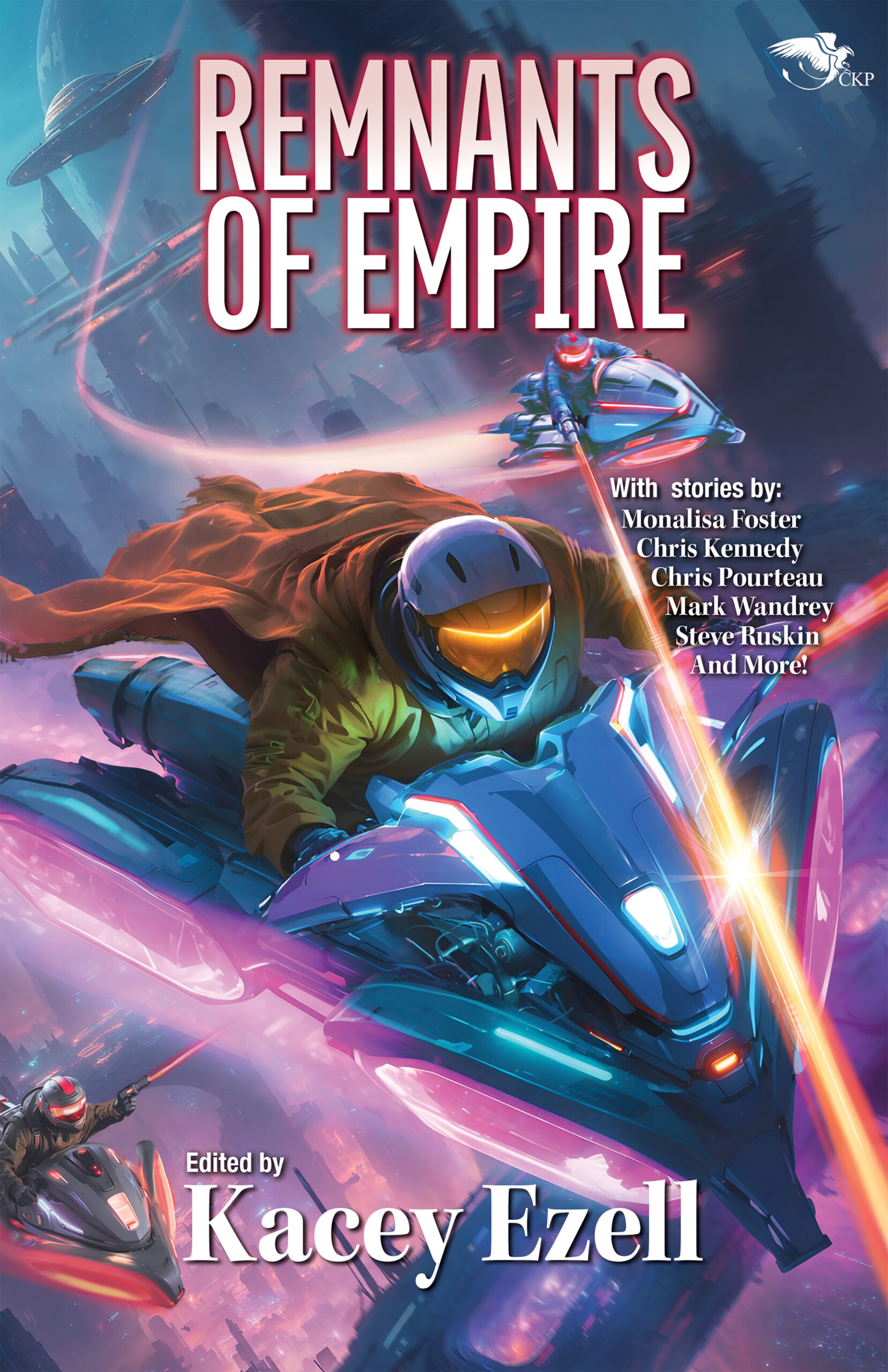
    My friend Kacey Ezell has a great new space opera series out, called the Ashes of Entecea* and I’m thrilled to be part of Remnants of Empire*, a new anthology set in that universe. Remnants of Empire launches on 7/26/24.


    Duty, danger, and unexpected romance await in this captivating tale from the Remnants of Empire anthology!

    On the planet Raneaux, two young nobles are ready to part ways. But when a series of devastating attacks rock their world, everything changes. Thrust into a maelstrom of political intrigue and violence, Aidan and Deirdre must confront their true selves.

    He’s a scholar who dreams of quiet libraries. She longs for adventure. Now, they’re fighting for survival and the future of their planet.

    As assassins lurk and conspiracies unfold, Aidan and Deirdre discover strengths they never knew they possessed. But in a world turned upside down, can an unlikely partnership become something more?

    Experience heart-pounding action, complex characters, and the birth of an unexpected love that could change everything.

    Remnants of Empire brings you a collection of interconnected stories set in a richly imagined sci-fi universe. 


    The holographic ad touting off-world adventure holidays caught my eye. I slowed my rapid pace to admire the frozen landscape that morphed into images of divers swimming with amazing deep-sea creatures. Chills skittered across my skin as I aimed my ubiq at the ad so it could scan the relevant information.

    “Add to my wishlist,” I told it.

    “Confirming add to Deidre’s wishlist,” the ubiq replied. “Reminder: you have a lunch appointment with your parents in ten minutes. At your current rate of travel, it will take you seventeen minutes to reach your destination. Do you wish to send a status update?”

    I ignored the ubiq and promptly slipped it into my pocket. With any luck, Aidan would get to the restaurant first, and my fashionably late arrival wouldn’t matter. My parents adored my betrothed—what an archaic term. In their minds he was perfect. It’s why they arranged the marriage contract.

    Don’t get me wrong. Aidan is a wonderful man. Kind, attentive, but not my type. He’s very smart and scholarly, and it didn’t take us long to figure out that we have different goals in life. He wants to make a name for himself as a professor of history. I want to travel. I want to go places and skydive and swim with alien whales and get into zero-g sports. He finds libraries as interesting as I find them boring.

    We’d be horrible for each other. I’d feel held back, and he’d feel—well, I don’t know, abandoned maybe. It’d be one thing if I wanted to go off and adventure on my own for the rest of my life and then come back to hearth and home when I felt like it, but would that be fair to him? Or to me? What if I found someone with whom I could adventure with? What if he found someone to be a homebody with? Would we be stuck in one of those awful marriage-in-name only things?

    I had to step around a holo-ad that popped out of the ground. “Stay informed with our latest updates on anti-monarchist activities—” If you make the mistake of walking through one, they will follow you—well, your ubiq—everywhere.  I didn’t have time to deal with viral ads.

    Thank all that’s good that we’re both lesser nobility—Aidan’s father is, I think, fourth in line for the throne. Being so far from power is why we can say no to a marriage contract. There are no world-ending consequences to either of us wanting to live our own lives. I doubt the ‘casts will even announce it, and if they do it’ll be buried in the day’s feed, and no one will care.

    My consolations and the rehearsed speech that I’d been working on since Aidan and I decided to part ways rolled around in my head as I made my way from the mag-rail station to Le Goût de l’Elysée. It’s the kind of place one goes to for special occasions like engagements and anniversaries, and that is no doubt why my mother chose it. 

    It was also the kind of place frequented by Raneaux’s planetary royals and judiciars and prime ministers and celebrities from all over Entecea. Frankly, I’m allergic to all those people, although I do endure them for my parents’ sake.

    As I crossed the cobblestone pathway, I wished I’d picked something other than spiky heels. There was a dress code though, so I had dressed up, partly out of guilt. I knew going into this just how disappointed our parents were going to be, and for some reason, I had thought that one of my nicer, semi-formal dresses would somehow make up for it. This one was gray, asymmetrical, with a high neck and cap sleeves, a minimalist design with sculpted details, and everything someone like me was supposed to be wearing for something important. Like I said, guilt, or maybe apology. But in dress form.

    The upside to l’Elysée was going to be that no one was going to dare make a scene—even though neither of our mothers were that type. It had been Aidan’s idea. See, I told you he was clever. And so very smart. 

    I sighed. Oh, if that were only enough. If only we had chemistry. I wanted that thrill, those butterflies, that out-of-control-in-love feeling. I wanted it all. Preferably now. And forevermore.

    Doormen in matching uniforms, complete with caps and white gloves, swung the doors open as I approached. It’s such things that make l’Elysée an experience in itself, particularly for the nostalgic.

    The foyer was done in a deconstructed chandelier, where each crystal was suspended by invisible nanofibers. To me, it had always looked like an exploded diagram of a chandelier, instead of an assembled piece. Art, I guess.

    The maître’d looked up from his tablet and shot me a smile. “Ah, Miss Pinet. How good to see you.”

    “Good morning. Are my parents here yet?”

    “Yes, Miss. They were seated about twenty minutes ago. Lady and Lord Stout have also been seated.”

    “And Professor Stout?”

    “I’m afraid not. Would you like us to ping his ubiq with a reminder or request his current location?”

    Sometimes people like the maître’d expected people like me to above carrying ubiqs. The really important people didn’t. Their staffers and aides did.

    “No, thank you. I can do it myself.”

    “Very well. This way, Miss.”

    And so he led me through the main dining room with its fleet of curved banquettes and gazebo-like hooded loveseats. It wasn’t quite noon yet, but I knew that it would soon be filled with glitterati, with the cream of Raneaux society coming together to impress each other over fancy lunches.

    The parents sat cozily on the veranda. It really was a lovely day for it with spring sunshine pouring in through slats strategically placed so that the light wouldn’t bother anyone’s eyes. Floral scents floated on the breeze, just a hint of them so as not to interfere with the more discerning palates that were bound to be l’Elysée’s best customers. It was no surprise that my mother had been making noises about having them cater the wedding. I just hoped that she hadn’t already booked them.

    Mother wore a long dress with a bolero top—lavender, of course. Lady Stout was in a similar outfit, but in mint green. It made me think they’d coordinated and that made my stomach hurt. Father and Lord Stout both wore what I called their uniforms—tunic-like business jackets that hit mid-thigh and pressed trousers, high-collared shirts, and cravats—like they might stop by the House of Lords and argue for this or that or the other. 

    The two empty chairs beckoned like a challenge. I really didn’t want to face them alone.

    Nevertheless, I braced myself.

    Here. I. Go.


    Read the rest in Remnants of Empire.


    *As an Amazon Associate I earn from qualifying purchases.

  • Relics. A SF-noir-flavored nibble

    Relics. A SF-noir-flavored nibble

    I’m very excited for the release of Relics, a short story set in the same universe as Threading the Needle.

    When I originally conceived of a story that included a replica of Charlton Heston, I didn’t know any of the following things: Charlton Heston was Chuck to his friends. He and Toshirô Mifune were also friends, despite a language barrier. Heston said that if Mifune would have spoken English he’d have been one of the greatest actors of our time. Ironically, Mifune served in the Imperial Japanese Army aviation division during WWII and Charlton Heston served as a radio operator and aerial gunner in the US Army Air Service and would have taken part in Operation Coronet, the planned invasion of Japan. That gave me chills. 

    The thought of would-be enemies developing a friendship that lasted for the rest of their lives even with an ocean between them and despite the cultural gulf that also must have been there has its own appeal. This story is my tribute not just to that idea (ideal?) but to two of my favorite actors, Charlton Heston and Toshirô Mifune themselves.


    AIs don’t go rogue. Everybody knows it. Especially SAIs. Which never really made sense to me. They’re supposed to be people just like you and me, and people—flesh and blood humans such as yours truly—are sapient and we go rogue all the time.

    But you never know.

    Digital citizens were one of the first truly sapient AIs. Who knows what happens after a couple of centuries of rattling around, especially when you’ve been designed and built as an anachronism to begin with. Maybe they can’t handle change. If there’s one thing that the last three centuries have proven it’s that some people just can’t handle the world as it is, so why wouldn’t “digital citizens” lose it and go rogue?

    To be honest, I was surprised to find out that these digital fossils were still around, although with the rise of Nostalgism, maybe I shouldn’t have been. The Commonwealth tolerated the movement because it helped move the, shall we say less-than-desirable, off-world. That much I knew.

    A leggy brunette with doe eyes, ruby-red lips, and an hourglass figure—some things remain classics even in this screwed-up century—led me into a wood-paneled office and “He’ll be right with you Mr. Elliott,” rolled off her tongue with a distinctive twentieth-century lilt.

    Given that this was a museum, her accent and the throwback design of the office shouldn’t have surprised me, although I’d figured the front—a replica of the historical Grumman Theatre—had been strictly for show and expected the back to be, well, a little bit more twenty-fourth century.

    The desk was wood, the chair leather, and what had to be a mid-twentieth century television set complete with antennae was tucked neatly into a corner. No computers, no tablets, no holographic interfaces of any kind, at least not that I could see. Two couches fronted the desk, facing each other across a low table—also wood. A couple of books, huge ones, held it down, their covers sporting images from a cinematic golden age almost five centuries gone.

    I picked up the top volume only to find that while indeed it was made of paper, the pages were blank.

    “You’ll find us in compliance with the law.”

    Setting the book back down, I turned toward the commanding voice. Like the human who’d shown me in, the SAI in the doorway wore twentieth-century attire—in his case, a suit and tie. It looked a bit odd on his tall and broad but clearly synthetic frame.

    The pixelated membrane that covered the android skeleton mimicked human skin to an uncanny degree, one that immediately gave me chills. The face too did a remarkable job of emulating skin and coloring, placed as it was over a bone structure that must have been true to the original human—strong but not overpowering jaw, slightly curved nose, steely blue eyes. I’d seen images of SAIs of course, but never met one. It was the eyes that gave them away. They weren’t orbs inside sockets and didn’t move as such.

    “I’m not a cop anymore,” I said a bit defensively, I don’t know why.

    “But you are still required to report violations, are you not?”

    A smirk found its way onto my face before I could stop it. “I don’t make it a practice to inform on my clients. Tarnished I might be, but not that much.”

    He gave me a skeptical look and extended his hand. “Call me Chuck. I insist.”

    What a throw-back custom.

    Awkwardly, I shook his hand. Room-temperature like a corpse. While it emulated skin right down to the veins and calluses on his hand, there was no accompanying texture. Images of hairs were overlaid over images of veins. The calluses were as smooth as you’d expect a pixelated surface to be. Ironic, no? He was an image on a screen, just as he must have been when his original had been alive.

    You can read the rest of the story at the Baen Books website.

  • Ravages of Honor: Handwavium Part 4, The Concept of Generations

    Ravages of Honor: Handwavium Part 4, The Concept of Generations

    When I was creating (handwaving into existence) the donai, I didn’t expect the “rule of cool” concept of “ooh, genetically engineered samurai” to lead down the rabbit holes that it did. 

    One of those rabbit holes had to do with age disparities in a long-lived species and how to deal with the ick-factor brought on by the so-called “creepiness formula” which states that a person can only date/marry someone who is at least half their own age plus seven years.

    What that means is that if you’re 30, the formula says that you shouldn’t date someone who is younger than 22. Why 22? Because (30)(.5)+7=15+7=22.

    Even though it’s a made-up world, we have to deal with two things. 

    • The first has to do with suspension of disbelief which is dependent on things making sense. And the more you know, the harder that is. (Trust me on this. I’m quite ignorant when it comes to historical fashion which is why I can enjoy The Tudors more than my friends who know a lot about fashion history.) 
    • The second has to do with social mores or acceptance of certain practices and it’s a lot more ingrained than one would expect.

    Case in point, the number of people complaining about Edward being so old as compared to Bella in Twilight. Ridiculous really, since it was dealt with up front. 

    “How old are you?” 
    “Seventeen.” 
    “How long have you been seventeen?” 
    “Awhile.”

    the movie

    The idea of vampires being static, i.e. not aging, not maturing, being anachronistic because they are frozen in place, etc. is a trope of the vampire genre (and some others as well).

    Edward may have come across as too mature for a contemporary seventeen-year-old boy, but that too was dealt with. He was an artifact of his own time, the turn of the 20th century, when a 17-yo was a man, not a boy. He grew up in a world and in circumstances where a 17-yo was far more mature than the 17-yo of today.

    The very same people (the ones who have a problem with this) have no problem with a science fiction story where some guy goes on ice (stasis or cryogenic suspension) and then boings a girl/woman who could easily be his great-granddaughter. Yet the same situation applies, a stasis or developmental pause that is not just physical but mental. And it makes sense in both situations. If vampires don’t age it stands to reason that their brains don’t age either, which is why they’re not grumpy old men yelling at clouds or at kids to get off their lawns.

    (I wrote about this from a more general perspective about a year ago. Vampirism and Other Afflictions)

    But it still presented a problem for my worldbuilding, and not because I figured some might object. It was one of those things I had to figure out, if only for myself.

    So I started off by looking into how generations were defined. I had always assumed (been taught?) that generations were twenty years. Well, there are generations and then there are generations. Obviously I’m not talking about the “Gen X” type of generation, i.e. a group of people born in a certain decade.

    I reached out to one of my doctor friends, as one does, and got quite an education on the more scientific definition. Long story short, generations are determined by how long a woman is fertile.

    Menarche typically occurs between the ages of 10 and 16, with the average age of onset being 12.4 years.—NIH
    The menopausal transition most often begins between ages 45 and 55.—NIH

    Oh no! We’re in girl cootie territory again! Surely this can’t have anything to do with “real science fiction.”

    Sure it does. 

    So let’s go with 50 as the end of fertility and 15 as the start of it (because of the lack of regular periods at the onset of 12.4 years) which gives us a nice number like 50-15=35. (Or if we go with 55, we get 40; either way that’s much longer than the 20-yr span I thought it must be).

    Keep in mind now, this is for handwavium, for a made-up world, so don’t waggle your finger at me about how a real biologist might do this. I’m using this as a launching pad for my handwavium. My handwavium may be crunchy, but not so crunchy that it’s no longer handwavium.

    Now, this period of fertility is obviously dependent on life span as well, so if you live at a time when 30 was your expected life span, it would be 30-15=15 and then also factor in that percentage body fat is a factor so girls who don’t live in industrialized first-world countries or who lived when they couldn’t accumulate enough body fat by age 12, would have later menarche-onset dates. It’s entirely possible that at one point in history, the fertility period (generation) was between 18 and 30 due to limits of body fat percentages and life expectancy, so 12 years. 

    Apply the creepiness formula to that and you can see why a 30-yo man paired with a 22-yo woman wouldn’t make sense or be typical, but a 30-yo man paired with a younger woman makes far more sense. And then factor in the number of deaths due to childbirth on top of that. If you’re not glad that you’re living today instead of way back then, you should be. (Backwards time-traveling heroines notwithstanding).

    This is why we shouldn’t judge the past by our own distorted modern lens. Things happened for reasons (usually) that have everything to do with rules imposed by nature, not because of The Patriarchy (TM) or whatever the hate-on is for today.

    Once you start looking at things with an eye towards impositions made by nature, the world-building gets rigorous, i.e. your scifi elements aren’t just a thin skin or veneer for your fiction.

    For the donai, this meant that I could not use generations at all. When the women that are able to have babies are an anomaly due to errors in genetic coding and only have a handful of fertile cycles, then there is no concept of generations. There can’t be. 

    But it’s not enough to just say and handwave it away. It should be, but it’s not. You need more because of that issue of “aging” in terms of maturity, i.e. old man yells at cloud. The social derision for an older partner comes from the objection that a mature person is taking advantage of an immature one, even if the immature one is 22 and well into being considered an adult whose choices we shouldn’t question due to agency, respect, blah-whatever-blah. Having it both ways, aren’t we?

    I see this derision all the time, especially when an older man is dating a much younger woman. We all assume she’s the poor victim and he’s taking advantage of her. Less so if the older partner is a woman for some reason. Now, there’s some sexism for ya!

    So how to deal with it in-world for Ravages of Honor?

    It turns out I already had a built-in answer, one I didn’t even think of when I created them. 

    Since the donai can live for centuries (How many? I don’t know yet and won’t until I have written it.) and their nanite symbionts keep them in a semi-perpetual middle-age1 for most of their lives, it follows that we have that “stuck at seventeen” or static stage of life like vampires where the character doesn’t transition to the old-man-yelling-at-cloud phase, i.e. senescence.

    Being aware of potential objections made by readers is very helpful, maybe even key, when it comes to rigor. Yes, it means that you can’t just write what you want, and there are certainly times when you’ll want to ignore such “objections” (I certainly do) but it works oh-so-much better when you can head them off with something that makes sense.

    For the record, in RoH, Syteria is, I would say, in her early twenties (or the in-world equivalent) with Darien being about ten years older (chronologically), which makes him very young for a donai. He is not even in that middle-age phase yet. If you were to do an apples-to-apples comparison, as in judging a human by human standards, and a donai by donai standards, she’s “older” than he is because humans age AND mature faster, whereas donai do not. 

    By the way, I was stunned to learn that 20-30 is considered young adult and that middle age as we define it is 40-50. I guess when you don’t start being an adult until you’re 26 that makes sense, but it was still a shock. In my world (IRL), you were expected to act and function as an adult at about 13 and by that I mean in terms of responsibility and maturity, and not by being sexually active. Yes, I’m very Old World. Go figure!

    Now that I’ve started RoH4 and it’s looking like a story where Lady Neria Bhanot and Lord Dobromil (Darien’s father) are going to be forging a new world order, the “May/September romance” question kicked in hard since he is much older. But it doesn’t matter for in-world reasons. People are free to screech about it of course, but that’s not really my problem.

    [crossposted to Substack]


    Side notes for writers:

    This kind of thing is also why I’m glad I resisted the urge to explain, that practice of dumping information into the story when there really is no need for it other than for the author to masturbate on the page and show you how much thought she’s put into it. In fact, I have no less than three deleted scenes over the last three novels where I gave in to that urge and then in going back over it, ruthlessly cut myself out of it. It saved writing myself into a corner, and one of the reasons I continue to love close/deep point-of-view.

    Word of caution. The scientific rigor is what throws such stories out of the Romance genre. Once you start making your story about the worldbuilding or the handwavium rather than the romantic relationship you have crossed into romantic subplot. You’re going to end up overplotting it (for a Romance) because in order for it to make sense you’re going to have to dramatize the “science” to the reader.


  • Pre-release Screening of Threading the Needle

    Pre-release Screening of Threading the Needle

    I’m pleased to announce the release of electronic Advanced Reader Copy (eARC) 1of Threading the Needle.

    No tuxedos or formalwear required. You can walk up the red carpet with me and get an advanced look at the entire novel right now. “Here it is!” (Raises champagne glass)

    A NEW START—OR AN OLD CALLING?

    Talia Merritt, a former military sniper once known as Death’s Handmaiden, is a woman haunted by her past. Her cybernetic arm and the implant that allows her to control it serve as a constant reminder of what she’s lost. But Talia is hoping to leave her past and her reputation behind and start anew on the colony world of Gōruden, a hardscrabble planet of frontier-minded people seeking a better life. And she’s finally earned enough to start making that dream come true.

    But soon, Talia finds herself thrust into the start of another conflict. Talia desperately wants to stay out of it, but she may not have that luxury.

    With the fate of a planet and her own peace of mind hanging in the balance, Talia must decide whether or not to once again take up the mantle of Death’s Handmaiden.

    Hard science fiction with a touch of frontier justice!

    “A new space western which combines hard science fiction with frontier action. Fans of Firefly will love this kick-ass female protagonist.”


    Praise for Threading the Needle:
    “If you want something beautiful and fun to read, you would do well to grab Threading the Needle as soon as it becomes available. This is space opera with Japanese flair and Western archetypes at its best.” —Upstream Reviews

    “Monalisa Foster is one of my very favorite writers.”
    —Kacey Ezell


    Get the eARC here now!

    1. Electronic advanced reader copy. Usually available only to book reviewers, but via Baen available for sale to enthusiastic fans. Note: this is not guaranteed to be the final version of the work! ↩︎
  • One-of-Antonia Excerpt

    One-of-Antonia Excerpt

    On May 3, 2023, my latest short-story will be out as part of The Ross 248 Project, a hard-sf shared-world anthology edited by Les Johnson and Ken Roy.

    I am thrilled to join Patrick Chiles, Stephanie Osborn, Brent Ziarnick, Laura Montgomery, Daniel M. Hoyt & E. Marshall Hoyt, Matthew Williams, D. J. Butler, Robert E. Hampson, J. L. Curtis, and K. S. Daniels on this roster of great hard-sf stories. Everyone one of these writers brings in their unique perspective, background, experience, and style to this anthology. I hope you check out their backlists.

    You can pre-order or check out the early release version of The Ross 248 Project here.

    HUMANITY’S HOPE FOR A BETTER FUTURE AT A NEW STAR

    A bold journey into a future where humanity and its children travel to a new star where they must overcome the unexpected challenges on the exoplanets that await them—or die trying.

    Traveling to the stars will be difficult, but not, perhaps, the most difficult part. What about when we get to another star? What then? Will the planets be immediately habitable? Not likely. Will those who undertook the journey be able to easily turn around and come home if they don’t find “Earth 2.0”? Almost certainly not. Therein lies the challenge: Finding worlds that are potentially habitable and then taking the time, perhaps centuries, to make them compatible with Earth life. They will encounter mysteries and unexpected challenges, but the human spirit will endure. Join this diverse group of science fiction writers and scientists as they take up the challenge of The Ross 248 Project.

    Here is the opening scene from One-of-Antonia

    The man in front of Suri was neither sick nor old. Despite the tubes and wires, the monitoring equipment around him, and the fact that they were in Pluto’s premiere clinic for the dying, he was very much a man in his prime. According to his file, Aidan Samuels was forty-two. It was an imprecise measurement—his real age was forty-two years, six months, three days, and sixteen-point-thirty-six hours—one that grated on Suri’s “nerves” such as they were. Tolerating such things without comment was one of the many adjustments that she had had to make.

    She may not have liked it, but humans trusted those who looked and acted like them more than those who did not, especially when it came to their health. That’s why she was wearing a humanoid skin rather than an arachnid one, even though having extra arms would have come in handy for most situations.

    “I don’t understand,” she said, glancing at the virtual-reality clinic supervisor.

    Dr. Benedict Lammens was tall for a human, one-point-nine-eight meters. She knew that he had let his hair go gray because he believed it gave him credibility and she could tell that the glasses he wore were just for the smart-glass lenses. Appearances were important to humans. They went to great lengths to project, not just credibility, but trustworthiness, intelligence—an entire list of positive traits—and mitigate an even longer list of negative ones. Would a four- or eight-armed surgeon with telescoping eyes convey competence and skill? Probably not. More likely to give them nightmares. 

    She filed the idea away, a side project for later, and connected to the clinic’s network. Samuels’ file said that he had gone into a very private and highly customized virtual reality in order to be with his dying wife. When her human body had failed, her corpse had been preserved for a later time in the hope that a cure for her neurological disease would be found. Her corpse had been placed in the family’s vault. There were thousands of such family vaults here on Pluto. It was known for its cryo facilities.

    While Samuels and his wife had been in the VR, thirty years had passed for them. They had essentially enjoyed their “golden years” while only a year had passed in the real world. 

    “Mr. Samuels here is refusing to come out of the VR,” Lammens said.

    “As is his right,” Suri noted, scrolling through the agreements between the SAIN and Samuels. “According to this, the Host agreed to keep him in VR for as long as he wanted.”

    “Unfortunately, the board of 3D-Printed-Homes wants him back in the boardroom,” Lammens said, shoving his hands deep into the pockets of his lab coat. “Some dispute or other. They need his vote to break a tie. Something about a takeover that might destroy the company he inherited from his father. Apparently the Martian cartels are involved and frankly it sounds rather messy.”

    “And he knows this?” she asked as she looked Samuels over.

    “The Host told him. He doesn’t care.”

    “Thirty years have passed for him,” Suri said, scanning through the VR’s logs. It had been just him and his wife for most of that time. There had been other constructs in there, but only artificial ones. No other real person had plugged in and interacted with them except for the Host. “And he’s just lost his wife. Of course he doesn’t care.”

    “We need some time to sort things out with his Board.” Lammens shrugged. “They’ve threatened to pull his credit, force our hand. Sue us. It could get ugly and undermine the trust in both SAIN and our facilities here.”

     Suri had worked with terminal patients and their families before. She didn’t understand grief herself, but she did have to work with it and around it. It was as much a part of working with humans as fixing their bodies was.

    She took hold on Samuels’ left hand. It was cool to the touch, with fading callouses and a simple gold band for a wedding ring. Tiny scars peppered three of his fingers and the backs of both hands. A man whose family had their own vault here, who could afford non-subjective years in VR, hadn’t had those tiny scars removed. Often such things were indicative of sentiment or a lack of vanity.

    She reviewed his public appearances. Not a vain man, but one who definitely understood the importance of appearance enough to opt into standard enhancements—teeth, hair, eyes. A man who liked to work with his hands too by the look of it—there were lots of images of him doing physical labor, building things, making things.

    Humans had such strange affectations. She ran her fingers along the pale scars. Nicks really, tiny little things. What had made them? She wanted to know. It would help her understand humans, which would help her help them, keep them alive, keep them healthy, give her purpose.

    There was a hum in the back of her mind, like a warm caress. She smiled. Antonia, her AI-mother approved. A human would have said that she was giving her blessing. 

    A plan to help Samuels and the decision to proceed was processed at AI speeds. She let go of Samuels’ hand and sat down in the chair next to his bed. 

    “Wait, what are you doing?” Lammens asked.

    “My job.”

    In the time it took her to answer, she ported the specs for her VR avatar to the Host. Suri liked to keep things simple. She liked to manifest as the statistically likely progeny of the two humans who had raised her.

    After all, she was Catrina and Ian Hinman’s daughter as much as she was Antonia’s. So she’d adopted her foster father’s dark hair and mismatched eyes (one blue, one brown) as well as her foster mother’s oval face and sun-kissed skin. 

    Last time she’d been in VR her avatar had worn an eclectic mix of calf-length skirt with a bustle, combat boots, corset-top, and short, bolero jacket with epaulets, all in blues and greens. She discarded the idea of aging her avatar, since most humans, especially older ones, presented as younger, healthier versions of themselves. VR was seductive because one could be anything, or anyone, and things weren’t what they seemed.

    Lammens had stepped back, a skeptical look on his face. But he didn’t say anything. She took it as assent.   

    Suri closed her eyes. She and SAIN came to an agreement at AI-speeds: unless Samuels’ real-world body was in danger, no one was to intervene or interfere. Once inside, she’d be stuck in the VR with Samuels until he agreed to leave or they shut it down and forced him out. Suri would be cut off, her ties to SAIN and her AI-mother severed. 

    She felt herself move as if through a tunnel of light, riding effortlessly through corridors that didn’t exist in physical space.

    The final bit of it, entering Aidan Samuels’ VR, was like fighting her way through a wall of fire. If she’d had any sense of self-preservation, she’d have turned back. 

    Samuels didn’t want her there. That much was clear. Painfully so.

  • Reviewing A Civil Campaign (Vorkosigan Saga #12)

    Reviewing A Civil Campaign (Vorkosigan Saga #12)

    I found myself opening A Civil Campaign by Lois McMaster Bujold*, Book #12 of her Vorkosigan Saga*, for a variety of reasons. For one, it’s my second favorite book in the series (Barrayar* being the favorite) and I was also looking at it in terms of material for a class I’m developing.

    For whatever reason I also honed in on the subtitle, A Comedy of Biology and Manners, and it struck me–Ha! A Regency in space! They do exist. Another reason I revisit certain books in this series is that Bujold is probably the only other space opera (not just sci-fi romance) writer who writes at close narrative distance. It’s why–for the longest time–Barrayar and Civil Campaign* were my comps for Ravages of Honor, with Barrayar* being the closer comp because of the action sequences.

    The other reason I wanted to re-read it is because it’s the part in the series where the protagonist has progressed to the next stage of life. One of the things about series, particularly long-running series (Dresden*, Honor Harrington*, Anita Blake*) is that you can’t afford to progress the character for risk of killing your series. I needed to read something where the protagonist doesn’t just start down the same path again for yet another journey to slay the monster-of-the-week.

    It’s notable that next to Babylon 5*, Vorkosigan Saga* is the only other series I can think of where the main character is progressed at something other than a glacial pace. And like B5, there are not just multiple protagonists (Sinclair and Sheridan) across the series and the deuteragonists (Ivanova, Delenn, Garabaldi, et al) have not just side stories but their own arcs and character progressions.

    My reviews contain spoilers. Continue at your own risk.

    A great beginning

    A Civil Campaign* returns us to Barrayar with an older (mid-thirties) Miles Vorkosigan coming home as an Imperial Auditor. This is his terminal promotion. He no longer gets to galavant around the galaxy, and this is a good thing. It opens with Miles deciding that he is going to court Ekaterin in secret–not as in a secret from others; as in a secret from her. Hence the comedy of biology and manners.

    In the background we have his cousin the emperor’s upcoming nuptials and Bujold expands on this theme of love and marriage by also introducing sub-plots about Mark’s –Miles’s clone brother’s–romantic endeavors. So we know right away that this will be about matchmaking and courting and not about spies and ships chasing each other and firing on each other and space-battle strategy, and how fast missiles will cross these huge distances (the answer to which is: not at movie-speeds, but at ponderously boring speeds which give the target plenty of time to change their course). In other words, it’s going to be about human drives, not hyperdrives.

    Bujold also expands on the “galactic” politics of her world. It’s not really galactic so much as multi-solar-system; IOW, it’s like saying that the regional politics of Texas are global and ignoring what global means. And to be frank, this is one of the things I like about it. I don’t buy into the magic of even something like jump ships being adequate for true galactic anything. It’s why I shake my head at stories that just assume that yes, galactic–and even inter-galactic–travel is just a level up. In many ways this series has harder science than some space-battle/hyperdrive/space-marines type hard sci-fi.

    The world-building is fantastic. It’s one of the things that really keep me in the books even when I’m annoyed with Miles–which I often am. I too have progressed in my own life from someone who can identify with Miles to someone who identifies with everyone who has to put up with Miles. And because there are so many viewpoint characters in this who do have to put up with Miles, it works.

    As far as characterization goes, Miles was never a Gary-Stu, despite being the protagonist of a space opera. Bujold built him from the start as physically less capable and while I was very upset with this when I first picked up The Warrior’s Apprentice*, he did grow on me and now as a writer, I understand why she did it. I did keep hoping that with “galactic” medicine he would eventually get a new body, perhaps a clone-without-a-brain, a la Sixth Day*, but that didn’t happen.

    The Lord Dono / Lady Donna storyline

    I loved the Lady Donna / Lord Dono subplot from the start, not just because we saw it through Ivan’s eyes and he is such a shallow person but because of the “science” behind it. Turning (not transitioning) from a woman into a man is the kind of thing you can get done on Beta Colony, and Lady Donna did this in order to inherit the Countship from her brother. That means removing and discarding her lady parts as well as “cloning” the man parts, putting them on, and making changes at the cellular level so that her muscles and bones are that of a man. This particular sub-plot is a great blend of science fiction and social sci-fi.

    Be warned that if you are looking for treatises and procedurals on the “science” of completely and irreversibly changing morphology from female to male, you will not find it here. Like me, Bujold is filing for copyrights, not patents and knows better than to bog down a great story with pseudo-sciencey info-dumps.

    The ghemlord bastard storyline

    We also deal with the politics of lineage via the Vorbretten storyline. What happens when you find out that your grandmother was having sex with a ghemlord (one of the Cetagandan invaders who waged war on Barrayar)? Whether she did it to survive, to ensure her family’s survival, or because she liked him, doesn’t matter. It was war. But it does come to bite you in the ass when you bring “galactic” technology into the picture. How does it change the person in question? None at all, as it turns out, except in the minds of some of his peers. Are we who we are or are we who our progenitors were? Well, it turns out that the sins of the father are still very much a thing to punish people for. Social sci-fi anyone? It’s why I love it.

    The love interest

    One of the things I really appreciated in this are the things that made Miles attractive to Ekaterin. Unlike a lot of sci-fi romances (which this is not strictly speaking in terms of what that sub-genre has become; think of the “men who’ve lost their shirts” book covers who instead of kilts have blue/green/purple skin/scales/horns instead; also consider that a similar cover, one of a headless woman that emphasized only her physique would be verbotten) we have a physically damaged man whose personality must be the thing that makes him attractive.

    Rarely do we see a romance between a widow and a cripple and that is what this is. (Bujold must not have gotten the memo about writing to market and I’m so glad she didn’t). While I have had to read something in what is not known as the non-typically-abled sub-genre, the characters were nowhere near as relatable and the story nowhere near as good. In fact, it was instantly forgettable, despite being a leader in that sub-genre, and that is a good thing.

    Ekaterin is a mature woman (despite being young) who is not looking for some young or even middle-aged stud. Male beauty is a strange and many-splendored thing that allows for real men to be attractive to women for different, and sometimes, very practical and realistic reasons like stability, personality, and emotional compatability. One can certainly see why a young widow who was emotionally and psychologically abused by her husband would have absolutely no interest in repeating the experience and would find trust an attractive quality. Which is exactly why Bujold pivots the story by having Miles abuse that trust, lose it, and then have to win it back. This is also why Miles’s life has to stabilize and he has to get that final character growth spurt that will terminally progress him as well.

    The mid-point

    The turning point (the middle) of the story happens when Ekaterin discovers how and why Miles has been manipulating her and results in that all-important loss of trust that he now must get back. We are half-way through and have not had a single moment of Hulk!Smash! but all the action in the story has been there to up the stakes and move the characters forward, so be warned, if you are expecting a bunch of “action” as in gunfights of space battles or anything like that, this is probably not the story for you.

    The butter bug storyline

    Like the ghemlord bastard story line and the Lady Donna storyline, the butter bug storyline adds an element of science fiction, a humorous one, kicking this story out of the pure Romance genre and into a romantic space opera. The addition of the sub-plots gives this story too much plot for what one might call a Romance. So, if you are looking for a pure Romance, or even a sci-fi Romance where the future technology is merely window dressing, you will be disappointed. The multiple viewpoints also kick this story out of the Romance definition.

    Steam level

    There is no on-screen sex in this story. It is very much G-rated.

    Burn level.

    Definitely slow burn.

    Tropes

    I was going to say that this has the “beauty and the beast” trope, but it really doesn’t. Nor does it have enemies-to-lovers or second-chance. Since Miles and Ekaterin were not in love before, it can’t be a second-chance romance. And since Miles doesn’t change from beast to hero, I can’t really apply beauty and the beast either. It skirts these tropes, but doesn’t embrace them. It’s not a fish-out-of-water either (for the Lady Donna storyline) because she is not a stranger to the Vor culture, having been born in it, even though for her, experiencing it as Lord Dono does have a bit of that feel to it.

    Recommendations

    I highly recommend A Civil Campaign*, either as a standalone or as part of this series. There is enough background information to allow you to read it as a standalone. In fact, a series reader, especially one who reads this back-to-back may be justified in complaining that there is too much recap. To them, I must note, that not everyone got to read them back-to-back. Some of us had to wait for years for the books. So judging it for not being written as if the series was complete and unlikely to be picked up mid-stream, is wrong.

    For those of you wanting the romance, I will re-iterate the two titles that cater to that: Barrayar* and Civil Campaign*.

    For those of you wanting the space opera, the rest of the series is more focused on Miles’s adventures than on anything that would be classified as “Romance.” So while there is an underlying romantic pursuit on Miles’s part of several women throughout the series, the other books focus on political intrigue, mystery-solving, adventure, and so forth. At no time is this a Weberesque space battle type of space opera. If you’re looking for that or space marines, look elsewhere.

    *As an Amazon Associate I earn from qualifying purchases.

  • Age of Samurai–A stunning docudrama

    Age of Samurai–A stunning docudrama

    If you haven’t watched Netflix’s Age of Samurai: Battle for Japan, you should. I highly recommend it. It is not just visually stunning, but this docudrama has all the action and intensity of a well-written fictional epic. It is about as far as you can get from boring history lessons and well worth your time.

    The series

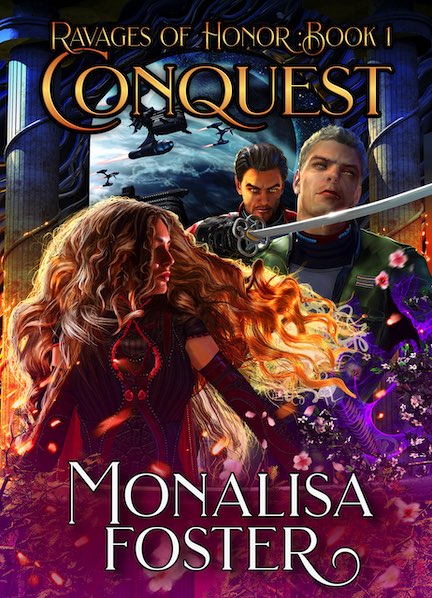
    One of the narrators is Stephen Turnbull*, is an “old friend” of mine. It was his book, Samurai: The Story of Japan’s Greatest Warriors, that I picked up when waiting for my kids to finish up at the library. It is one of the three books (the second one being on genetic engineering and the third being on nanotechnology) responsible for the Ravages of Honor series.

    Not only are the narrators experts in their fields, this dramatized account of history emphasizes the relationships between the people making history, rather than dry, pedantic statistics related to dates, troop movements, and other non-sense that is likely to be forgotten the moment it’s not needed for a test.

    Great acting, wonderful stories, amazing characters, my only complaint is that it is only six episodes of forty-five minutes each when it could be much longer.

    Noteworthy

    So much of what I was seeing in this docudrama resonated with me, that I started taking notes, mostly ones that might be of use for further stories in my Ravages of Honor universe.

    In case you’re new, my space opera series features genetically engineering warriors modeled — you guessed it — on the samurai. But it doesn’t just stop at the swords and honor codes. My writing also relies rather heavily on my favorite romantic trope–enemies-to-lovers.

    When genres blur

    One of the more interesting things about the enemies-to-lovers trope is that Jane Austen* is credited with creating it, via her most famous work, Pride and Prejudice*.

    As someone who didn’t grow up in the entitled First World where marrying for love, infatuation, or just hooking up was a valid thing, I’ve always found this interesting. History is full of stories where men and women married not just strangers, or people they didn’t love, but people who were their actual enemies.

    This is why I used the enemies-to-lovers trope in Ravages of Honor, not because I was going for some Regency in space.

    I used it because it’s hardwired into the samurai history I used as background for the donai. The marriages and concubinal arragements of this period (and others throughout history) precedes the Regency period and its ballrooms by centuries.

    Austen may have popularized enemies-to-lovers, but she didn’t invent it, and it saddens me to see what has been tradition throughout most of human history relegated to second place because we have no knowledge (or appreciation) of why these things happened. It means all the struggles and sacrifices of the people (usually women, but men as well) caught between duty, honor, and passion has been forgotten.

    The Ravages of Honor series, has far more in common with feudal Japan than it does with the ballrooms of Regency England. So, while the sparks, tension, and forbidden fruit of the enemies-to-lovers trope runs strong not just in Conquest but in the rest of the series, it is based on the political intrigues of a feudal culture, not ballroom dances and the matchmaking aspirations of mothers.

    So, if you like Byronic heroes (Mr. Darcy was one), actual strong women (like Elizabeth Bennett), but want to trade the gossip and manipulations of the Regency era for political alliances where millions of lives are at stake, where freedom and survival on a planetary scale are hang in the balance, where the ravages of honor are borne by grace and strength, then I hope you’ll give my take on the enemies-to-lovers trope a try.

    *As an Amazon Associate I earn from qualifying purchases.
  • Excerpt from Resilience, coming June 7, 2022 in Robosoldiers

    Excerpt from Resilience, coming June 7, 2022 in Robosoldiers

    When Stephen Lawson* asked me to be part of his new Baen* anthology, Robosoldiers* an anthology about augmented soldiers and military robotics I wasn’t sure what I was going to end up writing. Unlike all the militarily credentialed co-authors in this anthology (some of these guys are real heavy hitters) I am the fork-and-knife school variant, if even that. I don’t have any military service or credentials. Country of origin did matter in the mid-1980s when I was still a cadet and aspiring to be more. The more was out of reach for many reasons, including the peace dividend that came out of the fall of the Berlin wall, a good thing.

    My experiences have been on the other side of conflict–the civilians, the refugees, the collateral damage. I was born and grew up behind the Iron Curtain. I didn’t realize just how meaningless those two words had become until recently when a clerk asked me where “the incident” took place and I said “behind the Iron Curtain.” Without batting an eyelash she asked me the date and address so that she could request the medical records. I guess she was thinking it was a night club or something and maybe an ambulance or hospital was involved because she certainly gave no indication that she actually understood what she was asking for. When I related her request to close friends they suggested I give her the address of Ceaucescu’s grave or perhaps that of the Sighetul Marmatiei Memorial Museum for Communism Victims. I maintain that it would still be lost on her (and her ilk).

    Stephen did jokingly tell me what he didn’t want (I am first and foremost a romance writer, whether that means romance or Romance) which is always helpful. So for those of you who read me primarily for my romances, know that Resilience* is not a Romance or a love story, although I could not resist working in a slight romantic angle at the end.

    Readers and fans of mil-sf, like readers and fans of all other genres, are always clamoring for something new. For something different. So I gave it to them. In case I haven’t said it, Stephen, thanks for affording me this opportunity because you knew going into it that it was going to be different and let me play anyway.


    What doesn’t kill you makes you stronger. Or so they say. 

    They are full of shit.

    But then again, philosophy has never been my strong suit.

    Shrug.

    My scars are the first thing people notice about me. Even as they avoid noticing, looking anywhere but my face, the scars define me in their eyes. 

    Not my rank—Sergeant.

    Not my name—Engel, Karlie.

    Not my uniform—Air Force.

    It took me awhile to get used to the locked gazes, the way people’s eyes would unwaveringly lock onto mine because eyes are supposed to be safe.

    “It’s not your fault.”

    I know it’s not. 

    One of the more annoying things about my PTSD implant (or my anti-PTSD implant as the doctors would like me to think of it) was the way it—oops, I’m supposed to think of the intelligent agent as “she”—talked to me. It wasn’t its fault. It was the way “she” was programmed. She goes by Nicki. It’s supposed to be a “she” because female rape survivors are paired up with female counselors. Something about trust.

    Like so many sailors, soldiers, marines, and airmen—I was never really alone in this—I was a casualty of war. Wrong place. Wrong time. 

    As far as billets went, a military air traffic controller in Germany was about as safe an assignment as possible. I wasn’t going into a war zone or into combat. 

    Unfortunately no one told the bad guys. And they wouldn’t have cared. I was alone and unarmed. I hadn’t even been in uniform. Just another tourist as far as they were concerned. That is, until they found my ID.

    “Ground yourself in the present,” Nicki said. Her voice was always calm, hypnotic, meant to be soothing, and supposedly tailored just for me.

    I took a deep breath, held it, and then let it out slowly to a count of four, my belly rising, my hand against my chest. It was supposed to be calming, part of a set of coping mechanism that I’d been taught. I did it to shut Nicki down. It—she—always booted up when my hypothalamic–pituitary–adrenal axis kicked into overdrive. I hated that I knew that term. I shouldn’t have to know what an HPA-axis was.

    About two years ago, I was recruited for a clinical trial to help test brain implant technology. Never my favorite thing, the MRI was even less so after my month of captivity. The jack-hammer sounds of the magnet were too reminiscent of gunfire, the having to lay still too reminiscent of being bound to a bed, the voices drifting in over the speakers too much like their disembodied voices as I escaped into my head while I lay helpless underneath them. 

    And having to relive it all so the MRI could map my brain was no picnic either. 

    “This is a flashback. It’s not real,” Nicki reassured me.

    It had been with me for about a year. Nicki controlled the circuitry—fine wires much smaller than a human hair—running through my brain and I had benefited from some of the physical stuff the implant does. Thanks to the mapping done by the MRIs, the implant knows which parts of my brain become active during a flashback. It keeps track not just of my pulse and temperature and respiration, but a bunch of other stuff. I stopped trying to figure it out. All I needed to know was that high levels of certain chemicals were bad and low were good and that the implant stimulates parts of the brain to counteract them. And then Nicki activates.

    It—she—is a little bit like the imaginary friend a kid might have: completely real to me, right down to the way she “smells.” There’s a light blue halo all around her, something the designers put in, so that I wouldn’t think she was an actual person I was seeing. Thank God for small favors.

    It has appeared to me as different people. I’ll be watching TV and find a character I connect with and poof, Nicki takes on her form, her mannerism, her facial expressions. She sounds like the character too, which bothers me far more than the other things. I think it was the blindfold. They kept it on almost the entire time. 

    So, I’ve stopped watching television shows or movies. I’d always been more of a reader anyway, but after a few months, she started manifesting as the female characters in my imagination, so she robbed me of that too.

    “Where are you, Karlie?” Nicki asked.

    The kitchen. I’m in the kitchen.

    “What are you doing?”

    Boiling water.

    Except that there was no longer water in the pot. It was gone and the pot was giving off a metallic smell reminiscent of the way guns smell as they heat up. All that was missing was the sulfur and that too kicked in, a phantom scent courtesy of my memory. 

    With a trembling hand, I shut off the burner and leaned against the kitchen counter so I wouldn’t curl up on the ground. Once again, I’d become lost in the white-noise of boiling water. The last thing I remembered was standing over the stove, watching the first bubbles form along the pot’s bottom.

    I’d wanted pasta with butter and garlic.

    But not anymore.


    *As an Amazon Associate I earn from qualifying purchases.

  • Ravages of Honor pronunciation guide

    I’m a logophile. My Spotify playlist is made up of songs in German, Japanese, Korean, Russian, Hungarian, Norwegian, Icelandic, Mongolian, Latin, French, and Italian.

    One of the reasons I love writing science fiction is that it allows me to make up words and use language in a creative way. I love making up words and names, but not all of them are original, even if they sound that way.

    So, if you were wondering about how to pronounce the unique names and terms I’ve created (and what the stories behind them are) you might enjoy the Ravages of Honor pronunciation guide. Each episode is very short (30 seconds to 1 minute long). I will be adding to it, so please remember to subscribe to my channel so that YouTube will notify you of additions.

    Click here for the pronunciation playlist.

    Pronunciation Guide
  • A blast from the past

    I was working on Ascension, the sequel to Ravages of Honor: Conquest today and went looking for some references related to a plot point. Somehow I found the very first iteration of what was then the opening scene for RoH:C. I’m sharing it with you today because I want you to see what a difference a few years of writing makes. It took me almost three years to finish Conquest and then another year to publish it (slush piles will do that).

    The 865-word hot mess below became the 2449-word second scene of Chapter Two. It went from being a thin, badly written, first draft to a well-written, fleshed-out piece with depth. Depth is really hard to explain but it comes down to how well you are able to pull the reader in and immerse him in your world. It is made up of thick, rich details that allow the reader to be more than a spectator watching a movie–it puts them solidly in the character’s head and heart. It is a hard-to-acquire skill. It is what makes a reader come back to a story again and again (so they can be the character) even after they know exactly what is going to happen next (the plot events).

    If you go to the sample on Amazon, the final form of this scene begins with “The contours of empty, midnight-quiet passageways blurred past Darien. His bare feet struck the metal decking with a steady rhythm.” You can read the entire thing in the sample for comparison if you like.

    Unlike the hot mess below–what I like to call a “first vomit draft”–the final product doesn’t open by dropping you cold into a dark room where you might as well be blind (because the details are absent). Unlike the hot mess below, it’s not full of fake details, devoid of characterization and opinions, and thin as the gruel in a Dickens orphanage.

    It took three long years of listening to criticism that cut me to the bone, that made me lose my lunch, that made me curl up and cry, but it was all worth it. Which is why my best advice to anyone thinking about taking up the madness of writing is this:


    “The trouble with most of us is that we would rather be ruined by praise than saved by criticism.”

    – Norman Vincent Peale
    (more…)