Category: Publication Announcement

  • One-of-Antonia Excerpt

    One-of-Antonia Excerpt

    On May 3, 2023, my latest short-story will be out as part of The Ross 248 Project, a hard-sf shared-world anthology edited by Les Johnson and Ken Roy.

    I am thrilled to join Patrick Chiles, Stephanie Osborn, Brent Ziarnick, Laura Montgomery, Daniel M. Hoyt & E. Marshall Hoyt, Matthew Williams, D. J. Butler, Robert E. Hampson, J. L. Curtis, and K. S. Daniels on this roster of great hard-sf stories. Everyone one of these writers brings in their unique perspective, background, experience, and style to this anthology. I hope you check out their backlists.

    You can pre-order or check out the early release version of The Ross 248 Project here.

    HUMANITY’S HOPE FOR A BETTER FUTURE AT A NEW STAR

    A bold journey into a future where humanity and its children travel to a new star where they must overcome the unexpected challenges on the exoplanets that await them—or die trying.

    Traveling to the stars will be difficult, but not, perhaps, the most difficult part. What about when we get to another star? What then? Will the planets be immediately habitable? Not likely. Will those who undertook the journey be able to easily turn around and come home if they don’t find “Earth 2.0”? Almost certainly not. Therein lies the challenge: Finding worlds that are potentially habitable and then taking the time, perhaps centuries, to make them compatible with Earth life. They will encounter mysteries and unexpected challenges, but the human spirit will endure. Join this diverse group of science fiction writers and scientists as they take up the challenge of The Ross 248 Project.

    Here is the opening scene from One-of-Antonia

    The man in front of Suri was neither sick nor old. Despite the tubes and wires, the monitoring equipment around him, and the fact that they were in Pluto’s premiere clinic for the dying, he was very much a man in his prime. According to his file, Aidan Samuels was forty-two. It was an imprecise measurement—his real age was forty-two years, six months, three days, and sixteen-point-thirty-six hours—one that grated on Suri’s “nerves” such as they were. Tolerating such things without comment was one of the many adjustments that she had had to make.

    She may not have liked it, but humans trusted those who looked and acted like them more than those who did not, especially when it came to their health. That’s why she was wearing a humanoid skin rather than an arachnid one, even though having extra arms would have come in handy for most situations.

    “I don’t understand,” she said, glancing at the virtual-reality clinic supervisor.

    Dr. Benedict Lammens was tall for a human, one-point-nine-eight meters. She knew that he had let his hair go gray because he believed it gave him credibility and she could tell that the glasses he wore were just for the smart-glass lenses. Appearances were important to humans. They went to great lengths to project, not just credibility, but trustworthiness, intelligence—an entire list of positive traits—and mitigate an even longer list of negative ones. Would a four- or eight-armed surgeon with telescoping eyes convey competence and skill? Probably not. More likely to give them nightmares. 

    She filed the idea away, a side project for later, and connected to the clinic’s network. Samuels’ file said that he had gone into a very private and highly customized virtual reality in order to be with his dying wife. When her human body had failed, her corpse had been preserved for a later time in the hope that a cure for her neurological disease would be found. Her corpse had been placed in the family’s vault. There were thousands of such family vaults here on Pluto. It was known for its cryo facilities.

    While Samuels and his wife had been in the VR, thirty years had passed for them. They had essentially enjoyed their “golden years” while only a year had passed in the real world. 

    “Mr. Samuels here is refusing to come out of the VR,” Lammens said.

    “As is his right,” Suri noted, scrolling through the agreements between the SAIN and Samuels. “According to this, the Host agreed to keep him in VR for as long as he wanted.”

    “Unfortunately, the board of 3D-Printed-Homes wants him back in the boardroom,” Lammens said, shoving his hands deep into the pockets of his lab coat. “Some dispute or other. They need his vote to break a tie. Something about a takeover that might destroy the company he inherited from his father. Apparently the Martian cartels are involved and frankly it sounds rather messy.”

    “And he knows this?” she asked as she looked Samuels over.

    “The Host told him. He doesn’t care.”

    “Thirty years have passed for him,” Suri said, scanning through the VR’s logs. It had been just him and his wife for most of that time. There had been other constructs in there, but only artificial ones. No other real person had plugged in and interacted with them except for the Host. “And he’s just lost his wife. Of course he doesn’t care.”

    “We need some time to sort things out with his Board.” Lammens shrugged. “They’ve threatened to pull his credit, force our hand. Sue us. It could get ugly and undermine the trust in both SAIN and our facilities here.”

     Suri had worked with terminal patients and their families before. She didn’t understand grief herself, but she did have to work with it and around it. It was as much a part of working with humans as fixing their bodies was.

    She took hold on Samuels’ left hand. It was cool to the touch, with fading callouses and a simple gold band for a wedding ring. Tiny scars peppered three of his fingers and the backs of both hands. A man whose family had their own vault here, who could afford non-subjective years in VR, hadn’t had those tiny scars removed. Often such things were indicative of sentiment or a lack of vanity.

    She reviewed his public appearances. Not a vain man, but one who definitely understood the importance of appearance enough to opt into standard enhancements—teeth, hair, eyes. A man who liked to work with his hands too by the look of it—there were lots of images of him doing physical labor, building things, making things.

    Humans had such strange affectations. She ran her fingers along the pale scars. Nicks really, tiny little things. What had made them? She wanted to know. It would help her understand humans, which would help her help them, keep them alive, keep them healthy, give her purpose.

    There was a hum in the back of her mind, like a warm caress. She smiled. Antonia, her AI-mother approved. A human would have said that she was giving her blessing. 

    A plan to help Samuels and the decision to proceed was processed at AI speeds. She let go of Samuels’ hand and sat down in the chair next to his bed. 

    “Wait, what are you doing?” Lammens asked.

    “My job.”

    In the time it took her to answer, she ported the specs for her VR avatar to the Host. Suri liked to keep things simple. She liked to manifest as the statistically likely progeny of the two humans who had raised her.

    After all, she was Catrina and Ian Hinman’s daughter as much as she was Antonia’s. So she’d adopted her foster father’s dark hair and mismatched eyes (one blue, one brown) as well as her foster mother’s oval face and sun-kissed skin. 

    Last time she’d been in VR her avatar had worn an eclectic mix of calf-length skirt with a bustle, combat boots, corset-top, and short, bolero jacket with epaulets, all in blues and greens. She discarded the idea of aging her avatar, since most humans, especially older ones, presented as younger, healthier versions of themselves. VR was seductive because one could be anything, or anyone, and things weren’t what they seemed.

    Lammens had stepped back, a skeptical look on his face. But he didn’t say anything. She took it as assent.   

    Suri closed her eyes. She and SAIN came to an agreement at AI-speeds: unless Samuels’ real-world body was in danger, no one was to intervene or interfere. Once inside, she’d be stuck in the VR with Samuels until he agreed to leave or they shut it down and forced him out. Suri would be cut off, her ties to SAIN and her AI-mother severed. 

    She felt herself move as if through a tunnel of light, riding effortlessly through corridors that didn’t exist in physical space.

    The final bit of it, entering Aidan Samuels’ VR, was like fighting her way through a wall of fire. If she’d had any sense of self-preservation, she’d have turned back. 

    Samuels didn’t want her there. That much was clear. Painfully so.

  • I have a shiny new cover

    I have a shiny new cover

    Check out this shiny new cover for my first Baen novel! Isn’t it awesome? I got chills when I first saw it. This is Talia Merritt with her heirloom 1911 on the newly colonized world of Gōruden.

    Available for pre-order here.

    Signed copies will be available through this website upon release, which is currently set for December 2023.

    If you’re interested in updates for Threading the Needle, you can sign up for my newsletter here.

  • Celebrate with me!

    Celebrate with me!

    When I gave in to the writing bug back in 2015 and started writing fiction again there was one specific thing on my bucket/wish list: to become a Baen author.

    I’ve been a huge fan of Bujold’s Vorkosigan Saga* since I discovered it via one of those book-of-the-month clubs way back when. I’m pretty sure that’s how I discovered Baen and I would re-read that series every year, whether or not there was a new release. Back then I wouldn’t have dared think that I would get to write for Baen or get to know the publisher, Toni Weisskopf, someone for whom I have deep respect).

    Over the past few years, I’ve had the good fortune to make it into several Baen anthologies, like The Founder Effect* (hard SF), World Breakers* (military SF) and Robosoldiers*. Resilience, my Robosoldiers short story, was named one of the year’s best by Tangent Online.

    That’s why I’m so thrilled and excited to announce that I’ve signed a contract with Baen Books to publish a new space opera, called Threading the Needle (press release here). It is scheduled for release in October 2023, so mark your calendars.

    Inspired by the John Wayne movie El Dorado*, Threading the Needle is the story of Talia Merritt, a wounded veteran turned bodyguard, who joins forces with her old sniper partner. Together, they help terraformers fight a rival who is trying to steal the secret that will bring the newly colonized planet of Gōruden closer to independence from the corporate nobility running Earth.

    Space opera is my absolute favorite genre to write. I can’t wait for you to meet my heroine and join her on this adventure.

    Sign up for my TtN newsletter, to be notified of eARCs (electronic advanced reader copies) and pre-order availability.


    *As an Amazon Associate I earn from qualifying purchases.

  • Excerpt from Resilience, coming June 7, 2022 in Robosoldiers

    Excerpt from Resilience, coming June 7, 2022 in Robosoldiers

    When Stephen Lawson* asked me to be part of his new Baen* anthology, Robosoldiers* an anthology about augmented soldiers and military robotics I wasn’t sure what I was going to end up writing. Unlike all the militarily credentialed co-authors in this anthology (some of these guys are real heavy hitters) I am the fork-and-knife school variant, if even that. I don’t have any military service or credentials. Country of origin did matter in the mid-1980s when I was still a cadet and aspiring to be more. The more was out of reach for many reasons, including the peace dividend that came out of the fall of the Berlin wall, a good thing.

    My experiences have been on the other side of conflict–the civilians, the refugees, the collateral damage. I was born and grew up behind the Iron Curtain. I didn’t realize just how meaningless those two words had become until recently when a clerk asked me where “the incident” took place and I said “behind the Iron Curtain.” Without batting an eyelash she asked me the date and address so that she could request the medical records. I guess she was thinking it was a night club or something and maybe an ambulance or hospital was involved because she certainly gave no indication that she actually understood what she was asking for. When I related her request to close friends they suggested I give her the address of Ceaucescu’s grave or perhaps that of the Sighetul Marmatiei Memorial Museum for Communism Victims. I maintain that it would still be lost on her (and her ilk).

    Stephen did jokingly tell me what he didn’t want (I am first and foremost a romance writer, whether that means romance or Romance) which is always helpful. So for those of you who read me primarily for my romances, know that Resilience* is not a Romance or a love story, although I could not resist working in a slight romantic angle at the end.

    Readers and fans of mil-sf, like readers and fans of all other genres, are always clamoring for something new. For something different. So I gave it to them. In case I haven’t said it, Stephen, thanks for affording me this opportunity because you knew going into it that it was going to be different and let me play anyway.


    What doesn’t kill you makes you stronger. Or so they say. 

    They are full of shit.

    But then again, philosophy has never been my strong suit.

    Shrug.

    My scars are the first thing people notice about me. Even as they avoid noticing, looking anywhere but my face, the scars define me in their eyes. 

    Not my rank—Sergeant.

    Not my name—Engel, Karlie.

    Not my uniform—Air Force.

    It took me awhile to get used to the locked gazes, the way people’s eyes would unwaveringly lock onto mine because eyes are supposed to be safe.

    “It’s not your fault.”

    I know it’s not. 

    One of the more annoying things about my PTSD implant (or my anti-PTSD implant as the doctors would like me to think of it) was the way it—oops, I’m supposed to think of the intelligent agent as “she”—talked to me. It wasn’t its fault. It was the way “she” was programmed. She goes by Nicki. It’s supposed to be a “she” because female rape survivors are paired up with female counselors. Something about trust.

    Like so many sailors, soldiers, marines, and airmen—I was never really alone in this—I was a casualty of war. Wrong place. Wrong time. 

    As far as billets went, a military air traffic controller in Germany was about as safe an assignment as possible. I wasn’t going into a war zone or into combat. 

    Unfortunately no one told the bad guys. And they wouldn’t have cared. I was alone and unarmed. I hadn’t even been in uniform. Just another tourist as far as they were concerned. That is, until they found my ID.

    “Ground yourself in the present,” Nicki said. Her voice was always calm, hypnotic, meant to be soothing, and supposedly tailored just for me.

    I took a deep breath, held it, and then let it out slowly to a count of four, my belly rising, my hand against my chest. It was supposed to be calming, part of a set of coping mechanism that I’d been taught. I did it to shut Nicki down. It—she—always booted up when my hypothalamic–pituitary–adrenal axis kicked into overdrive. I hated that I knew that term. I shouldn’t have to know what an HPA-axis was.

    About two years ago, I was recruited for a clinical trial to help test brain implant technology. Never my favorite thing, the MRI was even less so after my month of captivity. The jack-hammer sounds of the magnet were too reminiscent of gunfire, the having to lay still too reminiscent of being bound to a bed, the voices drifting in over the speakers too much like their disembodied voices as I escaped into my head while I lay helpless underneath them. 

    And having to relive it all so the MRI could map my brain was no picnic either. 

    “This is a flashback. It’s not real,” Nicki reassured me.

    It had been with me for about a year. Nicki controlled the circuitry—fine wires much smaller than a human hair—running through my brain and I had benefited from some of the physical stuff the implant does. Thanks to the mapping done by the MRIs, the implant knows which parts of my brain become active during a flashback. It keeps track not just of my pulse and temperature and respiration, but a bunch of other stuff. I stopped trying to figure it out. All I needed to know was that high levels of certain chemicals were bad and low were good and that the implant stimulates parts of the brain to counteract them. And then Nicki activates.

    It—she—is a little bit like the imaginary friend a kid might have: completely real to me, right down to the way she “smells.” There’s a light blue halo all around her, something the designers put in, so that I wouldn’t think she was an actual person I was seeing. Thank God for small favors.

    It has appeared to me as different people. I’ll be watching TV and find a character I connect with and poof, Nicki takes on her form, her mannerism, her facial expressions. She sounds like the character too, which bothers me far more than the other things. I think it was the blindfold. They kept it on almost the entire time. 

    So, I’ve stopped watching television shows or movies. I’d always been more of a reader anyway, but after a few months, she started manifesting as the female characters in my imagination, so she robbed me of that too.

    “Where are you, Karlie?” Nicki asked.

    The kitchen. I’m in the kitchen.

    “What are you doing?”

    Boiling water.

    Except that there was no longer water in the pot. It was gone and the pot was giving off a metallic smell reminiscent of the way guns smell as they heat up. All that was missing was the sulfur and that too kicked in, a phantom scent courtesy of my memory. 

    With a trembling hand, I shut off the burner and leaned against the kitchen counter so I wouldn’t curl up on the ground. Once again, I’d become lost in the white-noise of boiling water. The last thing I remembered was standing over the stove, watching the first bubbles form along the pot’s bottom.

    I’d wanted pasta with butter and garlic.

    But not anymore.


    *As an Amazon Associate I earn from qualifying purchases.

  • Excerpt from “Good of the Many”

    Excerpt from “Good of the Many”

    I’m very excited to share with you the opening of my short story, Good of the Many, released today in Worldbreakers, an anthology edited by Tony Daniel and Christopher Rucchio.

    Dedication

    Greater love hath no man…in recognition of the brave souls, Peter Wang, Alaina Petty, and Martin Duque. You embraced your duty sooner than you should have had to.

    There’s nothing quite like walking into a tomb, although technically—I guess—it’s not. We’re not exactly underground or under a church, even though storage unit six is part of the UENS Sanctuary (T-AH-1749) and her motto is “For the good of the many.”

    That must make stasis pod 06-004 a crypt. No, that also didn’t fit. No one—not one of the hundreds of citizens—inside Sanctuary were dead. Technically.

    There were two dozen sealed pods inside unit six, each one twice as wide and deep as a coffin, but not twice as long. My steps echoed as I made my way down the rows and rows of pods, trailing a pool of light cast by a lantern floating off my right shoulder. Its repulsor field made a barely audible hum as its weak light cast long shadows. Shadows that slithered in a place where nothing had moved since I was here exactly one year ago.

    I shuddered, my skin crawling and dimpling into goosebumps that raised the hairs on my arms.

    Get hold of yourself, Elena.

    (more…)
  • Catching the Dark

    I’m happy to present the release of Catching the Dark: An Alt History Short Story* as a standalone.

    Operation Barbarossa destroyed most of the Tsarina Tatiana Romanova’s aircraft. 

    Sixteen-year-old Natalya loves to fly, to soar. And now she gets to. As the youngest member of the Tsarina’s Own Night Bomber regiment.

    A short story for anyone who loves WW2 alt-history, aviation, and stories about heroism.

    Night Witches strike terror in the hearts of darkness.

    *This short story was previously published in To Slip the Surly Bonds (Phases of Mars 2) edited by Chris Kennedy and James Young

  • Coming Soon…

    If you want notifications of new releases, sign up for my newsletter.

  • Dominion Re-release

    In the spring of 2018 I was part of a writer’s workshop that included the chance to sell stories for six different anthologies.

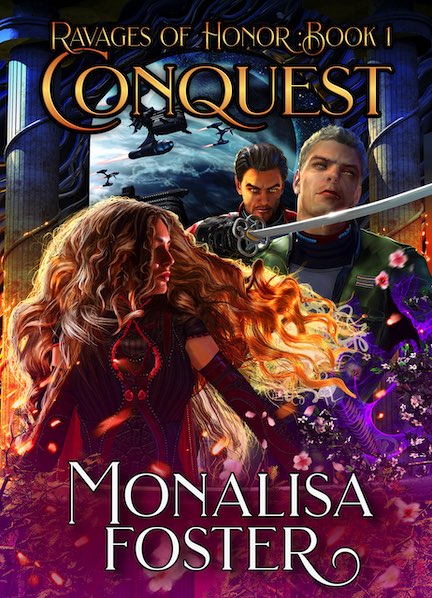
    Dominion was originally written for a romance anthology. However, it was bought by Ron and Bridget Collins for their Face the Strange anthology. The coronapocalypse delayed the publication until 2020. By then I had already written the first novel, Ravages of Honor, and several other shorter works in the same universe.

    I am thrilled to bring Dominion to you as a standalone. It allowed me to further explore the origins of the donai, something that I was still fleshing out in 2017. 

    Like all of my works, Dominion and its companion works are all complete, standalone works, with a beginning, middle, and end. 

    There are no cliffhangers. 

    You do not need to read any of the short stories or novellas in order for them to make sense.

    Available now from your favorite retailer.

  • Excerpt from Caliborne’s Curse

    The mechanics of creativity is very interesting. We–meaning a bunch of us writers–were judiciously avoiding the actual act of writing on a chat and the subject of urban fantasy tropes and heroines came up. I then casually mentioned that I not only own a sword but have been known to use it. This would not come as a surprise to my social media friends, but it may come as a surprise to some of my readers and it was a surprise to the writers in the chat.

    Caliborne’s Curse was written on a whim in 2017 because of this chat but stayed in my pile of unpublished works because genre-wise it doesn’t quite fit in anywhere. It’s kind of tongue-in-cheek as it pokes at the tropes of the Mary-Sue urban fantasy heroine: she of the magical combat-only coordination; she of the plain-but-gorgeous visage; she of “the one” with the man-harem.

    But when Jim Curtis approached me about this anthology and said I could submit anything, regardless of genre, I realized that Caliborne’s Curse had found a home.


    No way this ends well.

    Mallory Caliborne winced as she lowered the sword and reluctantly looked up. Dried paint and plaster drifted down like fine snow. Except it wasn’t snowing. And the six-inch slash in the ceiling was no cloud, silver-lined or otherwise. 

    The powder settled like dandruff atop the black CitroLu spandex of her tee-top. The Italian woman on the television kept going, slashing the fourth of an eight-cut sequence, all set to music, in some high-end studio filled with mirrors and overly coordinated fitness-types. And very high ceilings. 

    Mallory muted the sound and set the old katana on the second-hand couch she’d pushed to the wall to clear enough space to “Forza her way to fitness” as the DVD cover promised. She’d done a decent job of rearranging everything. No sense in slicing through the television. But she hadn’t thought about the ceiling.  

    The previous four lessons had all used angled cuts like two-to-eight or ten-to-four but today, her caffeine-fueled straight up and down cuts had been … enthusiastic. 

    Sure. The landlord will buy that. 

    She saw her deposit shrink to zero. After the flood, the fire, and the frogs, she thought she’d used up a lifetime’s supply of bad luck. What was next? Fiery hail? Locusts? Darkness? Come to think of it, there had been that three-day power outage starting on the day she’d moved in. Cross darkness off the list. Only two to go. She sighed.

    The house had been a bit of a wreck to begin with, but she’d been desperate and a six-month lease was hard to come by. Great location. Good price. Vacant. Furnished. The previous tenant had been a packrat—an eccentric packrat. Borderline hoarder, probably. But, no dead bodies had been unearthed after she’d taken possession. That would’ve been too much. Even for New Orleans.

    She could put up with almost anything for six months. 

    All the clutter had given her the impression that some old person had once lived here, some collector or academic. She hadn’t even begun to deal with the walls and walls of books, other than to note that not a single one was written in anything even resembling the Roman alphabet.

    The sword had seemed like one of those cheap props you see at uber-geek conventions. Until she’d found the DVDs. Some were serious training videos, all in Japanese, featuring men who never smiled, realistically hacking at each other with curved wooden swords. No samurai movies though. Not a one. The workout video was the only one in English. So very strange. 

    She turned the television off and put some water to boil in a kettle.

    Maybe the previous tenant had been an urban fantasy fan-girl with a cargo-cult belief system. The kind of woman who fancied herself a warrior by virtue of having a katana laying around for no reason. Said belief system hoped that the virtue of having something like said sword would result in the delivery of a desired cargo. In the urban fantasy context that would no doubt consist of a man-harem. 

    She smiled. Oh, that wouldn’t be bad. Not bad at all. Mmm. Better than fiery hail and locusts any day. And with all the clutter around here the honey-do list could be long enough to justify a whole harem. Maybe the previous tenant hadn’t been so crazy after all.  

    The kettle whistled and she set about making jasmine tea. Of all the kanji-bedazzled tins in the cupboard, she’d been brave enough to try only the one with a prominent jasmine flower on the lid. No sweetner. She added sugar to the top of her shopping list. Just for grins and giggles she added condoms.

    Hand wrapped around the tiny cup, she returned to the living room to pack up the sword and rearrange her furniture before heading to the hardware store for a ladder. 

    She moved the cushions around, looking for the cond—she shook her head and her grin widened—the pretty silk sheath that she’d found the sword in.

    Ouch.

    The cup wobbled, spilling tea.

    Great. Now she had a cut and a burn.

    Several drops of tea swirled on the end of the bloody sword-tip. Frowning, she bent to get a closer look at the play of light as she sucked her finger.

    “Please,” a deep voice rumbled from behind. Mallory pivoted and scrambled backward, knocking stuff over as she went, the bloody finger preventing a scream. 

    “Allow Ambrose to do that for you,” the heavily accented voice added.

    Bloody hell. Some vampire-movie reject from the theme-bar down the street had walked right in. She inched away, eyeing the distance to the couch where the sword lay. Too far. She threw the cup at his drop-undead-gorgeous head, and ran for it. On cue, she pulled a Mallory special, tripping over her own two feet like she was some young-adult novel heroine—except that she was clumsy all the time, not magically coordinated for all combat scenes. Of the many leaning towers of books gave way. She ducked underneath her crossed arms as the books pummeled her, one after the other. 

    Thunk, thunk, thunk.

    (more…)
  • Excerpt from “Dark Side of the Sun”

    Excerpt from “Dark Side of the Sun”

    Out today in the urban fantasy anthology Flights of Fantasy, I’m proud to present the opening to my short story, “Dark Side of the Sun.”


    June 20th, 2025

    Eliana pulled her sedan up to the curb, right under the biggest oak she’d ever seen. Its canopy cast welcome shade from the scorching mid-day sun. Ahead, an ambulance was pulled under a mansion’s porte cochère. Four black-and-whites were also present, their lights twirling madly: one behind the ambulance, the others scattered along the curb.

    A young cop was putting up barricades, while another was stringing crime scene tape between them. Another pair was gently encouraging five curious neighbors to back away. By the look of it, the gawkers were nannies and housewives, each with an obligatory kid or two in tow.

    Eliana pulled her too-big jacket on. Simple, lightweight, and cut to hide the full-size Sig Sauer 1911 behind her right hip, it was still another layer of clothing she’d rather not have on in suburban Phoenix’s triple-digit heat. She pulled her purse to her shoulder and stepped out. The car door slid shut and she made her way across the just-watered grass. It left drops on her flats, but even those were sucked dry by the greedy heat of day.

    She showed her credentials to the middle-aged cop who barred her way. It wasn’t exactly a badge, but the Order of Soteria was well-known and respected. His gaze flickered back and forth as he compared her photograph to the one on the card. When the picture had been taken, her pale, blonde hair had been short and curly. Now that she’d let it grow out, it was straighter, and she wore it in a tight bun at the back of her neck. Body guard work didn’t exactly pair well with flowing anything. 

    Besides, there was an appearance code. It could be summed up as “understated.” Armed nannies didn’t need to stand out. And they didn’t need to give wives any reason to worry that their husbands might find them interesting either. That’s why the Order went out of its way to emphasize the Bible’s version of Soteria as salvation from penalty, power, presence, and most importantly, the pleasures of sin.

    Hence the flats. The lack of makeup. The conservative suit cut not just to hide weapons, but de-emphasize a woman’s shape. And a vow of chastity. The idea of mortal sin had regained its power when the supernatural had become less “super” and more “natural.”

     There’d been a reason why the myths and legends of old had seen a rebirth during the last part of the twentieth century. The world was being prepared for the mainstreaming of vampires and shifters and witches. With the death of privacy, with the ubiquitous monitoring of everything, it had been inevitable. Science had tried to explain it all using reason and logic, but the world had been so ready to embrace the supernatural that it hadn’t mattered why things were. For most, accepting reality was easier than qualifying and quantifying it. 

    Some had feared the world would fall back into a dark age of superstition, but it hadn’t happened. Science and technology still had their uses. In truth the supernatural had always co-existed quite nicely alongside science and reason in most men’s minds.

    The cop used the mic at his shoulder to verify that she was expected and handed back her card.

    “Go on in, Sister, they’re expecting you.”

    “Thank you, Officer.”

    She crossed the cobblestoned driveway. The mansion was not the biggest in the gated neighborhood, but it was in a cul-de-sac, which were usually prime lots. The owner had obviously chosen it for privacy. It didn’t back to any other homes and it had been placed as far away from the neighboring properties as possible. Every single window had roll-down shutters masterfully made to look like anything but. And there were cameras everywhere, some better hidden than others. The cameras were not that unusual. The shutters were.

    The entryway’s double doors swung open and an EMT backed out, dragging a gurney with a body-bag strapped to it.

    His partner, a woman, was pushing from the other end. By the look on her face this might well have been her first day on the job. She looked more than a little green.

    “A moment please,” Eliana said and showed her ID again. The EMT pulled at the body-bag’s zipper. It parted to reveal a woman’s face. Her eyes were closed, her face pale, her lips blue. She looked about forty, with gray in her short, wispy hair. Forty was about fifteen years too old for this to be Sister Isadora Conley.  

    There was one way to be sure. 

    “Would you mind turning her head so I can look behind her right ear?” Eliana asked. No point in getting gloved up when the EMTs already were. 

    The rookie EMT complied, gently nudging the corpse’s head and folding her ear. A laurel wreath crown was inked into the skin. Eliana fished her UV flashlight from her purse and aimed it at the tattoo. There was enough shade under the porte cochère that a barcode was revealed within the circle of the wreath.

    Definitely Sister Conley. Eliana sighed as she put the flashlight away.

    The fact that Sister Conley looked forty meant that she hadn’t just died because she’d been shot. She’d died because someone had drained her anima. According to her file, she was magic sensitive, but not a magic-user. Not all of the Sisters were witches. But even the sensitives became users in the face of a powerful enough threat. Which meant Sister Conley had been in a desperate fight for her life even before the bullet found her.

    Eliana nodded at the EMT, who pulled the zipper shut. They loaded the gurney into the back of the ambulance, grunting as they lifted it.

    One of the cops was holding the mansion’s front left door open, and Eliana stepped into a foyer. Staircases curved upward on the left and the right and a chandelier hung from a heavy chain above. 

    Underneath it, three men and a woman with “forensics” stamped on their jackets were busy taking photographs, measurements, and bagging things handled with tweezers. Blood pooled on the floor and numerical tent markers littered the marble tiles.

    Two sets of couches that could each seat six filled the large room beyond the foyer. Its tall, wide windows were sealed against the sunlight by the rolling shutters. If it hadn’t been for the portable lights that the forensics people had set up, the house would be pitch black.

    Sweat trickled down Eliana’s back. No air conditioning.

    “Power’s out,” a voice from behind her said.

    Despite the heat, her skin pebbled. Her heart skipped a beat and then sped up. Thorne’s voice descended—as it always had—right past her brain, to her stomach, sending it, and lower things, aflutter.

    Even now, even here, with the stench of death still lingering in the air. Even after all these years. Would it ever lose its power? Would she ever be able to purge him out of her system?

    She swore under breath. He was the last person she wanted to see or deal with in the whole world. 

    Eliana turned.

    “The bloodsuckers’ bloodsucker,” she said. “I should’ve known.”

    Read the rest, here, and before you leave, don’t forget to sign up for my newsletter and get a free story for signing up.