Category: Publication Announcement

  • The Arrangement

    The Arrangement

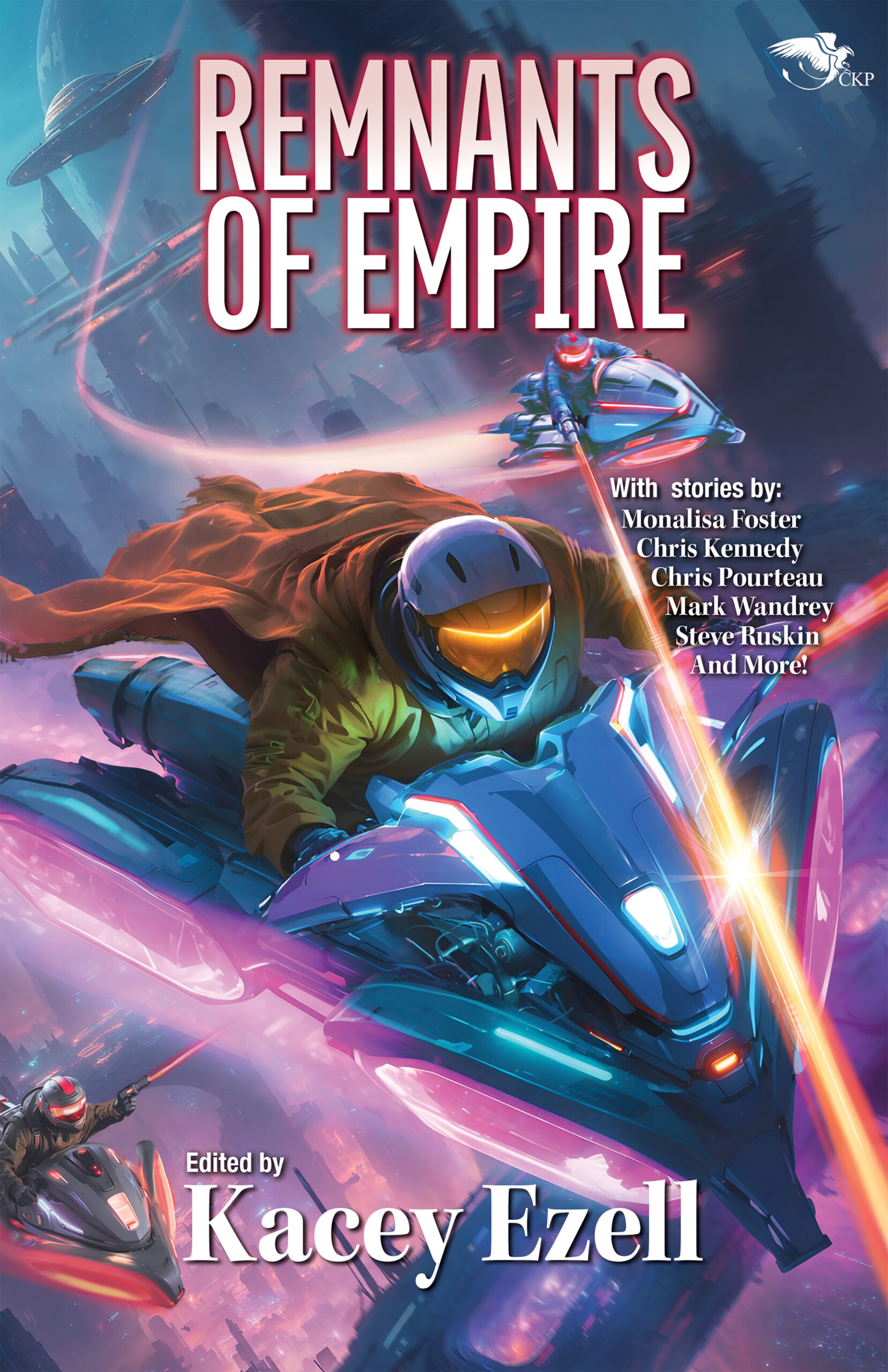
    My friend Kacey Ezell has a great new space opera series out, called the Ashes of Entecea* and I’m thrilled to be part of Remnants of Empire*, a new anthology set in that universe. Remnants of Empire launches on 7/26/24.


    Duty, danger, and unexpected romance await in this captivating tale from the Remnants of Empire anthology!

    On the planet Raneaux, two young nobles are ready to part ways. But when a series of devastating attacks rock their world, everything changes. Thrust into a maelstrom of political intrigue and violence, Aidan and Deirdre must confront their true selves.

    He’s a scholar who dreams of quiet libraries. She longs for adventure. Now, they’re fighting for survival and the future of their planet.

    As assassins lurk and conspiracies unfold, Aidan and Deirdre discover strengths they never knew they possessed. But in a world turned upside down, can an unlikely partnership become something more?

    Experience heart-pounding action, complex characters, and the birth of an unexpected love that could change everything.

    Remnants of Empire brings you a collection of interconnected stories set in a richly imagined sci-fi universe. 


    The holographic ad touting off-world adventure holidays caught my eye. I slowed my rapid pace to admire the frozen landscape that morphed into images of divers swimming with amazing deep-sea creatures. Chills skittered across my skin as I aimed my ubiq at the ad so it could scan the relevant information.

    “Add to my wishlist,” I told it.

    “Confirming add to Deidre’s wishlist,” the ubiq replied. “Reminder: you have a lunch appointment with your parents in ten minutes. At your current rate of travel, it will take you seventeen minutes to reach your destination. Do you wish to send a status update?”

    I ignored the ubiq and promptly slipped it into my pocket. With any luck, Aidan would get to the restaurant first, and my fashionably late arrival wouldn’t matter. My parents adored my betrothed—what an archaic term. In their minds he was perfect. It’s why they arranged the marriage contract.

    Don’t get me wrong. Aidan is a wonderful man. Kind, attentive, but not my type. He’s very smart and scholarly, and it didn’t take us long to figure out that we have different goals in life. He wants to make a name for himself as a professor of history. I want to travel. I want to go places and skydive and swim with alien whales and get into zero-g sports. He finds libraries as interesting as I find them boring.

    We’d be horrible for each other. I’d feel held back, and he’d feel—well, I don’t know, abandoned maybe. It’d be one thing if I wanted to go off and adventure on my own for the rest of my life and then come back to hearth and home when I felt like it, but would that be fair to him? Or to me? What if I found someone with whom I could adventure with? What if he found someone to be a homebody with? Would we be stuck in one of those awful marriage-in-name only things?

    I had to step around a holo-ad that popped out of the ground. “Stay informed with our latest updates on anti-monarchist activities—” If you make the mistake of walking through one, they will follow you—well, your ubiq—everywhere.  I didn’t have time to deal with viral ads.

    Thank all that’s good that we’re both lesser nobility—Aidan’s father is, I think, fourth in line for the throne. Being so far from power is why we can say no to a marriage contract. There are no world-ending consequences to either of us wanting to live our own lives. I doubt the ‘casts will even announce it, and if they do it’ll be buried in the day’s feed, and no one will care.

    My consolations and the rehearsed speech that I’d been working on since Aidan and I decided to part ways rolled around in my head as I made my way from the mag-rail station to Le Goût de l’Elysée. It’s the kind of place one goes to for special occasions like engagements and anniversaries, and that is no doubt why my mother chose it. 

    It was also the kind of place frequented by Raneaux’s planetary royals and judiciars and prime ministers and celebrities from all over Entecea. Frankly, I’m allergic to all those people, although I do endure them for my parents’ sake.

    As I crossed the cobblestone pathway, I wished I’d picked something other than spiky heels. There was a dress code though, so I had dressed up, partly out of guilt. I knew going into this just how disappointed our parents were going to be, and for some reason, I had thought that one of my nicer, semi-formal dresses would somehow make up for it. This one was gray, asymmetrical, with a high neck and cap sleeves, a minimalist design with sculpted details, and everything someone like me was supposed to be wearing for something important. Like I said, guilt, or maybe apology. But in dress form.

    The upside to l’Elysée was going to be that no one was going to dare make a scene—even though neither of our mothers were that type. It had been Aidan’s idea. See, I told you he was clever. And so very smart. 

    I sighed. Oh, if that were only enough. If only we had chemistry. I wanted that thrill, those butterflies, that out-of-control-in-love feeling. I wanted it all. Preferably now. And forevermore.

    Doormen in matching uniforms, complete with caps and white gloves, swung the doors open as I approached. It’s such things that make l’Elysée an experience in itself, particularly for the nostalgic.

    The foyer was done in a deconstructed chandelier, where each crystal was suspended by invisible nanofibers. To me, it had always looked like an exploded diagram of a chandelier, instead of an assembled piece. Art, I guess.

    The maître’d looked up from his tablet and shot me a smile. “Ah, Miss Pinet. How good to see you.”

    “Good morning. Are my parents here yet?”

    “Yes, Miss. They were seated about twenty minutes ago. Lady and Lord Stout have also been seated.”

    “And Professor Stout?”

    “I’m afraid not. Would you like us to ping his ubiq with a reminder or request his current location?”

    Sometimes people like the maître’d expected people like me to above carrying ubiqs. The really important people didn’t. Their staffers and aides did.

    “No, thank you. I can do it myself.”

    “Very well. This way, Miss.”

    And so he led me through the main dining room with its fleet of curved banquettes and gazebo-like hooded loveseats. It wasn’t quite noon yet, but I knew that it would soon be filled with glitterati, with the cream of Raneaux society coming together to impress each other over fancy lunches.

    The parents sat cozily on the veranda. It really was a lovely day for it with spring sunshine pouring in through slats strategically placed so that the light wouldn’t bother anyone’s eyes. Floral scents floated on the breeze, just a hint of them so as not to interfere with the more discerning palates that were bound to be l’Elysée’s best customers. It was no surprise that my mother had been making noises about having them cater the wedding. I just hoped that she hadn’t already booked them.

    Mother wore a long dress with a bolero top—lavender, of course. Lady Stout was in a similar outfit, but in mint green. It made me think they’d coordinated and that made my stomach hurt. Father and Lord Stout both wore what I called their uniforms—tunic-like business jackets that hit mid-thigh and pressed trousers, high-collared shirts, and cravats—like they might stop by the House of Lords and argue for this or that or the other. 

    The two empty chairs beckoned like a challenge. I really didn’t want to face them alone.

    Nevertheless, I braced myself.

    Here. I. Go.


    Read the rest in Remnants of Empire.


    *As an Amazon Associate I earn from qualifying purchases.

  • Threading the Needle is out today!

    Threading the Needle is out today!

    Hip, hip, hooray, it’s finally December 5th, aka “Release Day.”

    Threading the Needle is officially here! I’m beyond excited. I can’t wait for you to meet Talia and her friends.

    Praise for Threading the Needle:

    In Threading the Needle, Monalisa Foster has fused the legacies of Leigh Bracket, Louis Lamour, and Robert Heinlein — with maybe just a TOUCH of Akira Kurosowa — in a voice entirely her own. Starships, trains, six-guns, nanotech, gen-engineering, cattle rustlers, and the fierce loyalty of combat vets in a mix which ABSOLUTELY works! — David Weber, Author of the Honor Harrington series.

    A stunningly good book set in a world with rich cultures and a sense that violence and danger are always at hand. First, I feared Talia the sniper– then I cheered her, as she carved a path through intrigue so thick it required a sword to cut it. Fortunately, Talia is just that blade. A must read.— Terry Maggert, Author of Backyard Starship, The Messenger, and Starcaster series

    The reviews are in:

    “Foster has created one of the most intriguing characters I have seen in a while in science fiction…The plotting of this book reminded me of Timothy Zahn or Blake Crouch, with all sorts of twists and turns and other such events happening every which way. Foster is very good at it. She takes on a lot, and she succeeds in threading the needle (pun not intended but very much enjoyed), sewing them all into an engrossing narrative. She paces her story well, never letting it get off the rails, never letting it become dull.”–Nerds of a Feather

    “Fans of Leigh Brackett will also love the book for paying homage to the queen of science fiction, and anyone who wants a pulse-pounding adventure is sure to like the increasing tension as the story rushes to its conclusion.  This is space opera with Japanese flair and Western archetypes at its best.”--Upstream Reviews

    If you want to learn more about the story behind Threading the Needle…

    Halfling and the Spaceman podcast

    Paul Semel interview

  • Relics. A SF-noir-flavored nibble

    Relics. A SF-noir-flavored nibble

    I’m very excited for the release of Relics, a short story set in the same universe as Threading the Needle.

    When I originally conceived of a story that included a replica of Charlton Heston, I didn’t know any of the following things: Charlton Heston was Chuck to his friends. He and Toshirô Mifune were also friends, despite a language barrier. Heston said that if Mifune would have spoken English he’d have been one of the greatest actors of our time. Ironically, Mifune served in the Imperial Japanese Army aviation division during WWII and Charlton Heston served as a radio operator and aerial gunner in the US Army Air Service and would have taken part in Operation Coronet, the planned invasion of Japan. That gave me chills. 

    The thought of would-be enemies developing a friendship that lasted for the rest of their lives even with an ocean between them and despite the cultural gulf that also must have been there has its own appeal. This story is my tribute not just to that idea (ideal?) but to two of my favorite actors, Charlton Heston and Toshirô Mifune themselves.


    AIs don’t go rogue. Everybody knows it. Especially SAIs. Which never really made sense to me. They’re supposed to be people just like you and me, and people—flesh and blood humans such as yours truly—are sapient and we go rogue all the time.

    But you never know.

    Digital citizens were one of the first truly sapient AIs. Who knows what happens after a couple of centuries of rattling around, especially when you’ve been designed and built as an anachronism to begin with. Maybe they can’t handle change. If there’s one thing that the last three centuries have proven it’s that some people just can’t handle the world as it is, so why wouldn’t “digital citizens” lose it and go rogue?

    To be honest, I was surprised to find out that these digital fossils were still around, although with the rise of Nostalgism, maybe I shouldn’t have been. The Commonwealth tolerated the movement because it helped move the, shall we say less-than-desirable, off-world. That much I knew.

    A leggy brunette with doe eyes, ruby-red lips, and an hourglass figure—some things remain classics even in this screwed-up century—led me into a wood-paneled office and “He’ll be right with you Mr. Elliott,” rolled off her tongue with a distinctive twentieth-century lilt.

    Given that this was a museum, her accent and the throwback design of the office shouldn’t have surprised me, although I’d figured the front—a replica of the historical Grumman Theatre—had been strictly for show and expected the back to be, well, a little bit more twenty-fourth century.

    The desk was wood, the chair leather, and what had to be a mid-twentieth century television set complete with antennae was tucked neatly into a corner. No computers, no tablets, no holographic interfaces of any kind, at least not that I could see. Two couches fronted the desk, facing each other across a low table—also wood. A couple of books, huge ones, held it down, their covers sporting images from a cinematic golden age almost five centuries gone.

    I picked up the top volume only to find that while indeed it was made of paper, the pages were blank.

    “You’ll find us in compliance with the law.”

    Setting the book back down, I turned toward the commanding voice. Like the human who’d shown me in, the SAI in the doorway wore twentieth-century attire—in his case, a suit and tie. It looked a bit odd on his tall and broad but clearly synthetic frame.

    The pixelated membrane that covered the android skeleton mimicked human skin to an uncanny degree, one that immediately gave me chills. The face too did a remarkable job of emulating skin and coloring, placed as it was over a bone structure that must have been true to the original human—strong but not overpowering jaw, slightly curved nose, steely blue eyes. I’d seen images of SAIs of course, but never met one. It was the eyes that gave them away. They weren’t orbs inside sockets and didn’t move as such.

    “I’m not a cop anymore,” I said a bit defensively, I don’t know why.

    “But you are still required to report violations, are you not?”

    A smirk found its way onto my face before I could stop it. “I don’t make it a practice to inform on my clients. Tarnished I might be, but not that much.”

    He gave me a skeptical look and extended his hand. “Call me Chuck. I insist.”

    What a throw-back custom.

    Awkwardly, I shook his hand. Room-temperature like a corpse. While it emulated skin right down to the veins and calluses on his hand, there was no accompanying texture. Images of hairs were overlaid over images of veins. The calluses were as smooth as you’d expect a pixelated surface to be. Ironic, no? He was an image on a screen, just as he must have been when his original had been alive.

    You can read the rest of the story at the Baen Books website.

  • Ravages of Honor: Handwavium Part 3, The Genetic Engineering

    Ravages of Honor: Handwavium Part 3, The Genetic Engineering

    What if?

    That is the central question in scifi and the cause of all the trouble too. Trouble means tension and conflict. In fiction, trouble is good.

    MidJourney image

    One of the things I really wanted to get away from was the Star Trek “alien.” The Star Trek alien is just like a human except for one, or a few, altered physical features (purple eyes, wrinkled nose, differently shaped ears) and one exaggerated behavior or attribute—greed for the Ferengi, logic for the Vulcans, aggression for the Klingons. Until recently all Vulcans even shared one hairstyle.

    Practically you can see why this would happen. It makes it easy on the makeup department and allows the casting department to cast, well, humans. Duh. Budget constraints are a factor of course, even with the prevalence of CGI. We finally are a point where we have actors walking around on stilts to create the illusion of hooves like a horse, etc.

    Low-budget old-school Dr. Who was braver and gave us aliens/monsters made up of baling wire and spit. Ironically, also due to budget constraints. There’s a lesson there.

    That’s all fine and good and eventually Star Trek writers even came up with an explanation for why there are so many bipedal humanoid species—some race went around seeding planets and reused the same framework. Okay. That kinda, sorta explains things, but what about behavior? That’s actually more writing-related too, having to do with the readers.

    The readers (or viewers) must be able to relate to the alien. Hence we do not have the Broccoli people of Brassica IV except maybe for the short term as a curiosity or if the budget allows it, or just to be able to say, “Hey we don’t just have bipedal humanoid aliens with front-facing eyes.”

    Let’s face it, consumers may get a chuckle out of the Brassicans’ obsessions with butter-baths, but could we really relate to it if it didn’t touch the funny (or irony) bone?

    Now, if you think about it, an intelligent creature that looked like a stalk of broccoli because it had sensors on the stalks or operated each branch like an octopus does with multiple brains would be quite unique and might even make sense for a certain kind of environment, but how relatable would it be?

    And then we have the Furry-aliens, i.e. people in suits made up to look like a shark’s head was grafted atop a human torso, because, well, it was. I really wanted to get away from that, and the truth is, once I made that decision, I was limited to creating a sub-species of human, which I was actually fine with given what I wanted to do.

    In addition to it working with the story I was inspired to write, I think that going with a sub-species is more honest than pretending that you could have a shark-headed humanoid. Ironically, it’s actually done better in fantasy (via orcs, ogres, vampires, werewolves, and other supernatural creatures which are more rigorous, i.e. it makes more sense, than the shark-furry). This is also why I’m fine with calling the RoH series a “space fantasy” or a “space opera” rather than hard-SF, despite the crunchiness of the science or the rigor of internal consistency. 

    Remember, I’m here to entertain. As I’ve been saying, I’m filing for copyrights, not patents.

    Once I made the decision to go with the more rigorous notion of a sub-species, I delved into what I loosely call genetic engineering (mostly the old-fashioned kind that is actually in-vivo breeding for traits and/or hybridization rather than the in-vitro variety, although I use both in Ravages of Honor series (affiliate link)).

    Enter the mules. Wait, did she say mules? As in the four-legged things like horses.

    Yes, she did! Cause she’s like that.

    Because a mule has only 63 chromosomes (a horse has 64 and a donkey has 62), mules are infertile. Usually. I know! I was shocked to learn this too. I thought for sure that mules could not have babies. 

    And that’s when the trouble started.

    What if? What if the super-soldiers (my genetically engineered donai) were like mules? This would be a desirable trait since their creators wouldn’t want them breeding anyway. So I went down this rabbit hole and discovered that there are rare cases where the offspring of a fertile female mule ( a “mare”) can have fertile offspring that then go on to exhibit (atavistic expression I believe; remember, I’m not a geneticist or even a biologist) the traits/characteristics of horses despite their heritage including donkeys. That is, it’s possible to breed fertility back into the genome and to have those offspring express only the “desirable” traits of one species (or race).

    Talk about things that make this writer’s day! This is my playground. This is where my buttons are pushed (and like a 747 I have a lot of them; go figure).

    In the RoH universe this manifested as the genetically engineered donai having been created in such a way that they were infertile, but “nature finds a way” and produced errors—sometimes in the genome a la chromosomes, sometimes in the symbiotic nanites via coding errors. Sometimes those “errors” were helped along by the most successful venereal disease on record—life. Yes, life is a venereal disease, even when it occurs in-vitro (in a test tube). Pass it on!

    Scientists can play with test-tubes all they like, even en masse, but there’s nothing like the introduction of chaos (the scientific variety) that’s unleashed when the product, in this case, the donai, are released into the wild and have the opportunity to—ahem—interact with a far more prolific species, i.e. humans. 

    And this is where another “What if?” came in and then all the trouble called a story, called conflict, called complex characters, called intense relationships, called massive worldbuilding “happened.”

    If a story can’t be told without the extrapolation of science, it’s science fiction. 

    If a story has a premise based in that extrapolation of science (mine has three), then it’s science fiction. 

    If a story has a solution rooted in the same extrapolation, then it’s science fiction. 

    Which still leaves open the question of sub-genre.

    RoH meets all those criteria (requisite girl cooties notwithstanding). So what is it then? Hard science fiction, science fantasy, or space opera. I guess it all depends on your perspective, i.e. how much do you really care about the science being right, the science being rigorous, internally consistent, etc.

    From my perspective it’s got enough handwavium and other elements (i.e. it’s not just about the technology but about people and their adventures) to be space opera. It’s also space opera because the donai are more like the creatures of fantasy despite their non-supernatural basis. In many ways they are more human than human, but the story solution resting in the “rigor” of the story’s in-vivo genetic engineering makes it sci-fi (maybe even hard sci-fi). 

    Unlike a lot of space opera (I’m looking at you Star Trek) RoH is actual military-sf rather than militaristic-sf. But I don’t have a lot (I have a few) of space battles because I find them boring to read and even more boring to write. Nevertheless, I also don’t appropriate military culture (uniforms, ranks) and then disrespect them (bedding subordinates and making them into a “peacekeeping armada”—what an absurd term! Think about it!) because I know better. My militaries kill people and break things, just like (checks notes) in the real world. Huh. More rigor. 

    This is why I call myself  genre-fluid. I don’t set out to mix genres, but I do mix them, depending on what the in-world dynamics call for. I think this enriches the world and provides depth to characters. It’s what makes an enjoyable story to me and I hope, to you, my readers.

    Please don’t put any spoilers in any comments. I will delete anything I consider spoilerish.

    [Crossposted to Substack]

  • Ravages of Honor: Handwavium Part 2, Nanotechnology

    Ravages of Honor: Handwavium Part 2, Nanotechnology

    One of the reasons I’m doing this short series on the science in my books is because I wish more scifi writers would talk about what’s real science and what’s made up in their stories so that people won’t grow up thinking that Star Trek (ST) science is real. One of the reason I like reading certain historical fiction writers like Kate Quinn and Allison Pataki is because they go into what is made up and what was based on historical “facts.” As a non-historian I appreciate knowing. I’m hoping that the same will happen for what I’m discussing here.

    And here we go…

    The nano robot in blood vessel,medical concept,3d render; licensed image


    Most people (based on what I’ve seen) got their idea about nanotechnology from Star Trek. My introduction to it was somewhat different. ST:TNG had not yet hit television when I ran across Feynman’s There’s Plenty of Room at the Bottom (a 1959 lecture on “miniaturization” that is considered the basis for the concept) via Engines of Creation, the first book I ever checked out of a college library. 

    [The big bugaboo about this lecture on “miniaturization” was in its interpretation, i.e. what Feynman meant vs what people “understood.” He was not talking about miniaturization in the sense of making smaller and smaller versions of something, i.e. as in using the photolithography used to make semiconductors.1 The image above demonstrates this misunderstanding in action. That robot up there looks like a macro (real world) scale robot, something that has been scaled down.]

    (more…)
  • Ravages of Honor: Handwavium Part 1, FTL travel

    Ravages of Honor: Handwavium Part 1, FTL travel

    One of the reasons I made my Ravages of Honor series (affiliate link) into a space opera was so that I could focus on the characters, their adventures and relationships, the politics of a galactic empire, and the political machinations of feuding noble Houses. And so that I could use handwavium (i.e. make stuff up).

    MidJourney image

    As with most things I set out to do, things don’t always turn out the way I intended. There’s a reason I chose the slogan, “human drives, not hyperdrives” so I was surprised to find out that my handwavium (my science) was considered pretty crunchy after all.

    And actually, I’m okay with this. Like most writers, I ended up writing something I wanted to read—something that hit all of my buttons just right, and I have a lot of them. I want character-based stories with romantic elements (like chivalry and romance, not Romance) as well as handwavium that makes sense in-universe. I wanted to explore the question of “What makes us human?” as well as the cost and price of honor, i.e. of doing the right thing. I wanted to look what makes freedom and liberty and tyranny. I wanted to look at cultural clashes.

    I consider the FTL in RoH to be the least crunchy element of my handwavium, but maybe it’s not. When a writer friend pointed this one, I had to shrug and then nod and go off and think about it some.

    One of the reasons I don’t go into huge info-dumps in RoH is because as a reader, I find them quite boring. The characters don’t need to explain things to themselves (how often do you stop to explain to yourself how your car works?) and even when we contrive a reason to explain things to an ingenue, it comes across as authorial intrusion of the worst kind.

    Even if the character being used as a mouth-piece is actually an expert (in this case, an n-space expert) he has to have a good reason to “explain” things to another character. Then we have the level of explanation. If a differential geometer (someone who is mathematician specializing in differential geometry) were to explain something to a layman, would they use all the terms-of-art unique to differential geometry? The answer of course is no, so vomiting that on the page is again, pure authorial intrusion.

    My definition of science fiction is not just that it has to have a speculative element (like nanotechnology or FTL or genetic engineering) but that such elements have to be integral to the story, i.e. it can’t happen without it. It can’t just be window dressing or a thin veneer. There must be a speculative element that is integral to the story in such a way that taking it away kills the story. If the story solution depends on it, so much the better, and by the way, now you may have well crossed into “hard” sci-fi, whether you intended to or not.

    The Ravages of Honor series (affiliate link) has three such elements: FTL, nanotechnology, and genetic engineering. Take any of these elements away and there can be no story. Without FTL, Syteria can’t get pulled out of her part of the universe and find herself in Darien’s. Without FTL, there is no Imperium. Without genetic engineering and nanotechnology, the donai cannot exist.

    I think the genetic engineering in my series is actually the most speculative element, followed by the nanotech, but that’s probably more of a reflection on the fact that my education is the most lacking in the genetic engineering aspect, whereas I do have a better grasp of how nanotechnology would work just like I have a better but still tenuous (theoretical) grasp on the math and physics of “hyperspace” (as in the space of higher dimensions, not the x, y, and z of our own physical universe; oh, and t (time) of course, but let’s leave t’ (the prime of time) out of this, cause yeah, let’s just leave it out).

    I apologize in advance for making physicists cringe and for making lay people think about math, but I promise, no equations. I also apologize for the quality of my graphics. It was either spend ten minutes drawing it by hand or the next few days trying to figure out how to make the same image via some program I haven’t used in years, and I have a release coming up tomorrow (10/20/23). Yikes! 

    So here it is, the quick and dirty, and not very technical version of my FTL handwavium.

    It requires you to imagine the space between stars (just like in our universe) as a surface. If we were to look at a surface edge-on, we’d get a line. 

    What constitutes a region A as different from region B is part of the speculative element here. Let’s call it any region of space that is gravitationally connected in some way, like a solar system or a cluster of stars and their solar systems.

    Now imagine that this line (that represents a surface) has some curvature to it that can be represented mathematically (if not physically) via the surface (and surface only) of a sphere. 

    Kind of like this:

    So, what we have here is much like two soap bubbles that have been brought together and can touch, thereby creating an interface. 

    That interface is what connects region A to region B, in hyperspace (as in the space of higher dimensions).

    What does that interface itself actually look like?

    It’s an intersection where region A and region B “touch,” thus creating a “phase-point” connecting the regions and therefore providing a way to travel from star C to star D hyperspatially. This phase-point might look like a disk you can pass through.

    Everyone with a physics background, stop cringing. It’s called science “fiction” for a reason.

    Subscribed

    This is why the territory of any particular House in the RoH universe isn’t necessarily connected in real space. The n-space (phase-point) connections are the defining factor instead. And if one wants to travel through a phase-point that is located physically in another House’s territory, they must have permission or enough power not to worry about getting permission. This is part of the reason why we have a feudal system in this far-future universe, i.e. because one of the elements of a feudal system is that communication and/or travel is slow and/or difficult. Messages must also travel through these phase-points or take years or decades or centuries to arrive. 

    Now, imagine if you will, what happens when those bubbles move further or closer or get pushed apart. It would change the dynamics of alliances, both political and economic. Fertile ground for any space opera. 

    Especially this one (release date 10/20/23):

    Cover © Kurt Miller, 2023

    [Crossposted to Substack]

  • The First Trilogy in the Ravages of Honor Series is Complete

    The First Trilogy in the Ravages of Honor Series is Complete

    Back in, oh about, 2017 or so, when I first started thinking that maybe I could get back into writing fiction and I was playing around with the idea of a space opera about genetically engineered samurai-types, running around with swords in a universe that used not only nanotechnology but other advanced tech, I had no idea it would take more than half-a-million words to do that.

    Of course at the time I was not thinking in terms of trilogies or even series. My naive self thought that I could get it all done in one book. In fact, Darien and Syteria getting together happened in the first quarter of the book. I did mention my naïveté, didn’t I?

    The Syteria and Darien that existed on page in 2017 were two very different people.

    I set out to write a Syteria from a world ruled by women. Not just ruled, but viciously so, to the point where most men were killed. The Rhoans were misandrist (haters of men) misopedic (haters of children), and oikophobic (fear of home/domesticity). They used their advanced technology to make sure men were not needed or tolerated.

    Given who the Rhoans were, I had to create their opposite, the Kappans1. The Rhoans and Kappans had to be separate societies, and the only thing that made sense to me at the time was for them to be so separate that they didn’t even share the same planet. But they had to be inexorably bound together, unable to get away from each other. In order to do that, I put them on a double planet2.

    At some point, the people that would become the Rhoans, kicked the people that would become the Kappans off-world. I don’t exactly know how they did this, not having written it yet. In order for this to work, I had to posit that the Rhoans had more advanced technology in order to keep the more aggressive Kappans in check. Initially, the conflict was going to be between a Rhoan female and a Kappan male. I was going to take the battle of the sexes to a whole new level.

    But in fleshing out the premise, it soon became quite apparent that getting someone who believed in the Rhoan philosophy and in reducing the population of men just to the few required to keep a species going wouldn’t work. She could not be from a society that didn’t need the muscle power of men, that raised their female offspring in creches. How would I get her to the point where she would be able to hook up with a man of any kind? It was going to take a lot more time and effort and I would end up with a book that was about nothing but a war (a literal one) of the sexes. I decided that I didn’t want to go there.

    Because I am (somehow) a romantic at heart, I instead wanted to write about what a man and a woman could to together, how they could be greater than the sum of their parts.

    That meant recasting the Kappans as Syteria’s people and creating the donai. It made far more sense to have someone who was born on Kappa and initially raised as a Kappan (with a family, with men who loved and cared for and protected her) to be taken from the society of her birth and brainwashed to be a Rhoan. It also made sense that the Rhoans would not want to do the dirty work of war themselves and would instead take the daughters of their enemies and make cannon fodder out of them. And that is how the eniseri were born.

    It was at this point that I realized that I was also going to have to make this a fish-out-of-water story, i.e. have Syteria torn not just from the world of her birth, but from the world of the Rhoans, Matriarchs, and eniseri. And that I was going to make the donai not just the opposite of the Rhoans, but Kappans on steroids, i.e. more Kappan than Kappans.

    And since I wanted to write a space opera that included adventures on different worlds rather than a commentary on social issues wearing a thin mask of “science fiction” I was going to have to do more. Much more …

    In order for Syteria to survive, she was going to have to adapt, and the donai were not going to make it easy. It’s a good thing I like the enemies-to-lovers trope.

    Since the best heroes are the flip side of the villain coin, I gave the donai something in common with Syteria–they too had been, at one point, slave-soldiers. They too had been created as cannon fodder in someone else’s war. The difference was that they overthrew their masters–who of course had to be human, because that would complicate things for Darien.

    And if we were to design soldiers, how would we do it? We would give them speed, strength, the ability to heal, ingrain obedience and an overwhelming need to protect, and ensure that if they bred, they couldn’t breed on their own. Enter the Ryhmans. Like the Rhoans, they didn’t want to do their own fighting and dying. So they used their genetic engineering to create the donai and in that creation, made them dependent on their nanites symbionts for their ability to heal. The Ryhmans tweaked their own genetic code (their DNA) just enough to make sure that the donai would require their own custom nanotech.

    One of the things I learned from working in cancer research is that we have a tremendous amount of arrogance as a species, thinking that we can control things just because we have some level of understanding. We may be able to understand how our bodies work, but we can’t create a human being from scratch. And there are always unknown unknowns lurking in the shadows, waiting to teach us a lesson about hubris.

    Since I was already playing with the idea of the donai being based on the samurai, making the backdrop one consisting of feudal noble houses made sense and I ran with it. A happy-yappy rainbow world of equality is perfect for reality, but makes for horrible fiction. The uneven power dynamics that came out of that, with humans having the tables flipped on them and becoming slaves to their own creations, provides a backdrop fertile for all kinds of conflict and tension.

    This is the setup for the Ravages of Honor series.

    As I fleshed out Conquest (Book 1) I realized that it would have to be at least a trilogy. And now that I’ve finished Lineage (Book 3) I realize that it can be much more. But this trilogy is complete in the sense that it is complete for where Darien and Syteria are now.

    This does not mean that I am done them.

    Ultimately this story was about the choices that not only define us, but either make or break us. For Darien, it was the choice to defy the emperor by saving and then refusing to surrender Syteria. For Syteria, it was the choice to become the Kappan woman that the Rhoans had almost destroyed. For both of them, it was about the sacrifices they made –that’s what makes for heroes, after all–and their commitment to do the right thing despite the ravages of honor.

    This is why I’m proud to present to you this excerpt from book three, Lineage.


    Have no enemies.

    The words inscribed around House Kabrin’s dragon sigil glowed with a vibrant green that looked so much like the old color of Syteria’s eyes that it made her shudder. It was the way the light hit the dark, green stone, painting it with false hints of blue, cyan, and turquoise. What it was doing here, on Serigala, in the palace gardens, Syteria didn’t know.

    The Kabrin sigil and motto looked like something that had once been part of a stone edifice, probably an official government building or perhaps some monument. The stone it was carved into was twice as tall as she was, and wider still, its edges ragged, like it had been torn—rather than cut—from a larger piece.

    A breeze disturbed the night, ruffling the manicured lawn, making the grass tickle her bare ankles. It tugged at the flowing nightgown clinging to her. She grabbed at the billowing robe that had slipped off her shoulder and drew it up tight.

    Despite casting her as a threat to the Imperium, the emperor hadn’t really seen her as such. It was the only reason he and the other donai had ignored her. She’d been unarmed. They’d thought her defeated. It could have so easily gone wrong. Had her hands been shaking, had she hesitated, had she missed. Had she hit anything but that thin layer of bone, had the bullet not carved an easy path from temple through several lobes of his brain …

    For an instant she saw his body atop that crimson pool of blood. For a terrible moment it had looked like the nanites would repair the bone and skin. For too many moments since, she relived that dread, waiting for him to rise again, either whole or as an empty shell. 

    Her hand strayed to her dagger, tucked safely in its thigh sheath. Palleton still denied her the use of a sidearm. Lord Dobromil didn’t want anyone even suspecting that she could use one. All to keep their secret—her secret—that she, not Darien, had been the one to take the emperor’s life.

    The emperor’s lifeless body would be forever etched in her memory. Thán Kabrin had tried to break her—mind, body, spirit, and soul. He’d almost succeeded. Her broken body had been healed. Her mind and spirit were still healing. And her soul?

    That remained to be seen. If the emperor was to remain a ghost that haunted her in moments of weakness, that invaded her sleep and sent her wandering the palace grounds in the middle of the night, then so be it.

    A ghost could not harm her child. Not now while it was still in her womb. Not once it was born.

    That’s all that mattered.

    Keeping her child safe. Keeping it out of the reach of Kabrin’s allies and vassals who might see it as their duty to avenge their liege. Even if House Dobromil could keep the identity of the emperor’s executioner secret, its enemies would still come for her and her child. They would come if for no other reason than she was both the most vulnerable and the most dangerous member of House Dobromil. 

    Vulnerable because she was human. Dangerous because she bore its heir.

    It still didn’t feel quite right, counting herself as part of a donai House, but she was slipping into that way of thinking more easily with each passing day. She had to.

    Adapt or die.

    It was the way of things. Always had been. Here, where they traveled from star system to star system and used nanotechnology. Or on Kappa, where they’d fallen back to traveling by animal-drawn carts.

    She looked up at the darkness of Serigala’s sky. Its two moons had set, leaving only the net of the planet’s defensive grid, something that looked like a shell made up of bright, sparkling diamonds connected by fine silk.

    Lights flickered along the edge of the garden path. Darien was making his way toward her. He was already dressed for the coming day: black ship-fatigues with red piping and trim; House Dobromil’s wolf’s-head sigil on his breast; black boots, polished to a high gloss. Sidearm. Dagger. Sword. 

    Not so long ago, the thread of pair-bond would have warned her of his approach, but it too was gone. The strength of their pair-bond depended on his nanites, on a steady infusion of them via physical contact, on how often he bit her, how often they mated. In the weeks since he’d marked her—since he’d been forced to mark her—he had refused to make love to her, refused her advances, and the pair-bond had faded to nothing. 

    He came to stand at her side. He towered over her, and she wasn’t a small woman, not even for a human. She was still getting used to his newly gained height, a “gift” of the Cold that had had him in its grip for so long. It had changed him. 

    He was no longer the half-breed who had compromised his honor to save her life or who’d gone cold when he’d thought her dead. He had become something more, something that she should fear, but didn’t.

    “What is it?” Syteria asked, indicating the stone. 

    “A trophy.”

    Her fingers, slightly cold from the chill in the night air, hesitantly threaded into his. They were like embers against her skin. Embers that—for once—he did not pull away. 

    “Have no enemies,” she said, reading the bold strokes of High Kanthlos.

    “It sounds so … noble,” she continued, her tone full of irony. “Honorable even.” 

    “Does it? Why do you say that?”

    “It’s so … Rhoan. Like something the Matriarchs would use. It implies a lack of conflict, of strife. Like someone who only has friends, who will go to any length to avoid making enemies.”

    They turned to each other and he slowly brought her hand to his lips. He’d cut his hair when he’d broken with his House so he could challenge the emperor and rescue her. It still hadn’t quite grown back to the shoulder length required of someone of his station. Its thick, dark strands framed him in an unruly way, like a torn and battered halo that had settled reluctantly on his head. Two heartbeats later he laid a kiss atop her hand.

    His irises had returned to the usual donai-amber, a color she—as a marked woman—now shared. But unlike her very human pupils, his were gold. The brushed silver full of snaking black lines—something that no other donai, not even ones who’d gone cold, had ever exhibited—were gone from the whites of his eyes.

    For a moment there, as he’d marked her, as he’d sunk his cuspids into her jugular and put his nanites directly into her blood, she’d caught a glimpse of his shadow, that thing that lingered inside him. That darkness who wore a skin like ink and looked back at her with eyes like blood. She’d reached out to touch it, certain that it wasn’t—couldn’t—be real. She’d thought it an illusion, her pain-addled mind giving form to something it didn’t understand. 

    Crystals had formed as she’d touched it, making it look like black ice about to shatter. It had been as real as anything she’d ever seen or touched. Was it still there within him, hiding? 

    Even now, thinking of it, remembering it, chilled her blood. 

    She shivered. 

    Darien let her go and turned back to the stone. “House Kabrin chose this motto to let everyone know that their enemies would be destroyed. It is a warning to those who would stand against them.”

    She reached for the carving. A forcefield flared, betraying its presence with a resistant hum. She caressed it, letting the feel of it pulse and throb beneath her skin until its heat was too much to bear.

    “Palleton ordered it shielded before he left,” Darien said. “He’s not convinced it hasn’t been weaponized in some way.”

    “Who sent it?”

    “House Yedon. They are a minor House, a vassal of Kabrin’s.”

    “An enemy?” she asked.

    “Unfortunately, we’re not yet certain. Some of Kabrin’s vassals have stepped forward, eager to pledge themselves to us. Others have been silent.”

    “And you suspect those who’d so easily switch alliances as much as those who have not.”

    “Yes. It is not as simple as my father and I would like it to be. House Dobromil was a reluctant vassal for generations. We were one of the few who stood against Thán Kabrin, the ‘loyal opposition’ some called us.”

    She shook her head. “I didn’t intend to complicate things. I’m sor—”

    He grabbed her shoulders.

    She flinched, regretted it when he let her go just as quickly, and looked down at his hands as if they had moved on their own.

    “Never apologize,” he said. “Not for that. Not ever. You had every right to take his life.”

    The layered irises of his eyes contracted and expanded, his enhanced donai vision assessing if he’d hurt her. She didn’t need the pair-bond to tell her that it was the same fear that was responsible for the distance he’d put between them, for why they’d shared none of the intimacies she craved. She could see it in his eyes, in the way he hesitated, the way he always stopped himself.

    Anger rose up inside her. She wanted to rage at him, to beat her fists against his chest, to demand her due, but she couldn’t. Not again. She could not face the determined donai calm that would let her spend herself against him, let her pour her rage out, and then refuse to waver or yield in the face of her frustration. 

    “I’m not apologizing for killing him,” she said instead, and it came out without a tremor. “I’m not sorry he is dead. I sleep better at night knowing he is dead.”

    Her nightmares were of a different sort. Her nightmares were ones where the emperor lived, where he continued to rape and torture her, where he went on to hurt those she loved. Where he used her child against her. 

    Darien searched her face and for a moment he looked like he might say something. He was keeping something from her, she was sure of it. Had been sure of it for weeks now.

    She’d tried to coax it out of him before, screamed demands at him until her throat was raw, but it had only made him more determined in his silence. 

    They were both wounded. Her by the emperor. Him by the Cold. By what he saw as failure. She could not get him past his guilt for failing to protect her; for the loss of their first child; for what Kabrin had done to her.

    Instead of sharing his pain, he would withdraw. He would leave Serigala to pursue enemies he could kill. He would have his men bloody him to the point where even his father, who’d had no issue with Darien proving just how donai he’d really become, had put a limit on it.

    Darien’s hand strayed over the long cascade of chestnut curls falling around her shoulders. Usually she wore it up, twisted and pinned out of the way, but she hadn’t bothered after she’d given up on sleep. Gently, he lowered his face into it, tugging at its scent.

    Yes.

    Her chest heaved, anticipation mixed with fear. 

    Darien pulled away, traced the arch of her brow. This time she did not flinch. Daring more, she leaned into his touch.  

    He went to one knee in front of her, rested his ear against her belly.

    She placed her hand atop his head. At least they still had this. At least this time, their child had survived.

     “Our son will be a uniting force,” she said. “He will save both humans and donai.”

    This she believed with heart and soul. She needed it to be true, to make it all worthwhile. Darien’s father might see her unborn as a warchild—as an heir with all of the donai’s enhancements intact, a rarity on which donai survival depended—but she didn’t see it that way. She saw her unborn child as a savior, as that uniting force.

    The barest thread of Serigalan dawn trickled along the seam of the horizon, adding a splash of newborn gold to the palace’s soaring walls, gilding the trees and grasses of the garden, making the flecks of green flare in the stone in front of them. 

    Darien stood. “I need to go.”  

    “No,” she whispered, despite the need flaring in her chest. “Stay.”

    “I … can’t.” It came out edged with just enough humanity to make her believe that denying her was painful for him too. And then it faded, that guilt, that vulnerability, that ache, and he became so very … donai

    “I will return,” he said.

    She curled her hands into fists. Nothing she had done or said for the last few weeks had mattered. Not tears, not begging, not bearing her soul. Nothing.

    Tears pushed at her eyes.

    “What are you going to do with this trophy?” she asked, turning the conversation to something that would not devolve into a public expression of her rage. She didn’t think she could bear the shame of such a display.

    “It will probably be the first of many ‘gifts’ we will receive. It is customary to display them for all to see.”

    Her gaze remained on the stone, the sigil. She did not want to look at him. She couldn’t bear it.

    “My lady, is there something else you’d like to see done to it? With it?”

    “No.” 

    It was a lie. One that his donai enhancements could no doubt recognize, but he let it stand and retreated into the sunrise. 


    1. The terms “Rhoans” and “Kappans” as well as “Rho-Kappa” are derived from the concept of r/K evolutionary biology ↩︎
    2. As it turns out, the Earth-Moon system is more of a double-planet than not, due to the large size of the Moon relative to the Earth, i.e. it’s about a quarter the size of the planet. If you look at all the other satellites in the Solar System, the satellites are much smaller. The Moon is tidally locked, but Kappa is not. Likewise, Kappa is not a barren world, hence the speculative element for our purposes. ↩︎
  • Pre-release Screening of Threading the Needle

    Pre-release Screening of Threading the Needle

    I’m pleased to announce the release of electronic Advanced Reader Copy (eARC) 1of Threading the Needle.

    No tuxedos or formalwear required. You can walk up the red carpet with me and get an advanced look at the entire novel right now. “Here it is!” (Raises champagne glass)

    A NEW START—OR AN OLD CALLING?

    Talia Merritt, a former military sniper once known as Death’s Handmaiden, is a woman haunted by her past. Her cybernetic arm and the implant that allows her to control it serve as a constant reminder of what she’s lost. But Talia is hoping to leave her past and her reputation behind and start anew on the colony world of Gōruden, a hardscrabble planet of frontier-minded people seeking a better life. And she’s finally earned enough to start making that dream come true.

    But soon, Talia finds herself thrust into the start of another conflict. Talia desperately wants to stay out of it, but she may not have that luxury.

    With the fate of a planet and her own peace of mind hanging in the balance, Talia must decide whether or not to once again take up the mantle of Death’s Handmaiden.

    Hard science fiction with a touch of frontier justice!

    “A new space western which combines hard science fiction with frontier action. Fans of Firefly will love this kick-ass female protagonist.”


    Praise for Threading the Needle:
    “If you want something beautiful and fun to read, you would do well to grab Threading the Needle as soon as it becomes available. This is space opera with Japanese flair and Western archetypes at its best.” —Upstream Reviews

    “Monalisa Foster is one of my very favorite writers.”
    —Kacey Ezell


    Get the eARC here now!

    1. Electronic advanced reader copy. Usually available only to book reviewers, but via Baen available for sale to enthusiastic fans. Note: this is not guaranteed to be the final version of the work! ↩︎
  • The Deviltree

    The Deviltree

    I am so excited to present this hard science-fiction novelette to you. And I want to thank the editors and publishers at Analog Science Fiction and Fact for this debut.

    Be sure to check out the excerpt here.

  • Collective Responsibility

    Yesterday I wrote up quick piece for another flash fiction contest and I was going to post about it and share the last piece of flash I wrote. That’s when I realized that my last piece of flash, Collective Responsibility, wasn’t on my website. I guess it got lost when I ported the domain, so I decided to reshare it here.

    I don’t write much flash because I prefer depth and it’s hard to get depth in flash. One thousand words is just me warming up, plunging the reader into the depths of character and milieu. Most of the scenes I write are more than a thousand words, but when flash does work, it looks like this. Like a lot of my work, it was inspired by actual events. Get a hanky ready.

    Collective Responsibility won the Writer’s Guild of Texas Flash Fiction Contest in 2015 (OMG, I’m coming up on a decade as a writer). It is presented in its entirety below.

    https://unsplash.com/@zibik Photo by zibik on Unsplash

    This was the place. Police cars. Crowd held back by yellow tape and a few uniforms who looked like they didn’t want to be here — yeah, guys, me too. Reporters trying to push their way past the tape, earning scathing rebukes. Such language! I was envious. As a professional specializing in children, I’m not allowed to use such words. That doesn’t mean I don’t want to. Right now, I really want to.

    In the two minutes it takes me to verify that I’m in the right place, the crowd has doubled and the media vans have managed to block off the fire lane. For the vultures, all that’s missing is a red carpet — the buffet has been set and they are ravenous. Those poor badges. Thankless job. 

    Time to go inside, do my duty. It’s an upscale place, brand new by the look of it, but my gown and tiara are still completely out of place. Stupid wardrobe department! A fireman’s costume would have at least fit in, or maybe a superhero costume — a cape and a cowl are more my style.

    I joined the gathering inside. Beautiful decor, an elegant setting ready to be enjoyed. I drifted past the crystal chandelier, the baby grand piano. Snags and snippets of conversation, some shouted, some whispered, some choked out between varying jags of emotion, trail behind me.

    “I’m telling you, that’s not how it happened! Look…” A responsible, pillar-of-the-community type of gentleman.

    “We were playing just a few minutes ago…” Nice teenager, the kind you know is going on twenty-one in spite of just having turned thirteen.

    “She was just here! I saw her!” 

    “I thought you were…” 

    “…Right there. In the front. That was the last place I …” 

    “But it was your turn…”

    “…No, no, it couldn’t happen. We were all watching.”

    Commotion in the backyard caught my attention. I slipped through the glass door, somehow managing not to snag the dress. Tulle! Who wears tulle anymore? Really! As if the stupid tiara wasn’t bad enough.

    Rain was the norm here, even this late in the year and everything was still wet from the last storm. At least my shoes wouldn’t be ruined — glass slippers, it turns out. I found Sarah sitting alone, past the boundary of just-laid sod, sitting, humming to herself. She was the reason I was here, dressed like a fairy princess. We made quite a pair. A leotard christened with cookie dough and icing, a tulle skirt that had seen better days, a pillowcase drafted into service as a cape, hair in adorable little pig-tails drowning in mismatched gossamer ribbons, red patent leather booties of the most fashionable kind worn on the wrong foot of course — a formal ensemble that only a three-year-old could get away with.

    I joined her, sitting cross-legged on the freshly turned ground. Mud squelched out from under me with an audible squirt. It occurred to me that this was excellent use for tulle. Sarah was humming the alphabet song, and I was tempted to join in, it — along with a number of songs made famous by a variety of princesses and cartoon dogs — being part of my repertoire.  

    “You cold?” I asked.

    She shook her head, still humming, legs kicking back and forth, dangling over the edge. It wasn’t very deep. I guessed the neighbors were splurging on a basement — an expensive indulgence in this part of the country. 

    That odd sound, more felt than heard: a generator kicking in. It was time. Floodlights came on, illuminating the yard, casting unnatural shadows. 

    “Time to go sweetheart.” I held out my arms.

    “Can I say goodbye to Mommy?”

    “Of course you can.” 

    We stood and her fingers wrapped around mine. 

    “Who’s been taking care of you, Sarah?”

    She shrugged. “Everyone.” 

    I lifted Sarah into my arms, carried her back inside, parting the crowd that had gathered by sheer force of will.  

    Mommy was seated on the couch inside, staring with unseeing eyes, numb, surrounded by loved ones, utterly and completely alone, her hands clutching a stuffed animal because her daughter’s body was lying cold and lifeless at the bottom of a water-filled trench.

    “We were all watching her. It wasn’t your fault.” The words fell on deaf ears. I don’t know who spoke them. I didn’t care because it didn’t matter. The only piece of comfort that would ever matter to this woman was in my arms and once my work here was done, Sarah would no longer be part of this imperfect world, where everyone and no one mean the same thing.

    Sarah leaned forward, kissed her mother’s head. “I love you, Mommy.”