Category: Excerpt

  • The Arrangement

    The Arrangement

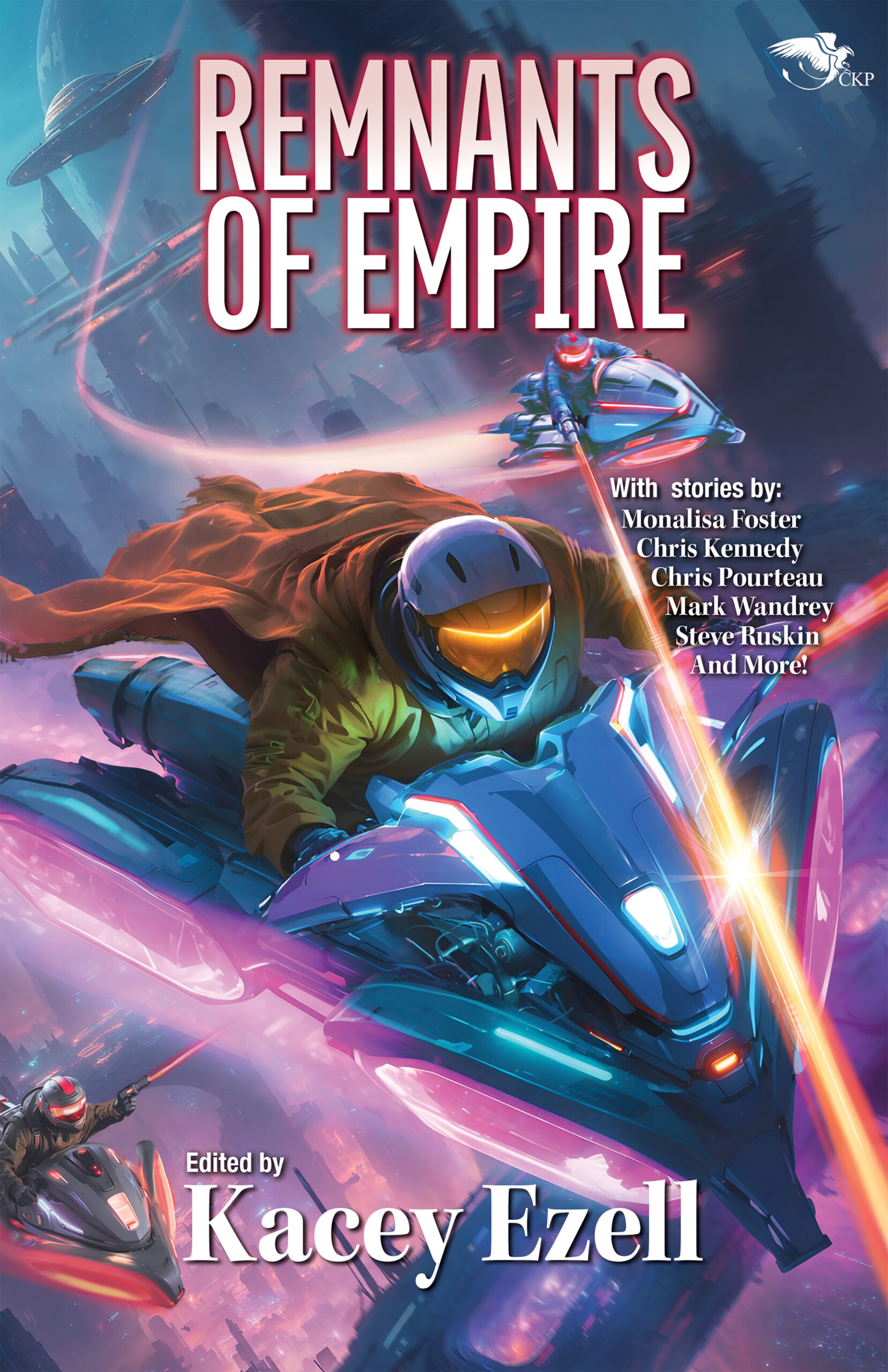
    My friend Kacey Ezell has a great new space opera series out, called the Ashes of Entecea* and I’m thrilled to be part of Remnants of Empire*, a new anthology set in that universe. Remnants of Empire launches on 7/26/24.


    Duty, danger, and unexpected romance await in this captivating tale from the Remnants of Empire anthology!

    On the planet Raneaux, two young nobles are ready to part ways. But when a series of devastating attacks rock their world, everything changes. Thrust into a maelstrom of political intrigue and violence, Aidan and Deirdre must confront their true selves.

    He’s a scholar who dreams of quiet libraries. She longs for adventure. Now, they’re fighting for survival and the future of their planet.

    As assassins lurk and conspiracies unfold, Aidan and Deirdre discover strengths they never knew they possessed. But in a world turned upside down, can an unlikely partnership become something more?

    Experience heart-pounding action, complex characters, and the birth of an unexpected love that could change everything.

    Remnants of Empire brings you a collection of interconnected stories set in a richly imagined sci-fi universe. 


    The holographic ad touting off-world adventure holidays caught my eye. I slowed my rapid pace to admire the frozen landscape that morphed into images of divers swimming with amazing deep-sea creatures. Chills skittered across my skin as I aimed my ubiq at the ad so it could scan the relevant information.

    “Add to my wishlist,” I told it.

    “Confirming add to Deidre’s wishlist,” the ubiq replied. “Reminder: you have a lunch appointment with your parents in ten minutes. At your current rate of travel, it will take you seventeen minutes to reach your destination. Do you wish to send a status update?”

    I ignored the ubiq and promptly slipped it into my pocket. With any luck, Aidan would get to the restaurant first, and my fashionably late arrival wouldn’t matter. My parents adored my betrothed—what an archaic term. In their minds he was perfect. It’s why they arranged the marriage contract.

    Don’t get me wrong. Aidan is a wonderful man. Kind, attentive, but not my type. He’s very smart and scholarly, and it didn’t take us long to figure out that we have different goals in life. He wants to make a name for himself as a professor of history. I want to travel. I want to go places and skydive and swim with alien whales and get into zero-g sports. He finds libraries as interesting as I find them boring.

    We’d be horrible for each other. I’d feel held back, and he’d feel—well, I don’t know, abandoned maybe. It’d be one thing if I wanted to go off and adventure on my own for the rest of my life and then come back to hearth and home when I felt like it, but would that be fair to him? Or to me? What if I found someone with whom I could adventure with? What if he found someone to be a homebody with? Would we be stuck in one of those awful marriage-in-name only things?

    I had to step around a holo-ad that popped out of the ground. “Stay informed with our latest updates on anti-monarchist activities—” If you make the mistake of walking through one, they will follow you—well, your ubiq—everywhere.  I didn’t have time to deal with viral ads.

    Thank all that’s good that we’re both lesser nobility—Aidan’s father is, I think, fourth in line for the throne. Being so far from power is why we can say no to a marriage contract. There are no world-ending consequences to either of us wanting to live our own lives. I doubt the ‘casts will even announce it, and if they do it’ll be buried in the day’s feed, and no one will care.

    My consolations and the rehearsed speech that I’d been working on since Aidan and I decided to part ways rolled around in my head as I made my way from the mag-rail station to Le Goût de l’Elysée. It’s the kind of place one goes to for special occasions like engagements and anniversaries, and that is no doubt why my mother chose it. 

    It was also the kind of place frequented by Raneaux’s planetary royals and judiciars and prime ministers and celebrities from all over Entecea. Frankly, I’m allergic to all those people, although I do endure them for my parents’ sake.

    As I crossed the cobblestone pathway, I wished I’d picked something other than spiky heels. There was a dress code though, so I had dressed up, partly out of guilt. I knew going into this just how disappointed our parents were going to be, and for some reason, I had thought that one of my nicer, semi-formal dresses would somehow make up for it. This one was gray, asymmetrical, with a high neck and cap sleeves, a minimalist design with sculpted details, and everything someone like me was supposed to be wearing for something important. Like I said, guilt, or maybe apology. But in dress form.

    The upside to l’Elysée was going to be that no one was going to dare make a scene—even though neither of our mothers were that type. It had been Aidan’s idea. See, I told you he was clever. And so very smart. 

    I sighed. Oh, if that were only enough. If only we had chemistry. I wanted that thrill, those butterflies, that out-of-control-in-love feeling. I wanted it all. Preferably now. And forevermore.

    Doormen in matching uniforms, complete with caps and white gloves, swung the doors open as I approached. It’s such things that make l’Elysée an experience in itself, particularly for the nostalgic.

    The foyer was done in a deconstructed chandelier, where each crystal was suspended by invisible nanofibers. To me, it had always looked like an exploded diagram of a chandelier, instead of an assembled piece. Art, I guess.

    The maître’d looked up from his tablet and shot me a smile. “Ah, Miss Pinet. How good to see you.”

    “Good morning. Are my parents here yet?”

    “Yes, Miss. They were seated about twenty minutes ago. Lady and Lord Stout have also been seated.”

    “And Professor Stout?”

    “I’m afraid not. Would you like us to ping his ubiq with a reminder or request his current location?”

    Sometimes people like the maître’d expected people like me to above carrying ubiqs. The really important people didn’t. Their staffers and aides did.

    “No, thank you. I can do it myself.”

    “Very well. This way, Miss.”

    And so he led me through the main dining room with its fleet of curved banquettes and gazebo-like hooded loveseats. It wasn’t quite noon yet, but I knew that it would soon be filled with glitterati, with the cream of Raneaux society coming together to impress each other over fancy lunches.

    The parents sat cozily on the veranda. It really was a lovely day for it with spring sunshine pouring in through slats strategically placed so that the light wouldn’t bother anyone’s eyes. Floral scents floated on the breeze, just a hint of them so as not to interfere with the more discerning palates that were bound to be l’Elysée’s best customers. It was no surprise that my mother had been making noises about having them cater the wedding. I just hoped that she hadn’t already booked them.

    Mother wore a long dress with a bolero top—lavender, of course. Lady Stout was in a similar outfit, but in mint green. It made me think they’d coordinated and that made my stomach hurt. Father and Lord Stout both wore what I called their uniforms—tunic-like business jackets that hit mid-thigh and pressed trousers, high-collared shirts, and cravats—like they might stop by the House of Lords and argue for this or that or the other. 

    The two empty chairs beckoned like a challenge. I really didn’t want to face them alone.

    Nevertheless, I braced myself.

    Here. I. Go.


    Read the rest in Remnants of Empire.


    *As an Amazon Associate I earn from qualifying purchases.

  • Relics. A SF-noir-flavored nibble

    Relics. A SF-noir-flavored nibble

    I’m very excited for the release of Relics, a short story set in the same universe as Threading the Needle.

    When I originally conceived of a story that included a replica of Charlton Heston, I didn’t know any of the following things: Charlton Heston was Chuck to his friends. He and Toshirô Mifune were also friends, despite a language barrier. Heston said that if Mifune would have spoken English he’d have been one of the greatest actors of our time. Ironically, Mifune served in the Imperial Japanese Army aviation division during WWII and Charlton Heston served as a radio operator and aerial gunner in the US Army Air Service and would have taken part in Operation Coronet, the planned invasion of Japan. That gave me chills. 

    The thought of would-be enemies developing a friendship that lasted for the rest of their lives even with an ocean between them and despite the cultural gulf that also must have been there has its own appeal. This story is my tribute not just to that idea (ideal?) but to two of my favorite actors, Charlton Heston and Toshirô Mifune themselves.


    AIs don’t go rogue. Everybody knows it. Especially SAIs. Which never really made sense to me. They’re supposed to be people just like you and me, and people—flesh and blood humans such as yours truly—are sapient and we go rogue all the time.

    But you never know.

    Digital citizens were one of the first truly sapient AIs. Who knows what happens after a couple of centuries of rattling around, especially when you’ve been designed and built as an anachronism to begin with. Maybe they can’t handle change. If there’s one thing that the last three centuries have proven it’s that some people just can’t handle the world as it is, so why wouldn’t “digital citizens” lose it and go rogue?

    To be honest, I was surprised to find out that these digital fossils were still around, although with the rise of Nostalgism, maybe I shouldn’t have been. The Commonwealth tolerated the movement because it helped move the, shall we say less-than-desirable, off-world. That much I knew.

    A leggy brunette with doe eyes, ruby-red lips, and an hourglass figure—some things remain classics even in this screwed-up century—led me into a wood-paneled office and “He’ll be right with you Mr. Elliott,” rolled off her tongue with a distinctive twentieth-century lilt.

    Given that this was a museum, her accent and the throwback design of the office shouldn’t have surprised me, although I’d figured the front—a replica of the historical Grumman Theatre—had been strictly for show and expected the back to be, well, a little bit more twenty-fourth century.

    The desk was wood, the chair leather, and what had to be a mid-twentieth century television set complete with antennae was tucked neatly into a corner. No computers, no tablets, no holographic interfaces of any kind, at least not that I could see. Two couches fronted the desk, facing each other across a low table—also wood. A couple of books, huge ones, held it down, their covers sporting images from a cinematic golden age almost five centuries gone.

    I picked up the top volume only to find that while indeed it was made of paper, the pages were blank.

    “You’ll find us in compliance with the law.”

    Setting the book back down, I turned toward the commanding voice. Like the human who’d shown me in, the SAI in the doorway wore twentieth-century attire—in his case, a suit and tie. It looked a bit odd on his tall and broad but clearly synthetic frame.

    The pixelated membrane that covered the android skeleton mimicked human skin to an uncanny degree, one that immediately gave me chills. The face too did a remarkable job of emulating skin and coloring, placed as it was over a bone structure that must have been true to the original human—strong but not overpowering jaw, slightly curved nose, steely blue eyes. I’d seen images of SAIs of course, but never met one. It was the eyes that gave them away. They weren’t orbs inside sockets and didn’t move as such.

    “I’m not a cop anymore,” I said a bit defensively, I don’t know why.

    “But you are still required to report violations, are you not?”

    A smirk found its way onto my face before I could stop it. “I don’t make it a practice to inform on my clients. Tarnished I might be, but not that much.”

    He gave me a skeptical look and extended his hand. “Call me Chuck. I insist.”

    What a throw-back custom.

    Awkwardly, I shook his hand. Room-temperature like a corpse. While it emulated skin right down to the veins and calluses on his hand, there was no accompanying texture. Images of hairs were overlaid over images of veins. The calluses were as smooth as you’d expect a pixelated surface to be. Ironic, no? He was an image on a screen, just as he must have been when his original had been alive.

    You can read the rest of the story at the Baen Books website.

  • The First Trilogy in the Ravages of Honor Series is Complete

    The First Trilogy in the Ravages of Honor Series is Complete

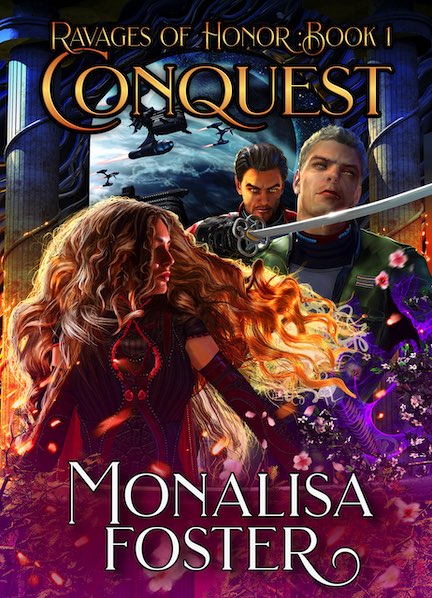
    Back in, oh about, 2017 or so, when I first started thinking that maybe I could get back into writing fiction and I was playing around with the idea of a space opera about genetically engineered samurai-types, running around with swords in a universe that used not only nanotechnology but other advanced tech, I had no idea it would take more than half-a-million words to do that.

    Of course at the time I was not thinking in terms of trilogies or even series. My naive self thought that I could get it all done in one book. In fact, Darien and Syteria getting together happened in the first quarter of the book. I did mention my naïveté, didn’t I?

    The Syteria and Darien that existed on page in 2017 were two very different people.

    I set out to write a Syteria from a world ruled by women. Not just ruled, but viciously so, to the point where most men were killed. The Rhoans were misandrist (haters of men) misopedic (haters of children), and oikophobic (fear of home/domesticity). They used their advanced technology to make sure men were not needed or tolerated.

    Given who the Rhoans were, I had to create their opposite, the Kappans1. The Rhoans and Kappans had to be separate societies, and the only thing that made sense to me at the time was for them to be so separate that they didn’t even share the same planet. But they had to be inexorably bound together, unable to get away from each other. In order to do that, I put them on a double planet2.

    At some point, the people that would become the Rhoans, kicked the people that would become the Kappans off-world. I don’t exactly know how they did this, not having written it yet. In order for this to work, I had to posit that the Rhoans had more advanced technology in order to keep the more aggressive Kappans in check. Initially, the conflict was going to be between a Rhoan female and a Kappan male. I was going to take the battle of the sexes to a whole new level.

    But in fleshing out the premise, it soon became quite apparent that getting someone who believed in the Rhoan philosophy and in reducing the population of men just to the few required to keep a species going wouldn’t work. She could not be from a society that didn’t need the muscle power of men, that raised their female offspring in creches. How would I get her to the point where she would be able to hook up with a man of any kind? It was going to take a lot more time and effort and I would end up with a book that was about nothing but a war (a literal one) of the sexes. I decided that I didn’t want to go there.

    Because I am (somehow) a romantic at heart, I instead wanted to write about what a man and a woman could to together, how they could be greater than the sum of their parts.

    That meant recasting the Kappans as Syteria’s people and creating the donai. It made far more sense to have someone who was born on Kappa and initially raised as a Kappan (with a family, with men who loved and cared for and protected her) to be taken from the society of her birth and brainwashed to be a Rhoan. It also made sense that the Rhoans would not want to do the dirty work of war themselves and would instead take the daughters of their enemies and make cannon fodder out of them. And that is how the eniseri were born.

    It was at this point that I realized that I was also going to have to make this a fish-out-of-water story, i.e. have Syteria torn not just from the world of her birth, but from the world of the Rhoans, Matriarchs, and eniseri. And that I was going to make the donai not just the opposite of the Rhoans, but Kappans on steroids, i.e. more Kappan than Kappans.

    And since I wanted to write a space opera that included adventures on different worlds rather than a commentary on social issues wearing a thin mask of “science fiction” I was going to have to do more. Much more …

    In order for Syteria to survive, she was going to have to adapt, and the donai were not going to make it easy. It’s a good thing I like the enemies-to-lovers trope.

    Since the best heroes are the flip side of the villain coin, I gave the donai something in common with Syteria–they too had been, at one point, slave-soldiers. They too had been created as cannon fodder in someone else’s war. The difference was that they overthrew their masters–who of course had to be human, because that would complicate things for Darien.

    And if we were to design soldiers, how would we do it? We would give them speed, strength, the ability to heal, ingrain obedience and an overwhelming need to protect, and ensure that if they bred, they couldn’t breed on their own. Enter the Ryhmans. Like the Rhoans, they didn’t want to do their own fighting and dying. So they used their genetic engineering to create the donai and in that creation, made them dependent on their nanites symbionts for their ability to heal. The Ryhmans tweaked their own genetic code (their DNA) just enough to make sure that the donai would require their own custom nanotech.

    One of the things I learned from working in cancer research is that we have a tremendous amount of arrogance as a species, thinking that we can control things just because we have some level of understanding. We may be able to understand how our bodies work, but we can’t create a human being from scratch. And there are always unknown unknowns lurking in the shadows, waiting to teach us a lesson about hubris.

    Since I was already playing with the idea of the donai being based on the samurai, making the backdrop one consisting of feudal noble houses made sense and I ran with it. A happy-yappy rainbow world of equality is perfect for reality, but makes for horrible fiction. The uneven power dynamics that came out of that, with humans having the tables flipped on them and becoming slaves to their own creations, provides a backdrop fertile for all kinds of conflict and tension.

    This is the setup for the Ravages of Honor series.

    As I fleshed out Conquest (Book 1) I realized that it would have to be at least a trilogy. And now that I’ve finished Lineage (Book 3) I realize that it can be much more. But this trilogy is complete in the sense that it is complete for where Darien and Syteria are now.

    This does not mean that I am done them.

    Ultimately this story was about the choices that not only define us, but either make or break us. For Darien, it was the choice to defy the emperor by saving and then refusing to surrender Syteria. For Syteria, it was the choice to become the Kappan woman that the Rhoans had almost destroyed. For both of them, it was about the sacrifices they made –that’s what makes for heroes, after all–and their commitment to do the right thing despite the ravages of honor.

    This is why I’m proud to present to you this excerpt from book three, Lineage.


    Have no enemies.

    The words inscribed around House Kabrin’s dragon sigil glowed with a vibrant green that looked so much like the old color of Syteria’s eyes that it made her shudder. It was the way the light hit the dark, green stone, painting it with false hints of blue, cyan, and turquoise. What it was doing here, on Serigala, in the palace gardens, Syteria didn’t know.

    The Kabrin sigil and motto looked like something that had once been part of a stone edifice, probably an official government building or perhaps some monument. The stone it was carved into was twice as tall as she was, and wider still, its edges ragged, like it had been torn—rather than cut—from a larger piece.

    A breeze disturbed the night, ruffling the manicured lawn, making the grass tickle her bare ankles. It tugged at the flowing nightgown clinging to her. She grabbed at the billowing robe that had slipped off her shoulder and drew it up tight.

    Despite casting her as a threat to the Imperium, the emperor hadn’t really seen her as such. It was the only reason he and the other donai had ignored her. She’d been unarmed. They’d thought her defeated. It could have so easily gone wrong. Had her hands been shaking, had she hesitated, had she missed. Had she hit anything but that thin layer of bone, had the bullet not carved an easy path from temple through several lobes of his brain …

    For an instant she saw his body atop that crimson pool of blood. For a terrible moment it had looked like the nanites would repair the bone and skin. For too many moments since, she relived that dread, waiting for him to rise again, either whole or as an empty shell. 

    Her hand strayed to her dagger, tucked safely in its thigh sheath. Palleton still denied her the use of a sidearm. Lord Dobromil didn’t want anyone even suspecting that she could use one. All to keep their secret—her secret—that she, not Darien, had been the one to take the emperor’s life.

    The emperor’s lifeless body would be forever etched in her memory. Thán Kabrin had tried to break her—mind, body, spirit, and soul. He’d almost succeeded. Her broken body had been healed. Her mind and spirit were still healing. And her soul?

    That remained to be seen. If the emperor was to remain a ghost that haunted her in moments of weakness, that invaded her sleep and sent her wandering the palace grounds in the middle of the night, then so be it.

    A ghost could not harm her child. Not now while it was still in her womb. Not once it was born.

    That’s all that mattered.

    Keeping her child safe. Keeping it out of the reach of Kabrin’s allies and vassals who might see it as their duty to avenge their liege. Even if House Dobromil could keep the identity of the emperor’s executioner secret, its enemies would still come for her and her child. They would come if for no other reason than she was both the most vulnerable and the most dangerous member of House Dobromil. 

    Vulnerable because she was human. Dangerous because she bore its heir.

    It still didn’t feel quite right, counting herself as part of a donai House, but she was slipping into that way of thinking more easily with each passing day. She had to.

    Adapt or die.

    It was the way of things. Always had been. Here, where they traveled from star system to star system and used nanotechnology. Or on Kappa, where they’d fallen back to traveling by animal-drawn carts.

    She looked up at the darkness of Serigala’s sky. Its two moons had set, leaving only the net of the planet’s defensive grid, something that looked like a shell made up of bright, sparkling diamonds connected by fine silk.

    Lights flickered along the edge of the garden path. Darien was making his way toward her. He was already dressed for the coming day: black ship-fatigues with red piping and trim; House Dobromil’s wolf’s-head sigil on his breast; black boots, polished to a high gloss. Sidearm. Dagger. Sword. 

    Not so long ago, the thread of pair-bond would have warned her of his approach, but it too was gone. The strength of their pair-bond depended on his nanites, on a steady infusion of them via physical contact, on how often he bit her, how often they mated. In the weeks since he’d marked her—since he’d been forced to mark her—he had refused to make love to her, refused her advances, and the pair-bond had faded to nothing. 

    He came to stand at her side. He towered over her, and she wasn’t a small woman, not even for a human. She was still getting used to his newly gained height, a “gift” of the Cold that had had him in its grip for so long. It had changed him. 

    He was no longer the half-breed who had compromised his honor to save her life or who’d gone cold when he’d thought her dead. He had become something more, something that she should fear, but didn’t.

    “What is it?” Syteria asked, indicating the stone. 

    “A trophy.”

    Her fingers, slightly cold from the chill in the night air, hesitantly threaded into his. They were like embers against her skin. Embers that—for once—he did not pull away. 

    “Have no enemies,” she said, reading the bold strokes of High Kanthlos.

    “It sounds so … noble,” she continued, her tone full of irony. “Honorable even.” 

    “Does it? Why do you say that?”

    “It’s so … Rhoan. Like something the Matriarchs would use. It implies a lack of conflict, of strife. Like someone who only has friends, who will go to any length to avoid making enemies.”

    They turned to each other and he slowly brought her hand to his lips. He’d cut his hair when he’d broken with his House so he could challenge the emperor and rescue her. It still hadn’t quite grown back to the shoulder length required of someone of his station. Its thick, dark strands framed him in an unruly way, like a torn and battered halo that had settled reluctantly on his head. Two heartbeats later he laid a kiss atop her hand.

    His irises had returned to the usual donai-amber, a color she—as a marked woman—now shared. But unlike her very human pupils, his were gold. The brushed silver full of snaking black lines—something that no other donai, not even ones who’d gone cold, had ever exhibited—were gone from the whites of his eyes.

    For a moment there, as he’d marked her, as he’d sunk his cuspids into her jugular and put his nanites directly into her blood, she’d caught a glimpse of his shadow, that thing that lingered inside him. That darkness who wore a skin like ink and looked back at her with eyes like blood. She’d reached out to touch it, certain that it wasn’t—couldn’t—be real. She’d thought it an illusion, her pain-addled mind giving form to something it didn’t understand. 

    Crystals had formed as she’d touched it, making it look like black ice about to shatter. It had been as real as anything she’d ever seen or touched. Was it still there within him, hiding? 

    Even now, thinking of it, remembering it, chilled her blood. 

    She shivered. 

    Darien let her go and turned back to the stone. “House Kabrin chose this motto to let everyone know that their enemies would be destroyed. It is a warning to those who would stand against them.”

    She reached for the carving. A forcefield flared, betraying its presence with a resistant hum. She caressed it, letting the feel of it pulse and throb beneath her skin until its heat was too much to bear.

    “Palleton ordered it shielded before he left,” Darien said. “He’s not convinced it hasn’t been weaponized in some way.”

    “Who sent it?”

    “House Yedon. They are a minor House, a vassal of Kabrin’s.”

    “An enemy?” she asked.

    “Unfortunately, we’re not yet certain. Some of Kabrin’s vassals have stepped forward, eager to pledge themselves to us. Others have been silent.”

    “And you suspect those who’d so easily switch alliances as much as those who have not.”

    “Yes. It is not as simple as my father and I would like it to be. House Dobromil was a reluctant vassal for generations. We were one of the few who stood against Thán Kabrin, the ‘loyal opposition’ some called us.”

    She shook her head. “I didn’t intend to complicate things. I’m sor—”

    He grabbed her shoulders.

    She flinched, regretted it when he let her go just as quickly, and looked down at his hands as if they had moved on their own.

    “Never apologize,” he said. “Not for that. Not ever. You had every right to take his life.”

    The layered irises of his eyes contracted and expanded, his enhanced donai vision assessing if he’d hurt her. She didn’t need the pair-bond to tell her that it was the same fear that was responsible for the distance he’d put between them, for why they’d shared none of the intimacies she craved. She could see it in his eyes, in the way he hesitated, the way he always stopped himself.

    Anger rose up inside her. She wanted to rage at him, to beat her fists against his chest, to demand her due, but she couldn’t. Not again. She could not face the determined donai calm that would let her spend herself against him, let her pour her rage out, and then refuse to waver or yield in the face of her frustration. 

    “I’m not apologizing for killing him,” she said instead, and it came out without a tremor. “I’m not sorry he is dead. I sleep better at night knowing he is dead.”

    Her nightmares were of a different sort. Her nightmares were ones where the emperor lived, where he continued to rape and torture her, where he went on to hurt those she loved. Where he used her child against her. 

    Darien searched her face and for a moment he looked like he might say something. He was keeping something from her, she was sure of it. Had been sure of it for weeks now.

    She’d tried to coax it out of him before, screamed demands at him until her throat was raw, but it had only made him more determined in his silence. 

    They were both wounded. Her by the emperor. Him by the Cold. By what he saw as failure. She could not get him past his guilt for failing to protect her; for the loss of their first child; for what Kabrin had done to her.

    Instead of sharing his pain, he would withdraw. He would leave Serigala to pursue enemies he could kill. He would have his men bloody him to the point where even his father, who’d had no issue with Darien proving just how donai he’d really become, had put a limit on it.

    Darien’s hand strayed over the long cascade of chestnut curls falling around her shoulders. Usually she wore it up, twisted and pinned out of the way, but she hadn’t bothered after she’d given up on sleep. Gently, he lowered his face into it, tugging at its scent.

    Yes.

    Her chest heaved, anticipation mixed with fear. 

    Darien pulled away, traced the arch of her brow. This time she did not flinch. Daring more, she leaned into his touch.  

    He went to one knee in front of her, rested his ear against her belly.

    She placed her hand atop his head. At least they still had this. At least this time, their child had survived.

     “Our son will be a uniting force,” she said. “He will save both humans and donai.”

    This she believed with heart and soul. She needed it to be true, to make it all worthwhile. Darien’s father might see her unborn as a warchild—as an heir with all of the donai’s enhancements intact, a rarity on which donai survival depended—but she didn’t see it that way. She saw her unborn child as a savior, as that uniting force.

    The barest thread of Serigalan dawn trickled along the seam of the horizon, adding a splash of newborn gold to the palace’s soaring walls, gilding the trees and grasses of the garden, making the flecks of green flare in the stone in front of them. 

    Darien stood. “I need to go.”  

    “No,” she whispered, despite the need flaring in her chest. “Stay.”

    “I … can’t.” It came out edged with just enough humanity to make her believe that denying her was painful for him too. And then it faded, that guilt, that vulnerability, that ache, and he became so very … donai

    “I will return,” he said.

    She curled her hands into fists. Nothing she had done or said for the last few weeks had mattered. Not tears, not begging, not bearing her soul. Nothing.

    Tears pushed at her eyes.

    “What are you going to do with this trophy?” she asked, turning the conversation to something that would not devolve into a public expression of her rage. She didn’t think she could bear the shame of such a display.

    “It will probably be the first of many ‘gifts’ we will receive. It is customary to display them for all to see.”

    Her gaze remained on the stone, the sigil. She did not want to look at him. She couldn’t bear it.

    “My lady, is there something else you’d like to see done to it? With it?”

    “No.” 

    It was a lie. One that his donai enhancements could no doubt recognize, but he let it stand and retreated into the sunrise. 


    1. The terms “Rhoans” and “Kappans” as well as “Rho-Kappa” are derived from the concept of r/K evolutionary biology ↩︎
    2. As it turns out, the Earth-Moon system is more of a double-planet than not, due to the large size of the Moon relative to the Earth, i.e. it’s about a quarter the size of the planet. If you look at all the other satellites in the Solar System, the satellites are much smaller. The Moon is tidally locked, but Kappa is not. Likewise, Kappa is not a barren world, hence the speculative element for our purposes. ↩︎
  • Collective Responsibility

    Yesterday I wrote up quick piece for another flash fiction contest and I was going to post about it and share the last piece of flash I wrote. That’s when I realized that my last piece of flash, Collective Responsibility, wasn’t on my website. I guess it got lost when I ported the domain, so I decided to reshare it here.

    I don’t write much flash because I prefer depth and it’s hard to get depth in flash. One thousand words is just me warming up, plunging the reader into the depths of character and milieu. Most of the scenes I write are more than a thousand words, but when flash does work, it looks like this. Like a lot of my work, it was inspired by actual events. Get a hanky ready.

    Collective Responsibility won the Writer’s Guild of Texas Flash Fiction Contest in 2015 (OMG, I’m coming up on a decade as a writer). It is presented in its entirety below.

    https://unsplash.com/@zibik Photo by zibik on Unsplash

    This was the place. Police cars. Crowd held back by yellow tape and a few uniforms who looked like they didn’t want to be here — yeah, guys, me too. Reporters trying to push their way past the tape, earning scathing rebukes. Such language! I was envious. As a professional specializing in children, I’m not allowed to use such words. That doesn’t mean I don’t want to. Right now, I really want to.

    In the two minutes it takes me to verify that I’m in the right place, the crowd has doubled and the media vans have managed to block off the fire lane. For the vultures, all that’s missing is a red carpet — the buffet has been set and they are ravenous. Those poor badges. Thankless job. 

    Time to go inside, do my duty. It’s an upscale place, brand new by the look of it, but my gown and tiara are still completely out of place. Stupid wardrobe department! A fireman’s costume would have at least fit in, or maybe a superhero costume — a cape and a cowl are more my style.

    I joined the gathering inside. Beautiful decor, an elegant setting ready to be enjoyed. I drifted past the crystal chandelier, the baby grand piano. Snags and snippets of conversation, some shouted, some whispered, some choked out between varying jags of emotion, trail behind me.

    “I’m telling you, that’s not how it happened! Look…” A responsible, pillar-of-the-community type of gentleman.

    “We were playing just a few minutes ago…” Nice teenager, the kind you know is going on twenty-one in spite of just having turned thirteen.

    “She was just here! I saw her!” 

    “I thought you were…” 

    “…Right there. In the front. That was the last place I …” 

    “But it was your turn…”

    “…No, no, it couldn’t happen. We were all watching.”

    Commotion in the backyard caught my attention. I slipped through the glass door, somehow managing not to snag the dress. Tulle! Who wears tulle anymore? Really! As if the stupid tiara wasn’t bad enough.

    Rain was the norm here, even this late in the year and everything was still wet from the last storm. At least my shoes wouldn’t be ruined — glass slippers, it turns out. I found Sarah sitting alone, past the boundary of just-laid sod, sitting, humming to herself. She was the reason I was here, dressed like a fairy princess. We made quite a pair. A leotard christened with cookie dough and icing, a tulle skirt that had seen better days, a pillowcase drafted into service as a cape, hair in adorable little pig-tails drowning in mismatched gossamer ribbons, red patent leather booties of the most fashionable kind worn on the wrong foot of course — a formal ensemble that only a three-year-old could get away with.

    I joined her, sitting cross-legged on the freshly turned ground. Mud squelched out from under me with an audible squirt. It occurred to me that this was excellent use for tulle. Sarah was humming the alphabet song, and I was tempted to join in, it — along with a number of songs made famous by a variety of princesses and cartoon dogs — being part of my repertoire.  

    “You cold?” I asked.

    She shook her head, still humming, legs kicking back and forth, dangling over the edge. It wasn’t very deep. I guessed the neighbors were splurging on a basement — an expensive indulgence in this part of the country. 

    That odd sound, more felt than heard: a generator kicking in. It was time. Floodlights came on, illuminating the yard, casting unnatural shadows. 

    “Time to go sweetheart.” I held out my arms.

    “Can I say goodbye to Mommy?”

    “Of course you can.” 

    We stood and her fingers wrapped around mine. 

    “Who’s been taking care of you, Sarah?”

    She shrugged. “Everyone.” 

    I lifted Sarah into my arms, carried her back inside, parting the crowd that had gathered by sheer force of will.  

    Mommy was seated on the couch inside, staring with unseeing eyes, numb, surrounded by loved ones, utterly and completely alone, her hands clutching a stuffed animal because her daughter’s body was lying cold and lifeless at the bottom of a water-filled trench.

    “We were all watching her. It wasn’t your fault.” The words fell on deaf ears. I don’t know who spoke them. I didn’t care because it didn’t matter. The only piece of comfort that would ever matter to this woman was in my arms and once my work here was done, Sarah would no longer be part of this imperfect world, where everyone and no one mean the same thing.

    Sarah leaned forward, kissed her mother’s head. “I love you, Mommy.” 

  • Excerpt from Resilience, coming June 7, 2022 in Robosoldiers

    Excerpt from Resilience, coming June 7, 2022 in Robosoldiers

    When Stephen Lawson* asked me to be part of his new Baen* anthology, Robosoldiers* an anthology about augmented soldiers and military robotics I wasn’t sure what I was going to end up writing. Unlike all the militarily credentialed co-authors in this anthology (some of these guys are real heavy hitters) I am the fork-and-knife school variant, if even that. I don’t have any military service or credentials. Country of origin did matter in the mid-1980s when I was still a cadet and aspiring to be more. The more was out of reach for many reasons, including the peace dividend that came out of the fall of the Berlin wall, a good thing.

    My experiences have been on the other side of conflict–the civilians, the refugees, the collateral damage. I was born and grew up behind the Iron Curtain. I didn’t realize just how meaningless those two words had become until recently when a clerk asked me where “the incident” took place and I said “behind the Iron Curtain.” Without batting an eyelash she asked me the date and address so that she could request the medical records. I guess she was thinking it was a night club or something and maybe an ambulance or hospital was involved because she certainly gave no indication that she actually understood what she was asking for. When I related her request to close friends they suggested I give her the address of Ceaucescu’s grave or perhaps that of the Sighetul Marmatiei Memorial Museum for Communism Victims. I maintain that it would still be lost on her (and her ilk).

    Stephen did jokingly tell me what he didn’t want (I am first and foremost a romance writer, whether that means romance or Romance) which is always helpful. So for those of you who read me primarily for my romances, know that Resilience* is not a Romance or a love story, although I could not resist working in a slight romantic angle at the end.

    Readers and fans of mil-sf, like readers and fans of all other genres, are always clamoring for something new. For something different. So I gave it to them. In case I haven’t said it, Stephen, thanks for affording me this opportunity because you knew going into it that it was going to be different and let me play anyway.


    What doesn’t kill you makes you stronger. Or so they say. 

    They are full of shit.

    But then again, philosophy has never been my strong suit.

    Shrug.

    My scars are the first thing people notice about me. Even as they avoid noticing, looking anywhere but my face, the scars define me in their eyes. 

    Not my rank—Sergeant.

    Not my name—Engel, Karlie.

    Not my uniform—Air Force.

    It took me awhile to get used to the locked gazes, the way people’s eyes would unwaveringly lock onto mine because eyes are supposed to be safe.

    “It’s not your fault.”

    I know it’s not. 

    One of the more annoying things about my PTSD implant (or my anti-PTSD implant as the doctors would like me to think of it) was the way it—oops, I’m supposed to think of the intelligent agent as “she”—talked to me. It wasn’t its fault. It was the way “she” was programmed. She goes by Nicki. It’s supposed to be a “she” because female rape survivors are paired up with female counselors. Something about trust.

    Like so many sailors, soldiers, marines, and airmen—I was never really alone in this—I was a casualty of war. Wrong place. Wrong time. 

    As far as billets went, a military air traffic controller in Germany was about as safe an assignment as possible. I wasn’t going into a war zone or into combat. 

    Unfortunately no one told the bad guys. And they wouldn’t have cared. I was alone and unarmed. I hadn’t even been in uniform. Just another tourist as far as they were concerned. That is, until they found my ID.

    “Ground yourself in the present,” Nicki said. Her voice was always calm, hypnotic, meant to be soothing, and supposedly tailored just for me.

    I took a deep breath, held it, and then let it out slowly to a count of four, my belly rising, my hand against my chest. It was supposed to be calming, part of a set of coping mechanism that I’d been taught. I did it to shut Nicki down. It—she—always booted up when my hypothalamic–pituitary–adrenal axis kicked into overdrive. I hated that I knew that term. I shouldn’t have to know what an HPA-axis was.

    About two years ago, I was recruited for a clinical trial to help test brain implant technology. Never my favorite thing, the MRI was even less so after my month of captivity. The jack-hammer sounds of the magnet were too reminiscent of gunfire, the having to lay still too reminiscent of being bound to a bed, the voices drifting in over the speakers too much like their disembodied voices as I escaped into my head while I lay helpless underneath them. 

    And having to relive it all so the MRI could map my brain was no picnic either. 

    “This is a flashback. It’s not real,” Nicki reassured me.

    It had been with me for about a year. Nicki controlled the circuitry—fine wires much smaller than a human hair—running through my brain and I had benefited from some of the physical stuff the implant does. Thanks to the mapping done by the MRIs, the implant knows which parts of my brain become active during a flashback. It keeps track not just of my pulse and temperature and respiration, but a bunch of other stuff. I stopped trying to figure it out. All I needed to know was that high levels of certain chemicals were bad and low were good and that the implant stimulates parts of the brain to counteract them. And then Nicki activates.

    It—she—is a little bit like the imaginary friend a kid might have: completely real to me, right down to the way she “smells.” There’s a light blue halo all around her, something the designers put in, so that I wouldn’t think she was an actual person I was seeing. Thank God for small favors.

    It has appeared to me as different people. I’ll be watching TV and find a character I connect with and poof, Nicki takes on her form, her mannerism, her facial expressions. She sounds like the character too, which bothers me far more than the other things. I think it was the blindfold. They kept it on almost the entire time. 

    So, I’ve stopped watching television shows or movies. I’d always been more of a reader anyway, but after a few months, she started manifesting as the female characters in my imagination, so she robbed me of that too.

    “Where are you, Karlie?” Nicki asked.

    The kitchen. I’m in the kitchen.

    “What are you doing?”

    Boiling water.

    Except that there was no longer water in the pot. It was gone and the pot was giving off a metallic smell reminiscent of the way guns smell as they heat up. All that was missing was the sulfur and that too kicked in, a phantom scent courtesy of my memory. 

    With a trembling hand, I shut off the burner and leaned against the kitchen counter so I wouldn’t curl up on the ground. Once again, I’d become lost in the white-noise of boiling water. The last thing I remembered was standing over the stove, watching the first bubbles form along the pot’s bottom.

    I’d wanted pasta with butter and garlic.

    But not anymore.


    *As an Amazon Associate I earn from qualifying purchases.

  • Excerpt from Caliborne’s Curse

    The mechanics of creativity is very interesting. We–meaning a bunch of us writers–were judiciously avoiding the actual act of writing on a chat and the subject of urban fantasy tropes and heroines came up. I then casually mentioned that I not only own a sword but have been known to use it. This would not come as a surprise to my social media friends, but it may come as a surprise to some of my readers and it was a surprise to the writers in the chat.

    Caliborne’s Curse was written on a whim in 2017 because of this chat but stayed in my pile of unpublished works because genre-wise it doesn’t quite fit in anywhere. It’s kind of tongue-in-cheek as it pokes at the tropes of the Mary-Sue urban fantasy heroine: she of the magical combat-only coordination; she of the plain-but-gorgeous visage; she of “the one” with the man-harem.

    But when Jim Curtis approached me about this anthology and said I could submit anything, regardless of genre, I realized that Caliborne’s Curse had found a home.


    No way this ends well.

    Mallory Caliborne winced as she lowered the sword and reluctantly looked up. Dried paint and plaster drifted down like fine snow. Except it wasn’t snowing. And the six-inch slash in the ceiling was no cloud, silver-lined or otherwise. 

    The powder settled like dandruff atop the black CitroLu spandex of her tee-top. The Italian woman on the television kept going, slashing the fourth of an eight-cut sequence, all set to music, in some high-end studio filled with mirrors and overly coordinated fitness-types. And very high ceilings. 

    Mallory muted the sound and set the old katana on the second-hand couch she’d pushed to the wall to clear enough space to “Forza her way to fitness” as the DVD cover promised. She’d done a decent job of rearranging everything. No sense in slicing through the television. But she hadn’t thought about the ceiling.  

    The previous four lessons had all used angled cuts like two-to-eight or ten-to-four but today, her caffeine-fueled straight up and down cuts had been … enthusiastic. 

    Sure. The landlord will buy that. 

    She saw her deposit shrink to zero. After the flood, the fire, and the frogs, she thought she’d used up a lifetime’s supply of bad luck. What was next? Fiery hail? Locusts? Darkness? Come to think of it, there had been that three-day power outage starting on the day she’d moved in. Cross darkness off the list. Only two to go. She sighed.

    The house had been a bit of a wreck to begin with, but she’d been desperate and a six-month lease was hard to come by. Great location. Good price. Vacant. Furnished. The previous tenant had been a packrat—an eccentric packrat. Borderline hoarder, probably. But, no dead bodies had been unearthed after she’d taken possession. That would’ve been too much. Even for New Orleans.

    She could put up with almost anything for six months. 

    All the clutter had given her the impression that some old person had once lived here, some collector or academic. She hadn’t even begun to deal with the walls and walls of books, other than to note that not a single one was written in anything even resembling the Roman alphabet.

    The sword had seemed like one of those cheap props you see at uber-geek conventions. Until she’d found the DVDs. Some were serious training videos, all in Japanese, featuring men who never smiled, realistically hacking at each other with curved wooden swords. No samurai movies though. Not a one. The workout video was the only one in English. So very strange. 

    She turned the television off and put some water to boil in a kettle.

    Maybe the previous tenant had been an urban fantasy fan-girl with a cargo-cult belief system. The kind of woman who fancied herself a warrior by virtue of having a katana laying around for no reason. Said belief system hoped that the virtue of having something like said sword would result in the delivery of a desired cargo. In the urban fantasy context that would no doubt consist of a man-harem. 

    She smiled. Oh, that wouldn’t be bad. Not bad at all. Mmm. Better than fiery hail and locusts any day. And with all the clutter around here the honey-do list could be long enough to justify a whole harem. Maybe the previous tenant hadn’t been so crazy after all.  

    The kettle whistled and she set about making jasmine tea. Of all the kanji-bedazzled tins in the cupboard, she’d been brave enough to try only the one with a prominent jasmine flower on the lid. No sweetner. She added sugar to the top of her shopping list. Just for grins and giggles she added condoms.

    Hand wrapped around the tiny cup, she returned to the living room to pack up the sword and rearrange her furniture before heading to the hardware store for a ladder. 

    She moved the cushions around, looking for the cond—she shook her head and her grin widened—the pretty silk sheath that she’d found the sword in.

    Ouch.

    The cup wobbled, spilling tea.

    Great. Now she had a cut and a burn.

    Several drops of tea swirled on the end of the bloody sword-tip. Frowning, she bent to get a closer look at the play of light as she sucked her finger.

    “Please,” a deep voice rumbled from behind. Mallory pivoted and scrambled backward, knocking stuff over as she went, the bloody finger preventing a scream. 

    “Allow Ambrose to do that for you,” the heavily accented voice added.

    Bloody hell. Some vampire-movie reject from the theme-bar down the street had walked right in. She inched away, eyeing the distance to the couch where the sword lay. Too far. She threw the cup at his drop-undead-gorgeous head, and ran for it. On cue, she pulled a Mallory special, tripping over her own two feet like she was some young-adult novel heroine—except that she was clumsy all the time, not magically coordinated for all combat scenes. Of the many leaning towers of books gave way. She ducked underneath her crossed arms as the books pummeled her, one after the other. 

    Thunk, thunk, thunk.

    (more…)
  • Excerpt from “Terms of Surrender”

    Brennan turned, blue eyes full of mischief, a twist of a smile on his face. It was the trim beard that had thrown her. But she’d recognized those sky-blue eyes that promised storms and lightning. 

    The noise of the terminal faded to nothing. The crowd did too, becoming shadows without substance, a tide that parted for her as if by magic.

    Her feet carried her towards him as if they had a will of their own.

    His hands were in her hair, strong fingers pulling her up towards his mouth, their hearts resonating through the fabric of their clothes. His scent—oh, she’d missed that clean, man-smell so much—floated around her.

    Their lips and tongues met—collided, dueled, renewed their acquaintance—and then retreated. He trailed a kiss down to her neck, tucking his head into the bend above her shoulder.

    “I’ve missed you so,” he whispered, the sound of it rumbling against the hand she had on his chest.

    Wrapped in the safety of his arms, her doubts and fears melted away like tears in the rain. It was what he did. Made her feel safe and loved and valued in a way no one and nothing else could. It was a different kind of “safe” from the one that she could create for herself.

    Yes, power was an aphrodisiac, alright. The nature of power, however, remained tenuous, undefined … raw.

    Read the rest in Men in Uniform.

  • Excerpt from “Dark Side of the Sun”

    Excerpt from “Dark Side of the Sun”

    Out today in the urban fantasy anthology Flights of Fantasy, I’m proud to present the opening to my short story, “Dark Side of the Sun.”


    June 20th, 2025

    Eliana pulled her sedan up to the curb, right under the biggest oak she’d ever seen. Its canopy cast welcome shade from the scorching mid-day sun. Ahead, an ambulance was pulled under a mansion’s porte cochère. Four black-and-whites were also present, their lights twirling madly: one behind the ambulance, the others scattered along the curb.

    A young cop was putting up barricades, while another was stringing crime scene tape between them. Another pair was gently encouraging five curious neighbors to back away. By the look of it, the gawkers were nannies and housewives, each with an obligatory kid or two in tow.

    Eliana pulled her too-big jacket on. Simple, lightweight, and cut to hide the full-size Sig Sauer 1911 behind her right hip, it was still another layer of clothing she’d rather not have on in suburban Phoenix’s triple-digit heat. She pulled her purse to her shoulder and stepped out. The car door slid shut and she made her way across the just-watered grass. It left drops on her flats, but even those were sucked dry by the greedy heat of day.

    She showed her credentials to the middle-aged cop who barred her way. It wasn’t exactly a badge, but the Order of Soteria was well-known and respected. His gaze flickered back and forth as he compared her photograph to the one on the card. When the picture had been taken, her pale, blonde hair had been short and curly. Now that she’d let it grow out, it was straighter, and she wore it in a tight bun at the back of her neck. Body guard work didn’t exactly pair well with flowing anything. 

    Besides, there was an appearance code. It could be summed up as “understated.” Armed nannies didn’t need to stand out. And they didn’t need to give wives any reason to worry that their husbands might find them interesting either. That’s why the Order went out of its way to emphasize the Bible’s version of Soteria as salvation from penalty, power, presence, and most importantly, the pleasures of sin.

    Hence the flats. The lack of makeup. The conservative suit cut not just to hide weapons, but de-emphasize a woman’s shape. And a vow of chastity. The idea of mortal sin had regained its power when the supernatural had become less “super” and more “natural.”

     There’d been a reason why the myths and legends of old had seen a rebirth during the last part of the twentieth century. The world was being prepared for the mainstreaming of vampires and shifters and witches. With the death of privacy, with the ubiquitous monitoring of everything, it had been inevitable. Science had tried to explain it all using reason and logic, but the world had been so ready to embrace the supernatural that it hadn’t mattered why things were. For most, accepting reality was easier than qualifying and quantifying it. 

    Some had feared the world would fall back into a dark age of superstition, but it hadn’t happened. Science and technology still had their uses. In truth the supernatural had always co-existed quite nicely alongside science and reason in most men’s minds.

    The cop used the mic at his shoulder to verify that she was expected and handed back her card.

    “Go on in, Sister, they’re expecting you.”

    “Thank you, Officer.”

    She crossed the cobblestoned driveway. The mansion was not the biggest in the gated neighborhood, but it was in a cul-de-sac, which were usually prime lots. The owner had obviously chosen it for privacy. It didn’t back to any other homes and it had been placed as far away from the neighboring properties as possible. Every single window had roll-down shutters masterfully made to look like anything but. And there were cameras everywhere, some better hidden than others. The cameras were not that unusual. The shutters were.

    The entryway’s double doors swung open and an EMT backed out, dragging a gurney with a body-bag strapped to it.

    His partner, a woman, was pushing from the other end. By the look on her face this might well have been her first day on the job. She looked more than a little green.

    “A moment please,” Eliana said and showed her ID again. The EMT pulled at the body-bag’s zipper. It parted to reveal a woman’s face. Her eyes were closed, her face pale, her lips blue. She looked about forty, with gray in her short, wispy hair. Forty was about fifteen years too old for this to be Sister Isadora Conley.  

    There was one way to be sure. 

    “Would you mind turning her head so I can look behind her right ear?” Eliana asked. No point in getting gloved up when the EMTs already were. 

    The rookie EMT complied, gently nudging the corpse’s head and folding her ear. A laurel wreath crown was inked into the skin. Eliana fished her UV flashlight from her purse and aimed it at the tattoo. There was enough shade under the porte cochère that a barcode was revealed within the circle of the wreath.

    Definitely Sister Conley. Eliana sighed as she put the flashlight away.

    The fact that Sister Conley looked forty meant that she hadn’t just died because she’d been shot. She’d died because someone had drained her anima. According to her file, she was magic sensitive, but not a magic-user. Not all of the Sisters were witches. But even the sensitives became users in the face of a powerful enough threat. Which meant Sister Conley had been in a desperate fight for her life even before the bullet found her.

    Eliana nodded at the EMT, who pulled the zipper shut. They loaded the gurney into the back of the ambulance, grunting as they lifted it.

    One of the cops was holding the mansion’s front left door open, and Eliana stepped into a foyer. Staircases curved upward on the left and the right and a chandelier hung from a heavy chain above. 

    Underneath it, three men and a woman with “forensics” stamped on their jackets were busy taking photographs, measurements, and bagging things handled with tweezers. Blood pooled on the floor and numerical tent markers littered the marble tiles.

    Two sets of couches that could each seat six filled the large room beyond the foyer. Its tall, wide windows were sealed against the sunlight by the rolling shutters. If it hadn’t been for the portable lights that the forensics people had set up, the house would be pitch black.

    Sweat trickled down Eliana’s back. No air conditioning.

    “Power’s out,” a voice from behind her said.

    Despite the heat, her skin pebbled. Her heart skipped a beat and then sped up. Thorne’s voice descended—as it always had—right past her brain, to her stomach, sending it, and lower things, aflutter.

    Even now, even here, with the stench of death still lingering in the air. Even after all these years. Would it ever lose its power? Would she ever be able to purge him out of her system?

    She swore under breath. He was the last person she wanted to see or deal with in the whole world. 

    Eliana turned.

    “The bloodsuckers’ bloodsucker,” she said. “I should’ve known.”

    Read the rest, here, and before you leave, don’t forget to sign up for my newsletter and get a free story for signing up.

  • Excerpt #1– RoH2: Ascension

    Darien bent to kiss her, capturing her lower lip with an audible groan as he pulled her to him with an insistent hand to her lower back. 

    He could feel the collective gazes of their audience settle and linger over them like a heavy cloak one might wrap around a child to spare it the terror of the coming death-stroke. It was the gusting scents—jealousy, betrayal, hatred—that lent potency to that dark image, signaling imminent threat he could not preempt. He must allow it to play out, no matter his desire to protect Syteria.

    Unaware, his beloved returned his kiss, one hand splayed across his cheek, as if she was afraid he was going to make it brief. 

    A younger, more impetuous version of him would’ve made an even greater display of his affection, so that no one watching would have any doubts about her status, about what she meant to him, about whose she was. 

    Bomani’s words about painting a target on Syteria’s back echoed as he reconsidered his newfound prudence. When he let go of Syteria’s lip she tilted her head in question. 

    He smiled and offered her his arm. 

  • Bonds of Duty and Love

    I’m very excited to share this snippet from my upcoming Ravages of Honor short story which will be released on April 7th (you can pre-order here) as part of Fantastic Hope, an anthology by Laurell K. Hamilton. I am thrilled to be part of this anthology because it brings you thirteen positive, uplifting stories (and don’t we all need those?).


    Calyce Dobromil leaned forward, her hands planted solidly on her workstation lest her knees give out. The gleaming pearl-white walls of the gestation lab seemed to spin around her like a veil, or more fittingly, a shroud. It spun and spun, tightening, as she gasped for air. Her mind grabbed at the possibility that she might be asleep and would wake at any moment. But, the universe showed her no such mercy. It was perfectly clear in its ruthlessness, in the fact that she was indeed awake.

    A message floated above her workstation like a cloud, all bright and golden and deceptive. It should have been a thunderhead, dark and malevolent.

    Destruction and termination orders shouldn’t be so antiseptic, so mundane, so much like every other communique that came down once a day from the Ryhman Council. She closed her eyes and took three deep breaths. When she opened them, the order was still there: destroy everything related to creating the donai.  And floating underneath it, a scrolling list of the designations of each child under her care.

    The oldest such child was twelve, a genetically engineered soldier whose nanites had just started turning him into his final donai form. Designated NT527, he was from one of their slow-growing—but most successful— batches and only two days shy of being sent off for formal military training.

    The youngest were fertilized ova. Two-hundred-and-forty of them—among them, twenty females. And then there were the five gestation tanks in her lab, the youngest still a blastocyst, the oldest, just a few days past twelve-months gestation.

    Calyce had given the last fifty years of her life to creating and raising the donai. And now the Council expected her to “terminate” them as if they were condemned prisoners. Even lab animals were “sacrificed.” 

    She pushed away from the workstation and dragged her hand across each gestation tank, blinking back against the pressure building up between her eyes. There had been a few unfortunate donai that hadn’t developed properly. She’d mourned every one of them but taken solace in the ones that had survived and thrived, the ones she’d nurtured. And then she’d proudly sent them off to defend humankind, her duty done, her desire to nurture serving a higher purpose. 

    The twelve-month-old floated in the amniotic fluid, sucking on his thumb. Dark, curly hair covered his scalp, framing the nubs at the tops of his ears, the vestigial points that would become more prominent as he reached adulthood. 

    The tank had reported a case of the hiccups that had lasted twelve minutes, and a surge in heart-rate from a dream that had lasted twenty. No anomalies. His nanites were keeping pace with his growth. Six more months and she’d decant a healthy boy and they would bond as if they were mother and child. Bonding the donai to humans was essential. It made them want to defend their creators. It was as necessary as air, water, and food. It made donai loyal. It kept them sane. 

    Calyce blinked back tears as she returned to her workstation, waved the termination order out of existence, and stuck her hands in her lab coat’s pockets.

    Every morning, whether on duty or not, she was always the first in the lab, checking on her children. But soon the others would trickle in, and once they did, her moment of opportunity would be lost. She’d been here the longest and had seniority, but she didn’t dare count on the others. If she was wrong about any one of them, that one could stop her.

    She tucked a fallen strand of gray hair behind her ear, took a deep breath, and passed her hand over the console controlling the tanks. The biometric scanner underneath her hand confirmed her identity. She programmed the workstation to flood the pods with a lethal dose of sedative in order to buy time. And walked away.

    In the adjoining lab she opened up the safe with the fertilized ova, setting the tubes marked “female” into a specimen container. Twenty tubes marked “male” went into a second container. Small enough for her to carry easily, the containers would keep the ova from deteriorating for years if necessary. All she had to do was get them away from this place, far beyond the reaches of the Council.


    Pre-Order Now