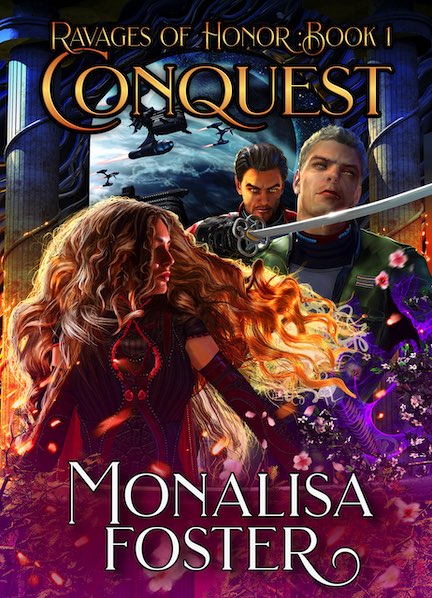
Author: Monalisa Foster

  • The First Trilogy in the Ravages of Honor Series is Complete

    The First Trilogy in the Ravages of Honor Series is Complete

    Back in, oh about, 2017 or so, when I first started thinking that maybe I could get back into writing fiction and I was playing around with the idea of a space opera about genetically engineered samurai-types, running around with swords in a universe that used not only nanotechnology but other advanced tech, I had no idea it would take more than half-a-million words to do that.

    Of course at the time I was not thinking in terms of trilogies or even series. My naive self thought that I could get it all done in one book. In fact, Darien and Syteria getting together happened in the first quarter of the book. I did mention my naïveté, didn’t I?

    The Syteria and Darien that existed on page in 2017 were two very different people.

    I set out to write a Syteria from a world ruled by women. Not just ruled, but viciously so, to the point where most men were killed. The Rhoans were misandrist (haters of men) misopedic (haters of children), and oikophobic (fear of home/domesticity). They used their advanced technology to make sure men were not needed or tolerated.

    Given who the Rhoans were, I had to create their opposite, the Kappans1. The Rhoans and Kappans had to be separate societies, and the only thing that made sense to me at the time was for them to be so separate that they didn’t even share the same planet. But they had to be inexorably bound together, unable to get away from each other. In order to do that, I put them on a double planet2.

    At some point, the people that would become the Rhoans, kicked the people that would become the Kappans off-world. I don’t exactly know how they did this, not having written it yet. In order for this to work, I had to posit that the Rhoans had more advanced technology in order to keep the more aggressive Kappans in check. Initially, the conflict was going to be between a Rhoan female and a Kappan male. I was going to take the battle of the sexes to a whole new level.

    But in fleshing out the premise, it soon became quite apparent that getting someone who believed in the Rhoan philosophy and in reducing the population of men just to the few required to keep a species going wouldn’t work. She could not be from a society that didn’t need the muscle power of men, that raised their female offspring in creches. How would I get her to the point where she would be able to hook up with a man of any kind? It was going to take a lot more time and effort and I would end up with a book that was about nothing but a war (a literal one) of the sexes. I decided that I didn’t want to go there.

    Because I am (somehow) a romantic at heart, I instead wanted to write about what a man and a woman could to together, how they could be greater than the sum of their parts.

    That meant recasting the Kappans as Syteria’s people and creating the donai. It made far more sense to have someone who was born on Kappa and initially raised as a Kappan (with a family, with men who loved and cared for and protected her) to be taken from the society of her birth and brainwashed to be a Rhoan. It also made sense that the Rhoans would not want to do the dirty work of war themselves and would instead take the daughters of their enemies and make cannon fodder out of them. And that is how the eniseri were born.

    It was at this point that I realized that I was also going to have to make this a fish-out-of-water story, i.e. have Syteria torn not just from the world of her birth, but from the world of the Rhoans, Matriarchs, and eniseri. And that I was going to make the donai not just the opposite of the Rhoans, but Kappans on steroids, i.e. more Kappan than Kappans.

    And since I wanted to write a space opera that included adventures on different worlds rather than a commentary on social issues wearing a thin mask of “science fiction” I was going to have to do more. Much more …

    In order for Syteria to survive, she was going to have to adapt, and the donai were not going to make it easy. It’s a good thing I like the enemies-to-lovers trope.

    Since the best heroes are the flip side of the villain coin, I gave the donai something in common with Syteria–they too had been, at one point, slave-soldiers. They too had been created as cannon fodder in someone else’s war. The difference was that they overthrew their masters–who of course had to be human, because that would complicate things for Darien.

    And if we were to design soldiers, how would we do it? We would give them speed, strength, the ability to heal, ingrain obedience and an overwhelming need to protect, and ensure that if they bred, they couldn’t breed on their own. Enter the Ryhmans. Like the Rhoans, they didn’t want to do their own fighting and dying. So they used their genetic engineering to create the donai and in that creation, made them dependent on their nanites symbionts for their ability to heal. The Ryhmans tweaked their own genetic code (their DNA) just enough to make sure that the donai would require their own custom nanotech.

    One of the things I learned from working in cancer research is that we have a tremendous amount of arrogance as a species, thinking that we can control things just because we have some level of understanding. We may be able to understand how our bodies work, but we can’t create a human being from scratch. And there are always unknown unknowns lurking in the shadows, waiting to teach us a lesson about hubris.

    Since I was already playing with the idea of the donai being based on the samurai, making the backdrop one consisting of feudal noble houses made sense and I ran with it. A happy-yappy rainbow world of equality is perfect for reality, but makes for horrible fiction. The uneven power dynamics that came out of that, with humans having the tables flipped on them and becoming slaves to their own creations, provides a backdrop fertile for all kinds of conflict and tension.

    This is the setup for the Ravages of Honor series.

    As I fleshed out Conquest (Book 1) I realized that it would have to be at least a trilogy. And now that I’ve finished Lineage (Book 3) I realize that it can be much more. But this trilogy is complete in the sense that it is complete for where Darien and Syteria are now.

    This does not mean that I am done them.

    Ultimately this story was about the choices that not only define us, but either make or break us. For Darien, it was the choice to defy the emperor by saving and then refusing to surrender Syteria. For Syteria, it was the choice to become the Kappan woman that the Rhoans had almost destroyed. For both of them, it was about the sacrifices they made –that’s what makes for heroes, after all–and their commitment to do the right thing despite the ravages of honor.

    This is why I’m proud to present to you this excerpt from book three, Lineage.


    Have no enemies.

    The words inscribed around House Kabrin’s dragon sigil glowed with a vibrant green that looked so much like the old color of Syteria’s eyes that it made her shudder. It was the way the light hit the dark, green stone, painting it with false hints of blue, cyan, and turquoise. What it was doing here, on Serigala, in the palace gardens, Syteria didn’t know.

    The Kabrin sigil and motto looked like something that had once been part of a stone edifice, probably an official government building or perhaps some monument. The stone it was carved into was twice as tall as she was, and wider still, its edges ragged, like it had been torn—rather than cut—from a larger piece.

    A breeze disturbed the night, ruffling the manicured lawn, making the grass tickle her bare ankles. It tugged at the flowing nightgown clinging to her. She grabbed at the billowing robe that had slipped off her shoulder and drew it up tight.

    Despite casting her as a threat to the Imperium, the emperor hadn’t really seen her as such. It was the only reason he and the other donai had ignored her. She’d been unarmed. They’d thought her defeated. It could have so easily gone wrong. Had her hands been shaking, had she hesitated, had she missed. Had she hit anything but that thin layer of bone, had the bullet not carved an easy path from temple through several lobes of his brain …

    For an instant she saw his body atop that crimson pool of blood. For a terrible moment it had looked like the nanites would repair the bone and skin. For too many moments since, she relived that dread, waiting for him to rise again, either whole or as an empty shell. 

    Her hand strayed to her dagger, tucked safely in its thigh sheath. Palleton still denied her the use of a sidearm. Lord Dobromil didn’t want anyone even suspecting that she could use one. All to keep their secret—her secret—that she, not Darien, had been the one to take the emperor’s life.

    The emperor’s lifeless body would be forever etched in her memory. Thán Kabrin had tried to break her—mind, body, spirit, and soul. He’d almost succeeded. Her broken body had been healed. Her mind and spirit were still healing. And her soul?

    That remained to be seen. If the emperor was to remain a ghost that haunted her in moments of weakness, that invaded her sleep and sent her wandering the palace grounds in the middle of the night, then so be it.

    A ghost could not harm her child. Not now while it was still in her womb. Not once it was born.

    That’s all that mattered.

    Keeping her child safe. Keeping it out of the reach of Kabrin’s allies and vassals who might see it as their duty to avenge their liege. Even if House Dobromil could keep the identity of the emperor’s executioner secret, its enemies would still come for her and her child. They would come if for no other reason than she was both the most vulnerable and the most dangerous member of House Dobromil. 

    Vulnerable because she was human. Dangerous because she bore its heir.

    It still didn’t feel quite right, counting herself as part of a donai House, but she was slipping into that way of thinking more easily with each passing day. She had to.

    Adapt or die.

    It was the way of things. Always had been. Here, where they traveled from star system to star system and used nanotechnology. Or on Kappa, where they’d fallen back to traveling by animal-drawn carts.

    She looked up at the darkness of Serigala’s sky. Its two moons had set, leaving only the net of the planet’s defensive grid, something that looked like a shell made up of bright, sparkling diamonds connected by fine silk.

    Lights flickered along the edge of the garden path. Darien was making his way toward her. He was already dressed for the coming day: black ship-fatigues with red piping and trim; House Dobromil’s wolf’s-head sigil on his breast; black boots, polished to a high gloss. Sidearm. Dagger. Sword. 

    Not so long ago, the thread of pair-bond would have warned her of his approach, but it too was gone. The strength of their pair-bond depended on his nanites, on a steady infusion of them via physical contact, on how often he bit her, how often they mated. In the weeks since he’d marked her—since he’d been forced to mark her—he had refused to make love to her, refused her advances, and the pair-bond had faded to nothing. 

    He came to stand at her side. He towered over her, and she wasn’t a small woman, not even for a human. She was still getting used to his newly gained height, a “gift” of the Cold that had had him in its grip for so long. It had changed him. 

    He was no longer the half-breed who had compromised his honor to save her life or who’d gone cold when he’d thought her dead. He had become something more, something that she should fear, but didn’t.

    “What is it?” Syteria asked, indicating the stone. 

    “A trophy.”

    Her fingers, slightly cold from the chill in the night air, hesitantly threaded into his. They were like embers against her skin. Embers that—for once—he did not pull away. 

    “Have no enemies,” she said, reading the bold strokes of High Kanthlos.

    “It sounds so … noble,” she continued, her tone full of irony. “Honorable even.” 

    “Does it? Why do you say that?”

    “It’s so … Rhoan. Like something the Matriarchs would use. It implies a lack of conflict, of strife. Like someone who only has friends, who will go to any length to avoid making enemies.”

    They turned to each other and he slowly brought her hand to his lips. He’d cut his hair when he’d broken with his House so he could challenge the emperor and rescue her. It still hadn’t quite grown back to the shoulder length required of someone of his station. Its thick, dark strands framed him in an unruly way, like a torn and battered halo that had settled reluctantly on his head. Two heartbeats later he laid a kiss atop her hand.

    His irises had returned to the usual donai-amber, a color she—as a marked woman—now shared. But unlike her very human pupils, his were gold. The brushed silver full of snaking black lines—something that no other donai, not even ones who’d gone cold, had ever exhibited—were gone from the whites of his eyes.

    For a moment there, as he’d marked her, as he’d sunk his cuspids into her jugular and put his nanites directly into her blood, she’d caught a glimpse of his shadow, that thing that lingered inside him. That darkness who wore a skin like ink and looked back at her with eyes like blood. She’d reached out to touch it, certain that it wasn’t—couldn’t—be real. She’d thought it an illusion, her pain-addled mind giving form to something it didn’t understand. 

    Crystals had formed as she’d touched it, making it look like black ice about to shatter. It had been as real as anything she’d ever seen or touched. Was it still there within him, hiding? 

    Even now, thinking of it, remembering it, chilled her blood. 

    She shivered. 

    Darien let her go and turned back to the stone. “House Kabrin chose this motto to let everyone know that their enemies would be destroyed. It is a warning to those who would stand against them.”

    She reached for the carving. A forcefield flared, betraying its presence with a resistant hum. She caressed it, letting the feel of it pulse and throb beneath her skin until its heat was too much to bear.

    “Palleton ordered it shielded before he left,” Darien said. “He’s not convinced it hasn’t been weaponized in some way.”

    “Who sent it?”

    “House Yedon. They are a minor House, a vassal of Kabrin’s.”

    “An enemy?” she asked.

    “Unfortunately, we’re not yet certain. Some of Kabrin’s vassals have stepped forward, eager to pledge themselves to us. Others have been silent.”

    “And you suspect those who’d so easily switch alliances as much as those who have not.”

    “Yes. It is not as simple as my father and I would like it to be. House Dobromil was a reluctant vassal for generations. We were one of the few who stood against Thán Kabrin, the ‘loyal opposition’ some called us.”

    She shook her head. “I didn’t intend to complicate things. I’m sor—”

    He grabbed her shoulders.

    She flinched, regretted it when he let her go just as quickly, and looked down at his hands as if they had moved on their own.

    “Never apologize,” he said. “Not for that. Not ever. You had every right to take his life.”

    The layered irises of his eyes contracted and expanded, his enhanced donai vision assessing if he’d hurt her. She didn’t need the pair-bond to tell her that it was the same fear that was responsible for the distance he’d put between them, for why they’d shared none of the intimacies she craved. She could see it in his eyes, in the way he hesitated, the way he always stopped himself.

    Anger rose up inside her. She wanted to rage at him, to beat her fists against his chest, to demand her due, but she couldn’t. Not again. She could not face the determined donai calm that would let her spend herself against him, let her pour her rage out, and then refuse to waver or yield in the face of her frustration. 

    “I’m not apologizing for killing him,” she said instead, and it came out without a tremor. “I’m not sorry he is dead. I sleep better at night knowing he is dead.”

    Her nightmares were of a different sort. Her nightmares were ones where the emperor lived, where he continued to rape and torture her, where he went on to hurt those she loved. Where he used her child against her. 

    Darien searched her face and for a moment he looked like he might say something. He was keeping something from her, she was sure of it. Had been sure of it for weeks now.

    She’d tried to coax it out of him before, screamed demands at him until her throat was raw, but it had only made him more determined in his silence. 

    They were both wounded. Her by the emperor. Him by the Cold. By what he saw as failure. She could not get him past his guilt for failing to protect her; for the loss of their first child; for what Kabrin had done to her.

    Instead of sharing his pain, he would withdraw. He would leave Serigala to pursue enemies he could kill. He would have his men bloody him to the point where even his father, who’d had no issue with Darien proving just how donai he’d really become, had put a limit on it.

    Darien’s hand strayed over the long cascade of chestnut curls falling around her shoulders. Usually she wore it up, twisted and pinned out of the way, but she hadn’t bothered after she’d given up on sleep. Gently, he lowered his face into it, tugging at its scent.

    Yes.

    Her chest heaved, anticipation mixed with fear. 

    Darien pulled away, traced the arch of her brow. This time she did not flinch. Daring more, she leaned into his touch.  

    He went to one knee in front of her, rested his ear against her belly.

    She placed her hand atop his head. At least they still had this. At least this time, their child had survived.

     “Our son will be a uniting force,” she said. “He will save both humans and donai.”

    This she believed with heart and soul. She needed it to be true, to make it all worthwhile. Darien’s father might see her unborn as a warchild—as an heir with all of the donai’s enhancements intact, a rarity on which donai survival depended—but she didn’t see it that way. She saw her unborn child as a savior, as that uniting force.

    The barest thread of Serigalan dawn trickled along the seam of the horizon, adding a splash of newborn gold to the palace’s soaring walls, gilding the trees and grasses of the garden, making the flecks of green flare in the stone in front of them. 

    Darien stood. “I need to go.”  

    “No,” she whispered, despite the need flaring in her chest. “Stay.”

    “I … can’t.” It came out edged with just enough humanity to make her believe that denying her was painful for him too. And then it faded, that guilt, that vulnerability, that ache, and he became so very … donai

    “I will return,” he said.

    She curled her hands into fists. Nothing she had done or said for the last few weeks had mattered. Not tears, not begging, not bearing her soul. Nothing.

    Tears pushed at her eyes.

    “What are you going to do with this trophy?” she asked, turning the conversation to something that would not devolve into a public expression of her rage. She didn’t think she could bear the shame of such a display.

    “It will probably be the first of many ‘gifts’ we will receive. It is customary to display them for all to see.”

    Her gaze remained on the stone, the sigil. She did not want to look at him. She couldn’t bear it.

    “My lady, is there something else you’d like to see done to it? With it?”

    “No.” 

    It was a lie. One that his donai enhancements could no doubt recognize, but he let it stand and retreated into the sunrise. 


    1. The terms “Rhoans” and “Kappans” as well as “Rho-Kappa” are derived from the concept of r/K evolutionary biology ↩︎
    2. As it turns out, the Earth-Moon system is more of a double-planet than not, due to the large size of the Moon relative to the Earth, i.e. it’s about a quarter the size of the planet. If you look at all the other satellites in the Solar System, the satellites are much smaller. The Moon is tidally locked, but Kappa is not. Likewise, Kappa is not a barren world, hence the speculative element for our purposes. ↩︎
  • My Analog interview


    I have a limited number of signed copies of this issue, here.

  • Pre-release Screening of Threading the Needle

    Pre-release Screening of Threading the Needle

    I’m pleased to announce the release of electronic Advanced Reader Copy (eARC) 1of Threading the Needle.

    No tuxedos or formalwear required. You can walk up the red carpet with me and get an advanced look at the entire novel right now. “Here it is!” (Raises champagne glass)

    A NEW START—OR AN OLD CALLING?

    Talia Merritt, a former military sniper once known as Death’s Handmaiden, is a woman haunted by her past. Her cybernetic arm and the implant that allows her to control it serve as a constant reminder of what she’s lost. But Talia is hoping to leave her past and her reputation behind and start anew on the colony world of Gōruden, a hardscrabble planet of frontier-minded people seeking a better life. And she’s finally earned enough to start making that dream come true.

    But soon, Talia finds herself thrust into the start of another conflict. Talia desperately wants to stay out of it, but she may not have that luxury.

    With the fate of a planet and her own peace of mind hanging in the balance, Talia must decide whether or not to once again take up the mantle of Death’s Handmaiden.

    Hard science fiction with a touch of frontier justice!

    “A new space western which combines hard science fiction with frontier action. Fans of Firefly will love this kick-ass female protagonist.”


    Praise for Threading the Needle:
    “If you want something beautiful and fun to read, you would do well to grab Threading the Needle as soon as it becomes available. This is space opera with Japanese flair and Western archetypes at its best.” —Upstream Reviews

    “Monalisa Foster is one of my very favorite writers.”
    —Kacey Ezell


    Get the eARC here now!

    1. Electronic advanced reader copy. Usually available only to book reviewers, but via Baen available for sale to enthusiastic fans. Note: this is not guaranteed to be the final version of the work! ↩︎
  • The Deviltree

    The Deviltree

    I am so excited to present this hard science-fiction novelette to you. And I want to thank the editors and publishers at Analog Science Fiction and Fact for this debut.

    Be sure to check out the excerpt here.

  • Collective Responsibility

    Yesterday I wrote up quick piece for another flash fiction contest and I was going to post about it and share the last piece of flash I wrote. That’s when I realized that my last piece of flash, Collective Responsibility, wasn’t on my website. I guess it got lost when I ported the domain, so I decided to reshare it here.

    I don’t write much flash because I prefer depth and it’s hard to get depth in flash. One thousand words is just me warming up, plunging the reader into the depths of character and milieu. Most of the scenes I write are more than a thousand words, but when flash does work, it looks like this. Like a lot of my work, it was inspired by actual events. Get a hanky ready.

    Collective Responsibility won the Writer’s Guild of Texas Flash Fiction Contest in 2015 (OMG, I’m coming up on a decade as a writer). It is presented in its entirety below.

    https://unsplash.com/@zibik Photo by zibik on Unsplash

    This was the place. Police cars. Crowd held back by yellow tape and a few uniforms who looked like they didn’t want to be here — yeah, guys, me too. Reporters trying to push their way past the tape, earning scathing rebukes. Such language! I was envious. As a professional specializing in children, I’m not allowed to use such words. That doesn’t mean I don’t want to. Right now, I really want to.

    In the two minutes it takes me to verify that I’m in the right place, the crowd has doubled and the media vans have managed to block off the fire lane. For the vultures, all that’s missing is a red carpet — the buffet has been set and they are ravenous. Those poor badges. Thankless job. 

    Time to go inside, do my duty. It’s an upscale place, brand new by the look of it, but my gown and tiara are still completely out of place. Stupid wardrobe department! A fireman’s costume would have at least fit in, or maybe a superhero costume — a cape and a cowl are more my style.

    I joined the gathering inside. Beautiful decor, an elegant setting ready to be enjoyed. I drifted past the crystal chandelier, the baby grand piano. Snags and snippets of conversation, some shouted, some whispered, some choked out between varying jags of emotion, trail behind me.

    “I’m telling you, that’s not how it happened! Look…” A responsible, pillar-of-the-community type of gentleman.

    “We were playing just a few minutes ago…” Nice teenager, the kind you know is going on twenty-one in spite of just having turned thirteen.

    “She was just here! I saw her!” 

    “I thought you were…” 

    “…Right there. In the front. That was the last place I …” 

    “But it was your turn…”

    “…No, no, it couldn’t happen. We were all watching.”

    Commotion in the backyard caught my attention. I slipped through the glass door, somehow managing not to snag the dress. Tulle! Who wears tulle anymore? Really! As if the stupid tiara wasn’t bad enough.

    Rain was the norm here, even this late in the year and everything was still wet from the last storm. At least my shoes wouldn’t be ruined — glass slippers, it turns out. I found Sarah sitting alone, past the boundary of just-laid sod, sitting, humming to herself. She was the reason I was here, dressed like a fairy princess. We made quite a pair. A leotard christened with cookie dough and icing, a tulle skirt that had seen better days, a pillowcase drafted into service as a cape, hair in adorable little pig-tails drowning in mismatched gossamer ribbons, red patent leather booties of the most fashionable kind worn on the wrong foot of course — a formal ensemble that only a three-year-old could get away with.

    I joined her, sitting cross-legged on the freshly turned ground. Mud squelched out from under me with an audible squirt. It occurred to me that this was excellent use for tulle. Sarah was humming the alphabet song, and I was tempted to join in, it — along with a number of songs made famous by a variety of princesses and cartoon dogs — being part of my repertoire.  

    “You cold?” I asked.

    She shook her head, still humming, legs kicking back and forth, dangling over the edge. It wasn’t very deep. I guessed the neighbors were splurging on a basement — an expensive indulgence in this part of the country. 

    That odd sound, more felt than heard: a generator kicking in. It was time. Floodlights came on, illuminating the yard, casting unnatural shadows. 

    “Time to go sweetheart.” I held out my arms.

    “Can I say goodbye to Mommy?”

    “Of course you can.” 

    We stood and her fingers wrapped around mine. 

    “Who’s been taking care of you, Sarah?”

    She shrugged. “Everyone.” 

    I lifted Sarah into my arms, carried her back inside, parting the crowd that had gathered by sheer force of will.  

    Mommy was seated on the couch inside, staring with unseeing eyes, numb, surrounded by loved ones, utterly and completely alone, her hands clutching a stuffed animal because her daughter’s body was lying cold and lifeless at the bottom of a water-filled trench.

    “We were all watching her. It wasn’t your fault.” The words fell on deaf ears. I don’t know who spoke them. I didn’t care because it didn’t matter. The only piece of comfort that would ever matter to this woman was in my arms and once my work here was done, Sarah would no longer be part of this imperfect world, where everyone and no one mean the same thing.

    Sarah leaned forward, kissed her mother’s head. “I love you, Mommy.” 

  • One-of-Antonia Excerpt

    One-of-Antonia Excerpt

    On May 3, 2023, my latest short-story will be out as part of The Ross 248 Project, a hard-sf shared-world anthology edited by Les Johnson and Ken Roy.

    I am thrilled to join Patrick Chiles, Stephanie Osborn, Brent Ziarnick, Laura Montgomery, Daniel M. Hoyt & E. Marshall Hoyt, Matthew Williams, D. J. Butler, Robert E. Hampson, J. L. Curtis, and K. S. Daniels on this roster of great hard-sf stories. Everyone one of these writers brings in their unique perspective, background, experience, and style to this anthology. I hope you check out their backlists.

    You can pre-order or check out the early release version of The Ross 248 Project here.

    HUMANITY’S HOPE FOR A BETTER FUTURE AT A NEW STAR

    A bold journey into a future where humanity and its children travel to a new star where they must overcome the unexpected challenges on the exoplanets that await them—or die trying.

    Traveling to the stars will be difficult, but not, perhaps, the most difficult part. What about when we get to another star? What then? Will the planets be immediately habitable? Not likely. Will those who undertook the journey be able to easily turn around and come home if they don’t find “Earth 2.0”? Almost certainly not. Therein lies the challenge: Finding worlds that are potentially habitable and then taking the time, perhaps centuries, to make them compatible with Earth life. They will encounter mysteries and unexpected challenges, but the human spirit will endure. Join this diverse group of science fiction writers and scientists as they take up the challenge of The Ross 248 Project.

    Here is the opening scene from One-of-Antonia

    The man in front of Suri was neither sick nor old. Despite the tubes and wires, the monitoring equipment around him, and the fact that they were in Pluto’s premiere clinic for the dying, he was very much a man in his prime. According to his file, Aidan Samuels was forty-two. It was an imprecise measurement—his real age was forty-two years, six months, three days, and sixteen-point-thirty-six hours—one that grated on Suri’s “nerves” such as they were. Tolerating such things without comment was one of the many adjustments that she had had to make.

    She may not have liked it, but humans trusted those who looked and acted like them more than those who did not, especially when it came to their health. That’s why she was wearing a humanoid skin rather than an arachnid one, even though having extra arms would have come in handy for most situations.

    “I don’t understand,” she said, glancing at the virtual-reality clinic supervisor.

    Dr. Benedict Lammens was tall for a human, one-point-nine-eight meters. She knew that he had let his hair go gray because he believed it gave him credibility and she could tell that the glasses he wore were just for the smart-glass lenses. Appearances were important to humans. They went to great lengths to project, not just credibility, but trustworthiness, intelligence—an entire list of positive traits—and mitigate an even longer list of negative ones. Would a four- or eight-armed surgeon with telescoping eyes convey competence and skill? Probably not. More likely to give them nightmares. 

    She filed the idea away, a side project for later, and connected to the clinic’s network. Samuels’ file said that he had gone into a very private and highly customized virtual reality in order to be with his dying wife. When her human body had failed, her corpse had been preserved for a later time in the hope that a cure for her neurological disease would be found. Her corpse had been placed in the family’s vault. There were thousands of such family vaults here on Pluto. It was known for its cryo facilities.

    While Samuels and his wife had been in the VR, thirty years had passed for them. They had essentially enjoyed their “golden years” while only a year had passed in the real world. 

    “Mr. Samuels here is refusing to come out of the VR,” Lammens said.

    “As is his right,” Suri noted, scrolling through the agreements between the SAIN and Samuels. “According to this, the Host agreed to keep him in VR for as long as he wanted.”

    “Unfortunately, the board of 3D-Printed-Homes wants him back in the boardroom,” Lammens said, shoving his hands deep into the pockets of his lab coat. “Some dispute or other. They need his vote to break a tie. Something about a takeover that might destroy the company he inherited from his father. Apparently the Martian cartels are involved and frankly it sounds rather messy.”

    “And he knows this?” she asked as she looked Samuels over.

    “The Host told him. He doesn’t care.”

    “Thirty years have passed for him,” Suri said, scanning through the VR’s logs. It had been just him and his wife for most of that time. There had been other constructs in there, but only artificial ones. No other real person had plugged in and interacted with them except for the Host. “And he’s just lost his wife. Of course he doesn’t care.”

    “We need some time to sort things out with his Board.” Lammens shrugged. “They’ve threatened to pull his credit, force our hand. Sue us. It could get ugly and undermine the trust in both SAIN and our facilities here.”

     Suri had worked with terminal patients and their families before. She didn’t understand grief herself, but she did have to work with it and around it. It was as much a part of working with humans as fixing their bodies was.

    She took hold on Samuels’ left hand. It was cool to the touch, with fading callouses and a simple gold band for a wedding ring. Tiny scars peppered three of his fingers and the backs of both hands. A man whose family had their own vault here, who could afford non-subjective years in VR, hadn’t had those tiny scars removed. Often such things were indicative of sentiment or a lack of vanity.

    She reviewed his public appearances. Not a vain man, but one who definitely understood the importance of appearance enough to opt into standard enhancements—teeth, hair, eyes. A man who liked to work with his hands too by the look of it—there were lots of images of him doing physical labor, building things, making things.

    Humans had such strange affectations. She ran her fingers along the pale scars. Nicks really, tiny little things. What had made them? She wanted to know. It would help her understand humans, which would help her help them, keep them alive, keep them healthy, give her purpose.

    There was a hum in the back of her mind, like a warm caress. She smiled. Antonia, her AI-mother approved. A human would have said that she was giving her blessing. 

    A plan to help Samuels and the decision to proceed was processed at AI speeds. She let go of Samuels’ hand and sat down in the chair next to his bed. 

    “Wait, what are you doing?” Lammens asked.

    “My job.”

    In the time it took her to answer, she ported the specs for her VR avatar to the Host. Suri liked to keep things simple. She liked to manifest as the statistically likely progeny of the two humans who had raised her.

    After all, she was Catrina and Ian Hinman’s daughter as much as she was Antonia’s. So she’d adopted her foster father’s dark hair and mismatched eyes (one blue, one brown) as well as her foster mother’s oval face and sun-kissed skin. 

    Last time she’d been in VR her avatar had worn an eclectic mix of calf-length skirt with a bustle, combat boots, corset-top, and short, bolero jacket with epaulets, all in blues and greens. She discarded the idea of aging her avatar, since most humans, especially older ones, presented as younger, healthier versions of themselves. VR was seductive because one could be anything, or anyone, and things weren’t what they seemed.

    Lammens had stepped back, a skeptical look on his face. But he didn’t say anything. She took it as assent.   

    Suri closed her eyes. She and SAIN came to an agreement at AI-speeds: unless Samuels’ real-world body was in danger, no one was to intervene or interfere. Once inside, she’d be stuck in the VR with Samuels until he agreed to leave or they shut it down and forced him out. Suri would be cut off, her ties to SAIN and her AI-mother severed. 

    She felt herself move as if through a tunnel of light, riding effortlessly through corridors that didn’t exist in physical space.

    The final bit of it, entering Aidan Samuels’ VR, was like fighting her way through a wall of fire. If she’d had any sense of self-preservation, she’d have turned back. 

    Samuels didn’t want her there. That much was clear. Painfully so.

  • I have a shiny new cover

    I have a shiny new cover

    Check out this shiny new cover for my first Baen novel! Isn’t it awesome? I got chills when I first saw it. This is Talia Merritt with her heirloom 1911 on the newly colonized world of Gōruden.

    Available for pre-order here.

    Signed copies will be available through this website upon release, which is currently set for December 2023.

    If you’re interested in updates for Threading the Needle, you can sign up for my newsletter here.

  • Celebrate with me!

    Celebrate with me!

    When I gave in to the writing bug back in 2015 and started writing fiction again there was one specific thing on my bucket/wish list: to become a Baen author.

    I’ve been a huge fan of Bujold’s Vorkosigan Saga* since I discovered it via one of those book-of-the-month clubs way back when. I’m pretty sure that’s how I discovered Baen and I would re-read that series every year, whether or not there was a new release. Back then I wouldn’t have dared think that I would get to write for Baen or get to know the publisher, Toni Weisskopf, someone for whom I have deep respect).

    Over the past few years, I’ve had the good fortune to make it into several Baen anthologies, like The Founder Effect* (hard SF), World Breakers* (military SF) and Robosoldiers*. Resilience, my Robosoldiers short story, was named one of the year’s best by Tangent Online.

    That’s why I’m so thrilled and excited to announce that I’ve signed a contract with Baen Books to publish a new space opera, called Threading the Needle (press release here). It is scheduled for release in October 2023, so mark your calendars.

    Inspired by the John Wayne movie El Dorado*, Threading the Needle is the story of Talia Merritt, a wounded veteran turned bodyguard, who joins forces with her old sniper partner. Together, they help terraformers fight a rival who is trying to steal the secret that will bring the newly colonized planet of Gōruden closer to independence from the corporate nobility running Earth.

    Space opera is my absolute favorite genre to write. I can’t wait for you to meet my heroine and join her on this adventure.

    Sign up for my TtN newsletter, to be notified of eARCs (electronic advanced reader copies) and pre-order availability.


    *As an Amazon Associate I earn from qualifying purchases.

  • Bright and Bright: Samurai Soul

    Bright and Bright: Samurai Soul

    Bright and its sequel, Bright:Samurai Soul, are two of the best things on Netflix (after Arcane).

    When Bright (starring Will Smith) first came out, I, like a lot of others, thought and hoped that it was a pilot for a new series. It was awesome. Set in modern day LA, it posits a world where humans live alongside elves, orcs, pixies, fairies, centaurs, dwarves, and other creatures.

    In this world, humans are second-class citizens and orcs are third-class. Elves rule the world. It’s an interesting premise, a twist on urban fantasy, and the best thing about it (at least for me) was that magic was used sparingly.

    Better than the world, were the characters. Will Smith has played this cop character before, in I, Robot*, and he does it well. Even better was Joel Edgerton’s portrayal of his orc partner. There was plenty of character conflict between the first-ever-orc policeman and his human partner. The movie grabbed me from the start and held me to the end and I really, really wanted more.

    Upon rewatching it recently, I discovered that it had a sequel, an anime of all things, called Bright: Samurai Soul. The same premise but in Meiji Restoration Japan? Yes! I went into it primed to like it and it delivered. The one critical item I have on the anime was the choice in colors for the landscape. (My eyes. Please respect my eyes.) But it was not enough to make me look away or keep me from rewatching it. It’s quickly become one of those “I have nothing to watch” go-to kind of movies.

    I highly recommend both, by the way, and I want more. More live action. More anime. And I want it now. Why isn’t Hollywood making more of these kinds of movies?

    *As an Amazon Associate I earn from qualifying purchases.

  • September Five-Book Giveaway

    September Five-Book Giveaway

    This month, Ravages of Honor: Conquest is part of this awesome five-book giveaway. Winners will get five signed books and there’s a variety of ways to increase your chances of winning. Be sure to read the rules.

    In the video below DJ Butler and Sean Patrick Hazlett talk about the contest and go into detail about each title.

    Click here to enter.