Whether you’re a longtime fan or new to my work, this is your chance to: – Get your books signed – Ask your burning questions – Hear behind-the-scenes stories from my latest release, including the sequel – Connect with fellow sci-fi readers
If you’re in the area, come by and say hello—I’d love to meet you in person.
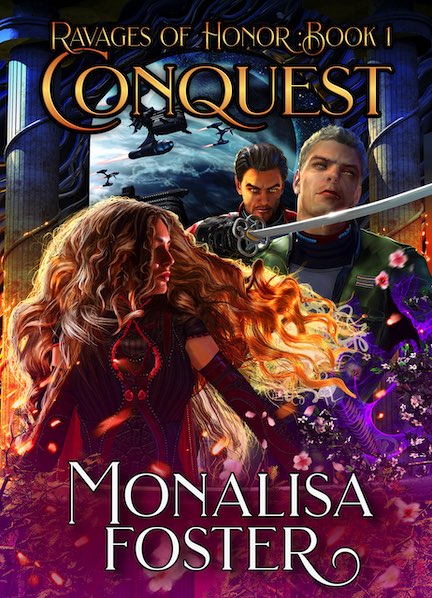
This is the opening scene to Ravages of Honor Book 1 Conquest, provided here as a reference for my Substack readers:
It had been more than a decade since Syteria had breathed the sweet air of Kappa, the world where she’d been born.
High above her, Rho—Kappa’s larger planetary sister, with its brilliant polar caps, its milky, white clouds swirling across deep, blue oceans—dominated the sky. To Syteria, it still looked like a vast, malevolent eye, despite all its beauty. A beauty that washed out the hauntingly familiar stars struggling to make their presence known.
A leaden weight, as heavy as her tactical vest’s armor plating, took form in her belly. Her grip on the rifle tightened, each deliberate breath bringing it closer as if it were some talisman.
Syteria had been paired with Mara, a trusted eniseri veteran. Age lines and scars crisscrossed the older woman’s face. Her dark hair, clipped close to the scalp like Syteria’s own, was covered almost entirely by her helmet. Mara’s gloved hands rested lightly on her rifle. A soft wind stirred the leaves on the trees above them, sending shadows into play across her confident face.
They knelt at the edge of a clearing, in the cover and concealment of a downed tree, awaiting the order to advance on the lone shack with its pitiful column of smoke.
A stone well fronted an animal corral. The lowing of the beasts within, the odor of manure, the tinkle of bells worn by the animals in case they got lost, all poked at Syteria’s memory. She had been born and raised in a place not so unlike this one.
She closed her eyes as flashes of her past surfaced: running barefoot through leaves; watching Rho rise and set; holding a soft, downy hatchling in her hands.
Syteria shook her head and opened her eyes, darting a glance at Mara, checking to see if she’d somehow given something away. But Mara was watching the shack.
To keep her hand from drifting up to the monitoring collar, Syteria tightened her grip on her rifle’s stock. Maybe the collar would attribute the change in her breathing and body chemistry to nerves, to this being her first time. Maybe the Matrons who were monitoring this mission were too busy to notice.
A jolt of pain traveled up to pierce her temple. She winced, gritting her teeth.
Others might get a pass. They didn’t have her history of disobedience, her willingness to endure round after round of exhaustion, pain, and deprivation. Others willingly took the mind-altering drugs that poisoned the soul and stripped them of individuality. For whatever reason, they didn’t work as well on Syteria, a fact for which she was grateful, despite the price.
Another jolt coursed up and down her spine. She would have screamed, but the collar took her voice. It would not be returned until it echoed in unison with all the others.
She mouthed the required words: I am eniseri. I will obey.
Closing her eyes, she repeated the words again and again. The tightening muscles felt like they might tear each other apart. Pain radiated from her heart. She could no longer breathe. The muscles in her chest had stopped working.
I am eniseri. I will obey.
Oh please, stop. Let this end. She sent that thought, that prayer not to the Matrons, not to Rho’s ruling Matriarchs, but to the Kappan deity whose name she couldn’t even remember.
Syteria didn’t care how it ended. Dead on the grass was as good as any other option. Better perhaps. But in all these years, the Matrons had not granted her that escape. Only the well-behaved eniseri that were monitored less closely managed to take their own lives.
The pain stopped as if someone had flipped a switch.
It’d be a while before they’d use the collar again. Recovery from pain scrambled the signals. Until they returned to baseline, Syteria could enjoy a bit of autonomy. Or at least the illusion of it, for whatever that was worth.
Trembling, she dragged a gloved hand across her mouth and tugged the water tube forward. The sip of water refused to make its way down. She spat it onto the already wet ground beside her and sat back, waiting for the shaking to subside.
“Your first culling?” Mara asked, her first words to Syteria. The hours since their initial introduction aboard the Rhoan drop-ship had been filled with the uneasy silence of untrusting strangers.
Syteria nodded.
A chilling gaze swept over her as Mara’s lip curled into a sneer. “Just remember why you’re here.”
How could Syteria forget? She was an instrument, a means to wage war against her own people.
“Adults are your priority targets,” Mara reminded her. “Take them out first. Let the children run. Remember, we want them to run.”
She remembered. Every day and night, every time she had to do any of the vile, vicious things required of her. Syteria would never forget the mask of streaked greens and browns, the harsh sneering face under a helmet masked with leaves. Ten years ago, an eniseri had appeared out of the forest to snatch her.
Her twelve-year-old self had screamed and kicked and bitten, earning the first of many “therapies.” And now the Matrons expected her to take just-orphaned Kappan children and make them forget who and what they were. All so they could replenish the dwindling numbers in the eniseri crèches.
Eniseri numbers must’ve dwindled unexpectedly. Why else would the Matrons drop them off only in pairs?
Obey. Obey and live.
The life of an eniseri was better than death. There were worse fates than life as an interchangeable cog in the Rhoan machine. A machine that ran on the inviolable, infallible triumvirate of the Matriarchy: Unity. Uniformity. Stability.
Syteria took another sip, forestalling the urge to retch. The water, body-warm and stale, slid down her throat more easily this time.
“What’s Control waiting for?” she asked, her voice soft and uncertain.
Mara gave her a look that asked, What kind of idiot are you? or perhaps, You’re going to get us both killed. Mara shrugged the question off, gaze darting to the shack.
Not even a breath of wind stirred.
“Last year one of them got me,” Mara said in that toneless voice of an eniseri veteran. “If they’re armed, they’re a target. Understand?”
“I understand.”
“Don’t let them get near you.” A hard edge cut through Mara’s tone. It matched the look in the older woman’s eyes.
Syteria had seen that edge before—in the eyes of the Matrons. Mara, was close, very close, to becoming one of them. Perhaps as close as one mission, this mission.
“They’re feral little beasts,” Mara added.
Heartbeats crashed in Syteria’s ears, accompanied by a rush of cold that seeped bone-deep.
“Feral beasts,” Syteria echoed. “I’ll be careful.”
Without these “feral beasts” the Rhoans would have to do their own fighting and dying. The Kappans were physically and emotionally better suited to fighting. Less to the dying, though, which made their use a double-edged sword. Without their technological advantage, the Rhoans never would have gained control of the Kappans.
Lying awake at night, Syteria’s mind had endlessly played with the question: What if the Kappans could advance enough to neutralize the Rhoans’ technological edge?
The collar vibrated in warning.
Follow orders. Obey.
The mantra echoed in the back of her mind, drowning out the bird and insect calls filling the night. Rho had risen to its zenith. A silent drone circled overhead. Over her earpiece, the comm chatter slowed to a trickle, then died, leaving only the lull of static.
Syteria shifted, easing back onto one knee.
The shack was no more than a dark shadow. Its column of smoke had thinned, gray tendrils turning to vapors. It was so quiet she could make out the drip from a leaking bucket hitting the distant well-water below.
Syteria wet her lips and whispered, “How did the ‘feral beast’ get you?”
“One of the little monsters had a knife,” Mara said. “Plunged it into my leg, right between the plates and into my thigh.” There was an edge of anger there, a tiny bit of it.
“What did you do?”
“Put a bullet in its brain,” Mara said, speaking as though it was something she did every day, something that didn’t haunt her at night.
How had Mara erased her true self? Like all eniseri, she’d been born on Kappa. How long had it taken to turn her into this monster? How many missions like this one, culling her own people? How much therapy? The questions died, unspoken. The scars on Syteria’s body were a testament to the severity with which such talk was punished.
“What if I’m wrong?” Syteria asked. “What if I kill a female?”
Mara reached for her spare magazine and flipped it so the ammunition nestled inside could be seen in the threadbare light.
“All our rounds are lethal, see? That means the Matrons don’t care.” Mara reseated the magazine in its pouch, shifted to a more comfortable position, and flashed a white smile. “This makes it easier for us. We don’t have to risk injury, or worry about collateral damage. You’ll see. Easy.”
“Easy.”
The word fouled Syteria’s mouth. Once more, she reached for the water tube dangling off her shoulder and sipped. Even as it went down, the water failed to clear her revulsion. One bullet was all that it would take to end Mara’s life. But the Rhoans had taken precautions. A rifle aimed at an eniseri wouldn’t fire.
“Once the adults and older children are dead,” Mara said, “we’ll round up the rest and worry about separating the males from the females.”
Syteria nodded. It was a kindness, really—for the Matriarchy was, by their own definition, kind. It had little use for males of any race and no use for Kappan males. They were too aggressive, too hard to control. Unpredictable too. She’d seen what had happened to the few Kappan males the Rhoans had brought back. Seen enough to know her brothers hadn’t been one of the unfortunates that had been captured.
And then she’d forgotten what she’d seen, buried it deep and kept it hidden, lest it weaken her. The collar buzzed, vibrating against her bones, sending pulses in quick succession to stab and claw at her conscience and her body.
She would dispense, quick, merciful kindness. She would follow orders.
Adrenaline flooded her body until she became as taut as a bowstring held too long at draw. She trembled, craving and fearing release.
Release came over the earpiece as a mix of orders and expletives. It was followed by the boom of a low-yield diversionary device that hit the shack’s meager roof. It didn’t demolish the structure, but it did make its walls shake and the roof planks splinter.
A child’s cry joined another and quickly died. That the children were still alive was a given. It wasn’t like the Kappans to kill their own outright, not even to deny them to the Rhoans. Every eniseri was proof of that.
Kappans fought viciously to save their offspring. Many fought to the end. It’s what made each culling so dangerous.
The airborne drone painted the clearing with its searchlight. Mara moved up and took point. Syteria followed, coming to rest behind the thickest tree trunk she could find.
They waited.
“Here they come,” Mara said, her voice tight. “Cover me.”
Syteria raised her rifle and thumbed the safety. She obediently put the center of the reticle on the shack door, right on the point where an adult’s center of mass would be.
Mara advanced, boots crunching the twigs and leaves beneath.
The shack door opened with a slow, deliberate swing, but no one emerged.
“Hold. I want them out in the open,” Mara said, her whisper carrying in the crisp, night air.
The stirrup and limbs of a crossbow preceded a rough, unkempt male as he crouch-walked into the open and turned towards them.
Syteria lowered her scope’s reticle until it framed a bearded face.
Breath caught in her chest. Blood froze in her veins. Muscles locked in place.
She knew him.
The crossbow twanged and an arrow cut through the air.
The wet sound of flesh parting for the arrowhead was followed by the gurgle of blood caught in an unyielding throat. A sack of flesh and bone that had once responded to the name of Mara, dropped. The twitching and gurgling of Mara’s life faded, joining the unnatural silence that hung like a fog.
The male looked up. Long, dirty hair fell back to reveal a determined face illuminated by the drone’s light.
They had been apart longer than they had been together, Syteria and her brother. But it was him. She was certain. They shared the same rare coloring, green eyes and chestnut hair, and whenever she looked in the contraband mirror in the eniseri barracks, the features that stared back at her reflected him more than not.
His name—Aviel—formed on her lips without sound.
He ducked back into the shack.
The door swung open again. Aviel’s back was to her as he shielded a pregnant female who was herding two small children towards the other side of the clearing. He looked up at the circling drone. An unarmed observer, it posed no immediate threat.
Would Aviel know that?
Syteria ran towards them, heart pounding, rifle held low. If he was alive, maybe the rest of her family was too. She’d forgotten their faces, their voices, their names. But something remained, like a scent in the air, that, if followed, led to the source.
She stumbled as the Matrons ordered her to kill the adults, their harsh voices buzzing in her ear.
Just short of the clearing, she ducked behind a tree, dug her gloved hands into the thick foliage, and bit down on a scream as she closed her eyes and pressed her face into the rough bark. There was only so much pain they could make her feel until her body simply shut down on its own. She waited for darkness to swallow her, to render her useless to them.
But it didn’t come.
Her rifle had swung to a stop at her side, its weight suddenly too burdensome to bear. She dropped the loaded magazine and cleared the chamber, tossing both into a thicket. She did the same with the spares. Then she released the buckle and the strap fell away. Numb fingers dropped the harness rig from across her chest. Whatever the Matrons did to compel her obedience now would be wasted.
Unarmed, she posed no threat to her people, or her family.
Syteria worked the clasp at her chin, took the helmet off, and dropped it. Next, she yanked the earpiece, placed it atop a rock, and crushed it under her heel. A wind had risen, whipping about her, tumbling the pieces of broken tech into the soil.
Aviel had stopped on the other side of the well. The woman and children huddled behind him. He spoke, but the wind snatched his words before they could reach Syteria.
She would not reveal herself, nor plead for the chance to join them.
After what the Rhoans had done to her body, her brother would not recognize her anyway. The homing beacon in her collar and the tracking implant in her body still posed a threat. By following them, by joining them, she would only doom them to her own fate.
Vision smearing, she bolted in the opposite direction.
An eniseri gone rogue would entice the drone to pursue her instead. A traitor was the worthier target, someone to be made an example of, someone to break.
She ran, stumbled, fell. Without hesitation, she pushed herself up and ran again, fueled by the return of something she had believed lost forever, something she’d surrendered, something that had been extracted from her unwilling self, something that had no value to the Rhoans—her honor.
The air rushing past her whispered with her grandfather’s voice, There is no greater love …
She swiped at the branches blocking her way. Uncaring, she plunged through darkness, ducking and weaving through the thinning trees.
There is no greater love …
The drone passed overhead, floating like a specter above the treetops.
How much time she’d bought Aviel, or if it was enough to let him and his escape what was to come, she didn’t know.
It had to be enough.
Syteria stumbled out into a field gone fallow and almost made it across. Between one step and another pain bloomed at the base of her spine and took her legs out from underneath her. She rolled onto her back, chest heaving. Copper and iron spilled over lips stretched into a smile.
An honorable death at last.
Tears filled her eyes as Rho’s malevolent light went grey. Her breaths rattled like a rusty chain about to snap.
And then there was no more light.
And no more pain.
If you’d like to read the rest, you can buy either ebook or print version here:
Cover for Ravages of Honor: Conquest (Book 1)
Cover for Ravages of Honor: Ascension (Book 2)
Cover for Ravages of Honor Lineage
Cover for Dominion: A Ravages of Honor Novella
Cover for Featherlight: A Ravages of Honor Novella
My friend Kacey Ezell has a great new space opera series out, called the Ashes of Entecea* and I’m thrilled to be part of Remnants of Empire*, a new anthology set in that universe. Remnants of Empire launches on 7/26/24.
Duty, danger, and unexpected romance await in this captivating tale from the Remnants of Empire anthology!
On the planet Raneaux, two young nobles are ready to part ways. But when a series of devastating attacks rock their world, everything changes. Thrust into a maelstrom of political intrigue and violence, Aidan and Deirdre must confront their true selves.
He’s a scholar who dreams of quiet libraries. She longs for adventure. Now, they’re fighting for survival and the future of their planet.
As assassins lurk and conspiracies unfold, Aidan and Deirdre discover strengths they never knew they possessed. But in a world turned upside down, can an unlikely partnership become something more?
Experience heart-pounding action, complex characters, and the birth of an unexpected love that could change everything.
Remnants of Empire brings you a collection of interconnected stories set in a richly imagined sci-fi universe.
The holographic ad touting off-world adventure holidays caught my eye. I slowed my rapid pace to admire the frozen landscape that morphed into images of divers swimming with amazing deep-sea creatures. Chills skittered across my skin as I aimed my ubiq at the ad so it could scan the relevant information.
“Add to my wishlist,” I told it.
“Confirming add to Deidre’s wishlist,” the ubiq replied. “Reminder: you have a lunch appointment with your parents in ten minutes. At your current rate of travel, it will take you seventeen minutes to reach your destination. Do you wish to send a status update?”
I ignored the ubiq and promptly slipped it into my pocket. With any luck, Aidan would get to the restaurant first, and my fashionably late arrival wouldn’t matter. My parents adored my betrothed—what an archaic term. In their minds he was perfect. It’s why they arranged the marriage contract.
Don’t get me wrong. Aidan is a wonderful man. Kind, attentive, but not my type. He’s very smart and scholarly, and it didn’t take us long to figure out that we have different goals in life. He wants to make a name for himself as a professor of history. I want to travel. I want to go places and skydive and swim with alien whales and get into zero-g sports. He finds libraries as interesting as I find them boring.
We’d be horrible for each other. I’d feel held back, and he’d feel—well, I don’t know, abandoned maybe. It’d be one thing if I wanted to go off and adventure on my own for the rest of my life and then come back to hearth and home when I felt like it, but would that be fair to him? Or to me? What if I found someone with whom I could adventure with? What if he found someone to be a homebody with? Would we be stuck in one of those awful marriage-in-name only things?
I had to step around a holo-ad that popped out of the ground. “Stay informed with our latest updates on anti-monarchist activities—” If you make the mistake of walking through one, they will follow you—well, your ubiq—everywhere. I didn’t have time to deal with viral ads.
Thank all that’s good that we’re both lesser nobility—Aidan’s father is, I think, fourth in line for the throne. Being so far from power is why we can say no to a marriage contract. There are no world-ending consequences to either of us wanting to live our own lives. I doubt the ‘casts will even announce it, and if they do it’ll be buried in the day’s feed, and no one will care.
My consolations and the rehearsed speech that I’d been working on since Aidan and I decided to part ways rolled around in my head as I made my way from the mag-rail station to Le Goût de l’Elysée. It’s the kind of place one goes to for special occasions like engagements and anniversaries, and that is no doubt why my mother chose it.
It was also the kind of place frequented by Raneaux’s planetary royals and judiciars and prime ministers and celebrities from all over Entecea. Frankly, I’m allergic to all those people, although I do endure them for my parents’ sake.
As I crossed the cobblestone pathway, I wished I’d picked something other than spiky heels. There was a dress code though, so I had dressed up, partly out of guilt. I knew going into this just how disappointed our parents were going to be, and for some reason, I had thought that one of my nicer, semi-formal dresses would somehow make up for it. This one was gray, asymmetrical, with a high neck and cap sleeves, a minimalist design with sculpted details, and everything someone like me was supposed to be wearing for something important. Like I said, guilt, or maybe apology. But in dress form.
The upside to l’Elysée was going to be that no one was going to dare make a scene—even though neither of our mothers were that type. It had been Aidan’s idea. See, I told you he was clever. And so very smart.
I sighed. Oh, if that were only enough. If only we had chemistry. I wanted that thrill, those butterflies, that out-of-control-in-love feeling. I wanted it all. Preferably now. And forevermore.
Doormen in matching uniforms, complete with caps and white gloves, swung the doors open as I approached. It’s such things that make l’Elysée an experience in itself, particularly for the nostalgic.
The foyer was done in a deconstructed chandelier, where each crystal was suspended by invisible nanofibers. To me, it had always looked like an exploded diagram of a chandelier, instead of an assembled piece. Art, I guess.
The maître’d looked up from his tablet and shot me a smile. “Ah, Miss Pinet. How good to see you.”
“Good morning. Are my parents here yet?”
“Yes, Miss. They were seated about twenty minutes ago. Lady and Lord Stout have also been seated.”
“And Professor Stout?”
“I’m afraid not. Would you like us to ping his ubiq with a reminder or request his current location?”
Sometimes people like the maître’d expected people like me to above carrying ubiqs. The really important people didn’t. Their staffers and aides did.
“No, thank you. I can do it myself.”
“Very well. This way, Miss.”
And so he led me through the main dining room with its fleet of curved banquettes and gazebo-like hooded loveseats. It wasn’t quite noon yet, but I knew that it would soon be filled with glitterati, with the cream of Raneaux society coming together to impress each other over fancy lunches.
The parents sat cozily on the veranda. It really was a lovely day for it with spring sunshine pouring in through slats strategically placed so that the light wouldn’t bother anyone’s eyes. Floral scents floated on the breeze, just a hint of them so as not to interfere with the more discerning palates that were bound to be l’Elysée’s best customers. It was no surprise that my mother had been making noises about having them cater the wedding. I just hoped that she hadn’t already booked them.
Mother wore a long dress with a bolero top—lavender, of course. Lady Stout was in a similar outfit, but in mint green. It made me think they’d coordinated and that made my stomach hurt. Father and Lord Stout both wore what I called their uniforms—tunic-like business jackets that hit mid-thigh and pressed trousers, high-collared shirts, and cravats—like they might stop by the House of Lords and argue for this or that or the other.
The two empty chairs beckoned like a challenge. I really didn’t want to face them alone.
I am absolutely thrilled to share some incredible news with you: The Deviltree has won the 2023 AnLab Award for Best Novelette! This honor is especially meaningful because it was determined by you, the fans. Your voices, your votes, and your passion made this possible, and I couldn’t be more grateful.
I also want to thank Analog Editor, Trevor Quachri and Senior Managing Editor Emily Hockaday for shepherding me through this, my first sale to Analog Science Fiction and Fact. It was an amazing experience.
And no shout-out would be complete without recognizing the great art for the story by Tomislav Tikulin.
I also want to take a moment to recognize the other finalists and their incredible work.
It’s an honor to be listed among such talented writers, and I encourage you to explore their works if you haven’t already.
Most importantly, I want to thank YOU. Your support, enthusiasm, and belief in my work have made this achievement possible.
As a token of my appreciation, I’m excited to announce a special giveaway!—a free copy of Promethea Invicta, my very first hard-sf novella.
Consider it a small way to say thank you for being part of this incredible journey.
Once again, from the bottom of my heart, thank you for your support.
P.S. If you haven’t had a chance to read The Deviltree yet, now’s the perfect time to dive in! Let me know what you think—I always love hearing from you. And if you want a signed hardcopy of the September/October 2023 Analog issue in which it appeared, I have a few copies available here.
Hip, hip, hooray, it’s finally December 5th, aka “Release Day.”
Threading the Needle is officially here! I’m beyond excited. I can’t wait for you to meet Talia and her friends.
Praise for Threading the Needle:
In Threading the Needle, Monalisa Foster has fused the legacies of Leigh Bracket, Louis Lamour, and Robert Heinlein — with maybe just a TOUCH of Akira Kurosowa — in a voice entirely her own. Starships, trains, six-guns, nanotech, gen-engineering, cattle rustlers, and the fierce loyalty of combat vets in a mix which ABSOLUTELY works! — David Weber, Author of the Honor Harrington series.
A stunningly good book set in a world with rich cultures and a sense that violence and danger are always at hand. First, I feared Talia the sniper– then I cheered her, as she carved a path through intrigue so thick it required a sword to cut it. Fortunately, Talia is just that blade. A must read.— Terry Maggert, Author of Backyard Starship, The Messenger, and Starcaster series
The reviews are in:
“Foster has created one of the most intriguing characters I have seen in a while in science fiction…The plotting of this book reminded me of Timothy Zahn or Blake Crouch, with all sorts of twists and turns and other such events happening every which way. Foster is very good at it. She takes on a lot, and she succeeds in threading the needle (pun not intended but very much enjoyed), sewing them all into an engrossing narrative. She paces her story well, never letting it get off the rails, never letting it become dull.”–Nerds of a Feather
“Fans of Leigh Brackett will also love the book for paying homage to the queen of science fiction, and anyone who wants a pulse-pounding adventure is sure to like the increasing tension as the story rushes to its conclusion. This is space opera with Japanese flair and Western archetypes at its best.”--Upstream Reviews
If you want to learn more about the story behind Threading the Needle…
I’m very excited for the release of Relics, a short story set in the same universe as Threading the Needle.
When I originally conceived of a story that included a replica of Charlton Heston, I didn’t know any of the following things: Charlton Heston was Chuck to his friends. He and Toshirô Mifune were also friends, despite a language barrier. Heston said that if Mifune would have spoken English he’d have been one of the greatest actors of our time. Ironically, Mifune served in the Imperial Japanese Army aviation division during WWII and Charlton Heston served as a radio operator and aerial gunner in the US Army Air Service and would have taken part in Operation Coronet, the planned invasion of Japan. That gave me chills.
The thought of would-be enemies developing a friendship that lasted for the rest of their lives even with an ocean between them and despite the cultural gulf that also must have been there has its own appeal. This story is my tribute not just to that idea (ideal?) but to two of my favorite actors, Charlton Heston and Toshirô Mifune themselves.
AIs don’t go rogue. Everybody knows it. Especially SAIs. Which never really made sense to me. They’re supposed to be people just like you and me, and people—flesh and blood humans such as yours truly—are sapient and we go rogue all the time.
But you never know.
Digital citizens were one of the first truly sapient AIs. Who knows what happens after a couple of centuries of rattling around, especially when you’ve been designed and built as an anachronism to begin with. Maybe they can’t handle change. If there’s one thing that the last three centuries have proven it’s that some people just can’t handle the world as it is, so why wouldn’t “digital citizens” lose it and go rogue?
To be honest, I was surprised to find out that these digital fossils were still around, although with the rise of Nostalgism, maybe I shouldn’t have been. The Commonwealth tolerated the movement because it helped move the, shall we say less-than-desirable, off-world. That much I knew.
A leggy brunette with doe eyes, ruby-red lips, and an hourglass figure—some things remain classics even in this screwed-up century—led me into a wood-paneled office and “He’ll be right with you Mr. Elliott,” rolled off her tongue with a distinctive twentieth-century lilt.
Given that this was a museum, her accent and the throwback design of the office shouldn’t have surprised me, although I’d figured the front—a replica of the historical Grumman Theatre—had been strictly for show and expected the back to be, well, a little bit more twenty-fourth century.
The desk was wood, the chair leather, and what had to be a mid-twentieth century television set complete with antennae was tucked neatly into a corner. No computers, no tablets, no holographic interfaces of any kind, at least not that I could see. Two couches fronted the desk, facing each other across a low table—also wood. A couple of books, huge ones, held it down, their covers sporting images from a cinematic golden age almost five centuries gone.
I picked up the top volume only to find that while indeed it was made of paper, the pages were blank.
“You’ll find us in compliance with the law.”
Setting the book back down, I turned toward the commanding voice. Like the human who’d shown me in, the SAI in the doorway wore twentieth-century attire—in his case, a suit and tie. It looked a bit odd on his tall and broad but clearly synthetic frame.
The pixelated membrane that covered the android skeleton mimicked human skin to an uncanny degree, one that immediately gave me chills. The face too did a remarkable job of emulating skin and coloring, placed as it was over a bone structure that must have been true to the original human—strong but not overpowering jaw, slightly curved nose, steely blue eyes. I’d seen images of SAIs of course, but never met one. It was the eyes that gave them away. They weren’t orbs inside sockets and didn’t move as such.
“I’m not a cop anymore,” I said a bit defensively, I don’t know why.
“But you are still required to report violations, are you not?”
A smirk found its way onto my face before I could stop it. “I don’t make it a practice to inform on my clients. Tarnished I might be, but not that much.”
He gave me a skeptical look and extended his hand. “Call me Chuck. I insist.”
What a throw-back custom.
Awkwardly, I shook his hand. Room-temperature like a corpse. While it emulated skin right down to the veins and calluses on his hand, there was no accompanying texture. Images of hairs were overlaid over images of veins. The calluses were as smooth as you’d expect a pixelated surface to be. Ironic, no? He was an image on a screen, just as he must have been when his original had been alive.
When I was creating (handwaving into existence) the donai, I didn’t expect the “rule of cool” concept of “ooh, genetically engineered samurai” to lead down the rabbit holes that it did.
One of those rabbit holes had to do with age disparities in a long-lived species and how to deal with the ick-factor brought on by the so-called “creepiness formula” which states that a person can only date/marry someone who is at least half their own age plus seven years.
What that means is that if you’re 30, the formula says that you shouldn’t date someone who is younger than 22. Why 22? Because (30)(.5)+7=15+7=22.
Even though it’s a made-up world, we have to deal with two things.
The first has to do with suspension of disbelief which is dependent on things making sense. And the more you know, the harder that is. (Trust me on this. I’m quite ignorant when it comes to historical fashion which is why I can enjoy The Tudors more than my friends who know a lot about fashion history.)
The second has to do with social mores or acceptance of certain practices and it’s a lot more ingrained than one would expect.
Case in point, the number of people complaining about Edward being so old as compared to Bella in Twilight. Ridiculous really, since it was dealt with up front.
“How old are you?” “Seventeen.” “How long have you been seventeen?” “Awhile.”
The idea of vampires being static, i.e. not aging, not maturing, being anachronistic because they are frozen in place, etc. is a trope of the vampire genre (and some others as well).
Edward may have come across as too mature for a contemporary seventeen-year-old boy, but that too was dealt with. He was an artifact of his own time, the turn of the 20th century, when a 17-yo was a man, not a boy. He grew up in a world and in circumstances where a 17-yo was far more mature than the 17-yo of today.
The very same people (the ones who have a problem with this) have no problem with a science fiction story where some guy goes on ice (stasis or cryogenic suspension) and then boings a girl/woman who could easily be his great-granddaughter. Yet the same situation applies, a stasis or developmental pause that is not just physical but mental. And it makes sense in both situations. If vampires don’t age it stands to reason that their brains don’t age either, which is why they’re not grumpy old men yelling at clouds or at kids to get off their lawns.
But it still presented a problem for my worldbuilding, and not because I figured some might object. It was one of those things I had to figure out, if only for myself.
So I started off by looking into how generations were defined. I had always assumed (been taught?) that generations were twenty years. Well, there are generations and then there are generations. Obviously I’m not talking about the “Gen X” type of generation, i.e. a group of people born in a certain decade.
I reached out to one of my doctor friends, as one does, and got quite an education on the more scientific definition. Long story short, generations are determined by how long a woman is fertile.
Menarche typically occurs between the ages of 10 and 16, with the average age of onset being 12.4 years.—NIH The menopausal transition most often begins between ages 45 and 55.—NIH
Oh no! We’re in girl cootie territory again! Surely this can’t have anything to do with “real science fiction.”
Sure it does.
So let’s go with 50 as the end of fertility and 15 as the start of it (because of the lack of regular periods at the onset of 12.4 years) which gives us a nice number like 50-15=35. (Or if we go with 55, we get 40; either way that’s much longer than the 20-yr span I thought it must be).
Keep in mind now, this is for handwavium, for a made-up world, so don’t waggle your finger at me about how a real biologist might do this. I’m using this as a launching pad for my handwavium. My handwavium may be crunchy, but not so crunchy that it’s no longer handwavium.
Now, this period of fertility is obviously dependent on life span as well, so if you live at a time when 30 was your expected life span, it would be 30-15=15 and then also factor in that percentage body fat is a factor so girls who don’t live in industrialized first-world countries or who lived when they couldn’t accumulate enough body fat by age 12, would have later menarche-onset dates. It’s entirely possible that at one point in history, the fertility period (generation) was between 18 and 30 due to limits of body fat percentages and life expectancy, so 12 years.
Apply the creepiness formula to that and you can see why a 30-yo man paired with a 22-yo woman wouldn’t make sense or be typical, but a 30-yo man paired with a younger woman makes far more sense. And then factor in the number of deaths due to childbirth on top of that. If you’re not glad that you’re living today instead of way back then, you should be. (Backwards time-traveling heroines notwithstanding).
This is why we shouldn’t judge the past by our own distorted modern lens. Things happened for reasons (usually) that have everything to do with rules imposed by nature, not because of The Patriarchy (TM) or whatever the hate-on is for today.
Once you start looking at things with an eye towards impositions made by nature, the world-building gets rigorous, i.e. your scifi elements aren’t just a thin skin or veneer for your fiction.
For the donai, this meant that I could not use generations at all. When the women that are able to have babies are an anomaly due to errors in genetic coding and only have a handful of fertile cycles, then there is no concept of generations. There can’t be.
But it’s not enough to just say and handwave it away. It should be, but it’s not. You need more because of that issue of “aging” in terms of maturity, i.e. old man yells at cloud. The social derision for an older partner comes from the objection that a mature person is taking advantage of an immature one, even if the immature one is 22 and well into being considered an adult whose choices we shouldn’t question due to agency, respect, blah-whatever-blah. Having it both ways, aren’t we?
I see this derision all the time, especially when an older man is dating a much younger woman. We all assume she’s the poor victim and he’s taking advantage of her. Less so if the older partner is a woman for some reason. Now, there’s some sexism for ya!
So how to deal with it in-world for Ravages of Honor?
It turns out I already had a built-in answer, one I didn’t even think of when I created them.
Since the donai can live for centuries (How many? I don’t know yet and won’t until I have written it.) and their nanite symbionts keep them in a semi-perpetual middle-age1 for most of their lives, it follows that we have that “stuck at seventeen” or static stage of life like vampires where the character doesn’t transition to the old-man-yelling-at-cloud phase, i.e. senescence.
Being aware of potential objections made by readers is very helpful, maybe even key, when it comes to rigor. Yes, it means that you can’t just write what you want, and there are certainly times when you’ll want to ignore such “objections” (I certainly do) but it works oh-so-much better when you can head them off with something that makes sense.
For the record, in RoH, Syteria is, I would say, in her early twenties (or the in-world equivalent) with Darien being about ten years older (chronologically), which makes him very young for a donai. He is not even in that middle-age phase yet. If you were to do an apples-to-apples comparison, as in judging a human by human standards, and a donai by donai standards, she’s “older” than he is because humans age AND mature faster, whereas donai do not.
By the way, I was stunned to learn that 20-30 is considered young adult and that middle age as we define it is 40-50. I guess when you don’t start being an adult until you’re 26 that makes sense, but it was still a shock. In my world (IRL), you were expected to act and function as an adult at about 13 and by that I mean in terms of responsibility and maturity, and not by being sexually active. Yes, I’m very Old World. Go figure!
Now that I’ve started RoH4 and it’s looking like a story where Lady Neria Bhanot and Lord Dobromil (Darien’s father) are going to be forging a new world order, the “May/September romance” question kicked in hard since he is much older. But it doesn’t matter for in-world reasons. People are free to screech about it of course, but that’s not really my problem.
[crossposted to Substack]
Side notes for writers:
This kind of thing is also why I’m glad I resisted the urge to explain, that practice of dumping information into the story when there really is no need for it other than for the author to masturbate on the page and show you how much thought she’s put into it. In fact, I have no less than three deleted scenes over the last three novels where I gave in to that urge and then in going back over it, ruthlessly cut myself out of it. It saved writing myself into a corner, and one of the reasons I continue to love close/deep point-of-view.
Word of caution. The scientific rigor is what throws such stories out of the Romance genre. Once you start making your story about the worldbuilding or the handwavium rather than the romantic relationship you have crossed into romantic subplot. You’re going to end up overplotting it (for a Romance) because in order for it to make sense you’re going to have to dramatize the “science” to the reader.
Cover for Ravages of Honor: Conquest (Book 1)
Cover for Ravages of Honor: Ascension (Book 2)
Cover for Ravages of Honor Lineage
Cover for Dominion: A Ravages of Honor Novella
Cover for Featherlight: A Ravages of Honor Novella
That is the central question in scifi and the cause of all the trouble too. Trouble means tension and conflict. In fiction, trouble is good.
MidJourney image
One of the things I really wanted to get away from was the Star Trek “alien.” The Star Trek alien is just like a human except for one, or a few, altered physical features (purple eyes, wrinkled nose, differently shaped ears) and one exaggerated behavior or attribute—greed for the Ferengi, logic for the Vulcans, aggression for the Klingons. Until recently all Vulcans even shared one hairstyle.
Practically you can see why this would happen. It makes it easy on the makeup department and allows the casting department to cast, well, humans. Duh. Budget constraints are a factor of course, even with the prevalence of CGI. We finally are a point where we have actors walking around on stilts to create the illusion of hooves like a horse, etc.
Low-budget old-school Dr. Who was braver and gave us aliens/monsters made up of baling wire and spit. Ironically, also due to budget constraints. There’s a lesson there.
That’s all fine and good and eventually Star Trek writers even came up with an explanation for why there are so many bipedal humanoid species—some race went around seeding planets and reused the same framework. Okay. That kinda, sorta explains things, but what about behavior? That’s actually more writing-related too, having to do with the readers.
The readers (or viewers) must be able to relate to the alien. Hence we do not have the Broccoli people of Brassica IV except maybe for the short term as a curiosity or if the budget allows it, or just to be able to say, “Hey we don’t just have bipedal humanoid aliens with front-facing eyes.”
Let’s face it, consumers may get a chuckle out of the Brassicans’ obsessions with butter-baths, but could we really relate to it if it didn’t touch the funny (or irony) bone?
Now, if you think about it, an intelligent creature that looked like a stalk of broccoli because it had sensors on the stalks or operated each branch like an octopus does with multiple brains would be quite unique and might even make sense for a certain kind of environment, but how relatable would it be?
And then we have the Furry-aliens, i.e. people in suits made up to look like a shark’s head was grafted atop a human torso, because, well, it was. I really wanted to get away from that, and the truth is, once I made that decision, I was limited to creating a sub-species of human, which I was actually fine with given what I wanted to do.
In addition to it working with the story I was inspired to write, I think that going with a sub-species is more honest than pretending that you could have a shark-headed humanoid. Ironically, it’s actually done better in fantasy (via orcs, ogres, vampires, werewolves, and other supernatural creatures which are more rigorous, i.e. it makes more sense, than the shark-furry). This is also why I’m fine with calling the RoH series a “space fantasy” or a “space opera” rather than hard-SF, despite the crunchiness of the science or the rigor of internal consistency.
Remember, I’m here to entertain. As I’ve been saying, I’m filing for copyrights, not patents.
Once I made the decision to go with the more rigorous notion of a sub-species, I delved into what I loosely call genetic engineering (mostly the old-fashioned kind that is actually in-vivo breeding for traits and/or hybridization rather than the in-vitro variety, although I use both in Ravages of Honor series (affiliate link)).
Enter the mules. Wait, did she say mules? As in the four-legged things like horses.
Yes, she did! Cause she’s like that.
Because a mule has only 63 chromosomes (a horse has 64 and a donkey has 62), mules are infertile. Usually. I know! I was shocked to learn this too. I thought for sure that mules could not have babies.
And that’s when the trouble started.
What if? What if the super-soldiers (my genetically engineered donai) were like mules? This would be a desirable trait since their creators wouldn’t want them breeding anyway. So I went down this rabbit hole and discovered that there are rare cases where the offspring of a fertile female mule ( a “mare”) can have fertile offspring that then go on to exhibit (atavistic expression I believe; remember, I’m not a geneticist or even a biologist) the traits/characteristics of horses despite their heritage including donkeys. That is, it’s possible to breed fertility back into the genome and to have those offspring express only the “desirable” traits of one species (or race).
Talk about things that make this writer’s day! This is my playground. This is where my buttons are pushed (and like a 747 I have a lot of them; go figure).
In the RoH universe this manifested as the genetically engineered donai having been created in such a way that they were infertile, but “nature finds a way” and produced errors—sometimes in the genome a la chromosomes, sometimes in the symbiotic nanites via coding errors. Sometimes those “errors” were helped along by the most successful venereal disease on record—life. Yes, life is a venereal disease, even when it occurs in-vitro (in a test tube). Pass it on!
Scientists can play with test-tubes all they like, even en masse, but there’s nothing like the introduction of chaos (the scientific variety) that’s unleashed when the product, in this case, the donai, are released into the wild and have the opportunity to—ahem—interact with a far more prolific species, i.e. humans.
And this is where another “What if?” came in and then all the trouble called a story, called conflict, called complex characters, called intense relationships, called massive worldbuilding “happened.”
If a story can’t be told without the extrapolation of science, it’s science fiction.
If a story has a premise based in that extrapolation of science (mine has three), then it’s science fiction.
If a story has a solution rooted in the same extrapolation, then it’s science fiction.
Which still leaves open the question of sub-genre.
RoH meets all those criteria (requisite girl cooties notwithstanding). So what is it then? Hard science fiction, science fantasy, or space opera. I guess it all depends on your perspective, i.e. how much do you really care about the science being right, the science being rigorous, internally consistent, etc.
From my perspective it’s got enough handwavium and other elements (i.e. it’s not just about the technology but about people and their adventures) to be space opera. It’s also space opera because the donai are more like the creatures of fantasy despite their non-supernatural basis. In many ways they are more human than human, but the story solution resting in the “rigor” of the story’s in-vivo genetic engineering makes it sci-fi (maybe even hard sci-fi).
Unlike a lot of space opera (I’m looking at you Star Trek) RoH is actual military-sf rather than militaristic-sf. But I don’t have a lot (I have a few) of space battles because I find them boring to read and even more boring to write. Nevertheless, I also don’t appropriate military culture (uniforms, ranks) and then disrespect them (bedding subordinates and making them into a “peacekeeping armada”—what an absurd term! Think about it!) because I know better. My militaries kill people and break things, just like (checks notes) in the real world. Huh. More rigor.
This is why I call myself genre-fluid. I don’t set out to mix genres, but I do mix them, depending on what the in-world dynamics call for. I think this enriches the world and provides depth to characters. It’s what makes an enjoyable story to me and I hope, to you, my readers.
Please don’t put any spoilers in any comments. I will delete anything I consider spoilerish.
One of the reasons I’m doing this short series on the science in my books is because I wish more scifi writers would talk about what’s real science and what’s made up in their stories so that people won’t grow up thinking that Star Trek (ST) science is real. One of the reason I like reading certain historical fiction writers like Kate Quinn and Allison Pataki is because they go into what is made up and what was based on historical “facts.” As a non-historian I appreciate knowing. I’m hoping that the same will happen for what I’m discussing here.
And here we go…
The nano robot in blood vessel,medical concept,3d render; licensed image
Most people (based on what I’ve seen) got their idea about nanotechnology from Star Trek. My introduction to it was somewhat different. ST:TNG had not yet hit television when I ran across Feynman’s There’s Plenty of Room at the Bottom (a 1959 lecture on “miniaturization” that is considered the basis for the concept) via Engines of Creation, the first book I ever checked out of a college library.
[The big bugaboo about this lecture on “miniaturization” was in its interpretation, i.e. what Feynman meant vs what people “understood.” He was not talking about miniaturization in the sense of making smaller and smaller versions of something, i.e. as in using the photolithography used to make semiconductors.1 The image above demonstrates this misunderstanding in action. That robot up there looks like a macro (real world) scale robot, something that has been scaled down.]
One of the reasons I made my Ravages of Honor series (affiliate link) into a space opera was so that I could focus on the characters, their adventures and relationships, the politics of a galactic empire, and the political machinations of feuding noble Houses. And so that I could use handwavium (i.e. make stuff up).
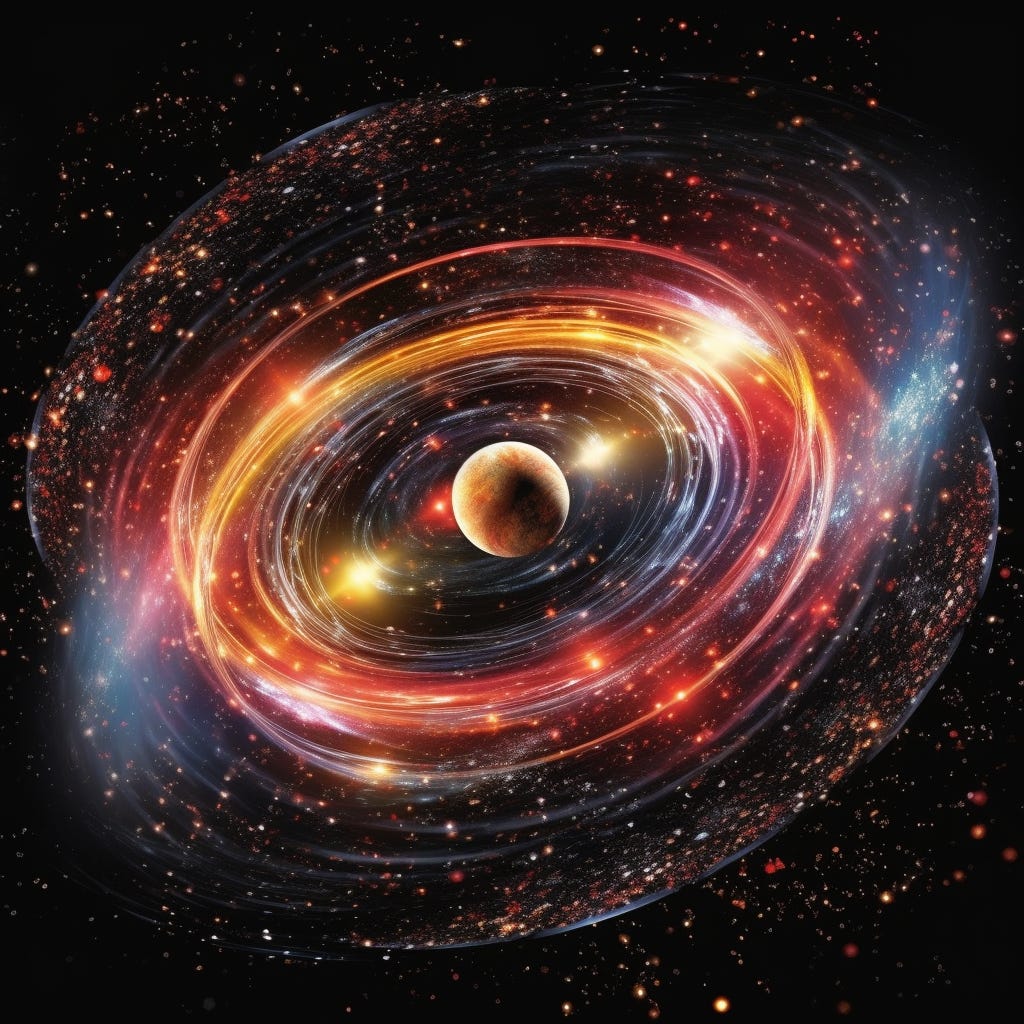
MidJourney image
As with most things I set out to do, things don’t always turn out the way I intended. There’s a reason I chose the slogan, “human drives, not hyperdrives” so I was surprised to find out that my handwavium (my science) was considered pretty crunchy after all.
And actually, I’m okay with this. Like most writers, I ended up writing something I wanted to read—something that hit all of my buttons just right, and I have a lot of them. I want character-based stories with romantic elements (like chivalry and romance, not Romance) as well as handwavium that makes sense in-universe. I wanted to explore the question of “What makes us human?” as well as the cost and price of honor, i.e. of doing the right thing. I wanted to look what makes freedom and liberty and tyranny. I wanted to look at cultural clashes.
I consider the FTL in RoH to be the least crunchy element of my handwavium, but maybe it’s not. When a writer friend pointed this one, I had to shrug and then nod and go off and think about it some.
One of the reasons I don’t go into huge info-dumps in RoH is because as a reader, I find them quite boring. The characters don’t need to explain things to themselves (how often do you stop to explain to yourself how your car works?) and even when we contrive a reason to explain things to an ingenue, it comes across as authorial intrusion of the worst kind.
Even if the character being used as a mouth-piece is actually an expert (in this case, an n-space expert) he has to have a good reason to “explain” things to another character. Then we have the level of explanation. If a differential geometer (someone who is mathematician specializing in differential geometry) were to explain something to a layman, would they use all the terms-of-art unique to differential geometry? The answer of course is no, so vomiting that on the page is again, pure authorial intrusion.
My definition of science fiction is not just that it has to have a speculative element (like nanotechnology or FTL or genetic engineering) but that such elements have to be integral to the story, i.e. it can’t happen without it. It can’t just be window dressing or a thin veneer. There must be a speculative element that is integral to the story in such a way that taking it away kills the story. If the story solution depends on it, so much the better, and by the way, now you may have well crossed into “hard” sci-fi, whether you intended to or not.
The Ravages of Honor series (affiliate link) has three such elements: FTL, nanotechnology, and genetic engineering. Take any of these elements away and there can be no story. Without FTL, Syteria can’t get pulled out of her part of the universe and find herself in Darien’s. Without FTL, there is no Imperium. Without genetic engineering and nanotechnology, the donai cannot exist.
I think the genetic engineering in my series is actually the most speculative element, followed by the nanotech, but that’s probably more of a reflection on the fact that my education is the most lacking in the genetic engineering aspect, whereas I do have a better grasp of how nanotechnology would work just like I have a better but still tenuous (theoretical) grasp on the math and physics of “hyperspace” (as in the space of higher dimensions, not the x, y, and z of our own physical universe; oh, and t (time) of course, but let’s leave t’ (the prime of time) out of this, cause yeah, let’s just leave it out).
I apologize in advance for making physicists cringe and for making lay people think about math, but I promise, no equations. I also apologize for the quality of my graphics. It was either spend ten minutes drawing it by hand or the next few days trying to figure out how to make the same image via some program I haven’t used in years, and I have a release coming up tomorrow (10/20/23). Yikes!
So here it is, the quick and dirty, and not very technical version of my FTL handwavium.
It requires you to imagine the space between stars (just like in our universe) as a surface. If we were to look at a surface edge-on, we’d get a line.
What constitutes a region A as different from region B is part of the speculative element here. Let’s call it any region of space that is gravitationally connected in some way, like a solar system or a cluster of stars and their solar systems.
Now imagine that this line (that represents a surface) has some curvature to it that can be represented mathematically (if not physically) via the surface (and surface only) of a sphere.
Kind of like this:
So, what we have here is much like two soap bubbles that have been brought together and can touch, thereby creating an interface.
That interface is what connects region A to region B, in hyperspace (as in the space of higher dimensions).
What does that interface itself actually look like?
It’s an intersection where region A and region B “touch,” thus creating a “phase-point” connecting the regions and therefore providing a way to travel from star C to star D hyperspatially. This phase-point might look like a disk you can pass through.
Everyone with a physics background, stop cringing. It’s called science “fiction” for a reason.
Subscribed
This is why the territory of any particular House in the RoH universe isn’t necessarily connected in real space. The n-space (phase-point) connections are the defining factor instead. And if one wants to travel through a phase-point that is located physically in another House’s territory, they must have permission or enough power not to worry about getting permission. This is part of the reason why we have a feudal system in this far-future universe, i.e. because one of the elements of a feudal system is that communication and/or travel is slow and/or difficult. Messages must also travel through these phase-points or take years or decades or centuries to arrive.
Now, imagine if you will, what happens when those bubbles move further or closer or get pushed apart. It would change the dynamics of alliances, both political and economic. Fertile ground for any space opera.