Category: Uncategorized

  • Conquest Opening Scene

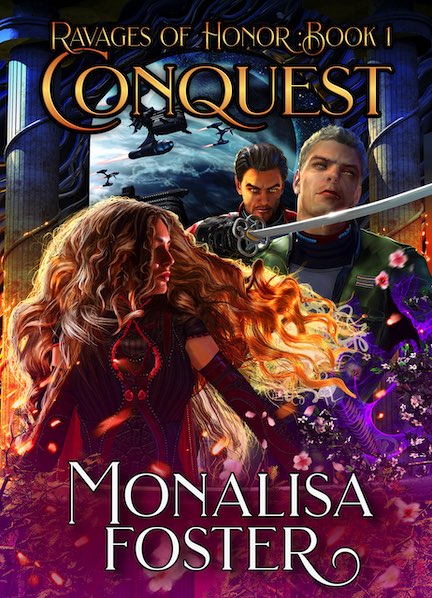
    This is the opening scene to Ravages of Honor Book 1 Conquest, provided here as a reference for my Substack readers:


    It had been more than a decade since Syteria had breathed the sweet air of Kappa, the world where she’d been born.

    High above her, Rho—Kappa’s larger planetary sister, with its brilliant polar caps, its milky, white clouds swirling across deep, blue oceans—dominated the sky. To Syteria, it still looked like a vast, malevolent eye, despite all its beauty. A beauty that washed out the hauntingly familiar stars struggling to make their presence known. 

    A leaden weight, as heavy as her tactical vest’s armor plating, took form in her belly. Her grip on the rifle tightened, each deliberate breath bringing it closer as if it were some talisman.

    Syteria had been paired with Mara, a trusted eniseri veteran. Age lines and scars crisscrossed the older woman’s face. Her dark hair, clipped close to the scalp like Syteria’s own, was covered almost entirely by her helmet. Mara’s gloved hands rested lightly on her rifle. A soft wind stirred the leaves on the trees above them, sending shadows into play across her confident face.

    They knelt at the edge of a clearing, in the cover and concealment of a downed tree, awaiting the order to advance on the lone shack with its pitiful column of smoke. 

    A stone well fronted an animal corral. The lowing of the beasts within, the odor of manure, the tinkle of bells worn by the animals in case they got lost, all poked at  Syteria’s memory. She had been born and raised in a place not so unlike this one.   

    She closed her eyes as flashes of her past surfaced: running barefoot through leaves; watching Rho rise and set; holding a soft, downy hatchling in her hands. 

    Syteria shook her head and opened her eyes, darting a glance at Mara, checking to see if she’d somehow given something away. But Mara was watching the shack.

    To keep her hand from drifting up to the monitoring collar, Syteria tightened her grip on her rifle’s stock. Maybe the collar would attribute the change in her breathing and body chemistry to nerves, to this being her first time. Maybe the Matrons who were monitoring this mission were too busy to notice.

    A jolt of pain traveled up to pierce her temple. She winced, gritting her teeth. 

    Others might get a pass. They didn’t have her history of disobedience, her willingness to endure round after round of exhaustion, pain, and deprivation. Others willingly took the mind-altering drugs that poisoned the soul and stripped them of individuality. For whatever reason, they didn’t work as well on Syteria, a fact for which she was grateful, despite the price. 

    Another jolt coursed up and down her spine. She would have screamed, but the collar took her voice. It would not be returned until it echoed in unison with all the others.

    She mouthed the required words: I am eniseri. I will obey.

    Closing her eyes, she repeated the words again and again. The tightening muscles felt like they might tear each other apart. Pain radiated from her heart. She could no longer breathe. The muscles in her chest had stopped working.

    I am eniseri. I will obey.

    Oh please, stop. Let this end. She sent that thought, that prayer not to the Matrons, not to Rho’s ruling Matriarchs, but to the Kappan deity whose name she couldn’t even remember.

    Syteria didn’t care how it ended. Dead on the grass was as good as any other option. Better perhaps. But in all these years, the Matrons had not granted her that escape. Only the well-behaved eniseri that were monitored less closely managed to take their own lives. 

    The pain stopped as if someone had flipped a switch. 

    It’d be a while before they’d use the collar again. Recovery from pain scrambled the signals. Until they returned to baseline, Syteria could enjoy a bit of autonomy. Or at least the illusion of it, for whatever that was worth.

    Trembling, she dragged a gloved hand across her mouth and tugged the water tube forward. The sip of water refused to make its way down. She spat it onto the already wet ground beside her and sat back, waiting for the shaking to subside.

    “Your first culling?” Mara asked, her first words to Syteria. The hours since their initial introduction aboard the Rhoan drop-ship had been filled with the uneasy silence of untrusting strangers.

    Syteria nodded. 

    A chilling gaze swept over her as Mara’s lip curled into a sneer. “Just remember why you’re here.”

    How could Syteria forget? She was an instrument, a means to wage war against her own people. 

    “Adults are your priority targets,” Mara reminded her. “Take them out first. Let the children run. Remember, we want them to run.”

    She remembered. Every day and night, every time she had to do any of the vile, vicious things required of her. Syteria would never forget the mask of streaked greens and browns, the harsh sneering face under a helmet masked with leaves. Ten years ago, an eniseri had appeared out of the forest to snatch her. 

    Her twelve-year-old self had screamed and kicked and bitten, earning the first of many “therapies.” And now the Matrons expected her to take just-orphaned Kappan children and make them forget who and what they were. All so they could replenish the dwindling numbers in the eniseri crèches.

    Eniseri numbers must’ve dwindled unexpectedly. Why else would the Matrons drop them off only in pairs?  

    Obey. Obey and live.

    The life of an eniseri was better than death. There were worse fates than life as an interchangeable cog in the Rhoan machine. A machine that ran on the inviolable, infallible triumvirate of the Matriarchy: Unity. Uniformity. Stability.

    Syteria took another sip, forestalling the urge to retch. The water, body-warm and stale, slid down her throat more easily this time.

    “What’s Control waiting for?” she asked, her voice soft and uncertain. 

    Mara gave her a look that asked, What kind of idiot are you? or perhaps, You’re going to get us both killed. Mara shrugged the question off, gaze darting to the shack. 

    Not even a breath of wind stirred.

    “Last year one of them got me,” Mara said in that toneless voice of an eniseri veteran. “If they’re armed, they’re a target. Understand?”

    “I understand.”

    “Don’t let them get near you.” A hard edge cut through Mara’s tone. It matched the look in the older woman’s eyes.

    Syteria had seen that edge before—in the eyes of the Matrons. Mara, was close, very close, to becoming one of them. Perhaps as close as one mission, this mission.

    “They’re feral little beasts,” Mara added.

    Heartbeats crashed in Syteria’s ears, accompanied by a rush of cold that seeped bone-deep. 

    “Feral beasts,” Syteria echoed. “I’ll be careful.”

    Without these “feral beasts” the Rhoans would have to do their own fighting and dying. The Kappans were physically and emotionally better suited to fighting. Less to the dying, though, which made their use a double-edged sword. Without their technological advantage, the Rhoans never would have gained control of the Kappans. 

    Lying awake at night, Syteria’s mind had endlessly played with the question: What if the Kappans could advance enough to neutralize the Rhoans’ technological edge?

    The collar vibrated in warning.

    Follow orders. Obey.

    The mantra echoed in the back of her mind, drowning out the bird and insect calls filling the night. Rho had risen to its zenith. A silent drone circled overhead. Over her earpiece, the comm chatter slowed to a trickle, then died, leaving only the lull of static. 

    Syteria shifted, easing back onto one knee. 

    The shack was no more than a dark shadow. Its column of smoke had thinned, gray tendrils turning to vapors. It was so quiet she could make out the drip from a leaking bucket hitting the distant well-water below.

    Syteria wet her lips and whispered, “How did the ‘feral beast’ get you?”

    “One of the little monsters had a knife,” Mara said. “Plunged it into my leg, right between the plates and into my thigh.” There was an edge of anger there, a tiny bit of it. 

    “What did you do?”

    “Put a bullet in its brain,” Mara said, speaking as though it was something she did every day, something that didn’t haunt her at night.

    How had Mara erased her true self? Like all eniseri, she’d been born on Kappa. How long had it taken to turn her into this monster? How many missions like this one, culling her own people? How much therapy? The questions died, unspoken. The scars on Syteria’s body were a testament to the severity with which such talk was punished. 

    “What if I’m wrong?” Syteria asked. “What if I kill a female?” 

    Mara reached for her spare magazine and flipped it so the ammunition nestled inside could be seen in the threadbare light.

    “All our rounds are lethal, see? That means the Matrons don’t care.” Mara reseated the magazine in its pouch, shifted to a more comfortable position, and flashed a white smile. “This makes it easier for us. We don’t have to risk injury, or worry about collateral damage. You’ll see. Easy.”

    “Easy.” 

    The word fouled Syteria’s mouth. Once more, she reached for the water tube dangling off her shoulder and sipped. Even as it went down, the water failed to clear her revulsion. One bullet was all that it would take to end Mara’s life. But the Rhoans had taken precautions. A rifle aimed at an eniseri wouldn’t fire. 

    “Once the adults and older children are dead,” Mara said, “we’ll round up the rest and worry about separating the males from the females.”

    Syteria nodded. It was a kindness, really—for the Matriarchy was, by their own definition, kind. It had little use for males of any race and no use for Kappan males. They were too aggressive, too hard to control. Unpredictable too. She’d seen what had happened to the few Kappan males the Rhoans had brought back. Seen enough to know her brothers hadn’t been one of the unfortunates that had been captured. 

    And then she’d forgotten what she’d seen, buried it deep and kept it hidden, lest it weaken her. The collar buzzed, vibrating against her bones, sending pulses in quick succession to stab and claw at her conscience and her body.

    She would dispense, quick, merciful kindness. She would follow orders.

    Adrenaline flooded her body until she became as taut as a bowstring held too long at draw. She trembled, craving and fearing release. 

    Release came over the earpiece as a mix of orders and expletives. It was followed by the boom of a low-yield diversionary device that hit the shack’s meager roof. It didn’t demolish the structure, but it did make its walls shake and the roof planks splinter.

    A child’s cry joined another and quickly died. That the children were still alive was a given. It wasn’t like the Kappans to kill their own outright, not even to deny them to the Rhoans. Every eniseri was proof of that. 

    Kappans fought viciously to save their offspring. Many fought to the end. It’s what made each culling so dangerous. 

    The airborne drone painted the clearing with its searchlight. Mara moved up and took point. Syteria followed, coming to rest behind the thickest tree trunk she could find. 

    They waited.

    “Here they come,” Mara said, her voice tight. “Cover me.”

    Syteria raised her rifle and thumbed the safety. She obediently put the center of the reticle on the shack door, right on the point where an adult’s center of mass would be. 

    Mara advanced, boots crunching the twigs and leaves beneath.

    The shack door opened with a slow, deliberate swing, but no one emerged.

    “Hold. I want them out in the open,” Mara said, her whisper carrying in the crisp, night air.

    The stirrup and limbs of a crossbow preceded a rough, unkempt male as he crouch-walked into the open and turned towards them. 

    Syteria lowered her scope’s reticle until it framed a bearded face.

    Breath caught in her chest. Blood froze in her veins. Muscles locked in place. 

    She knew him.

    The crossbow twanged and an arrow cut through the air.

    The wet sound of flesh parting for the arrowhead was followed by the gurgle of blood caught in an unyielding throat. A sack of flesh and bone that had once responded to the name of Mara, dropped. The twitching and gurgling of Mara’s life faded, joining the unnatural silence that hung like a fog.

    The male looked up. Long, dirty hair fell back to reveal a determined face illuminated by the drone’s light.

    They had been apart longer than they had been together, Syteria and her brother. But it was him. She was certain. They shared the same rare coloring, green eyes and chestnut hair, and whenever she looked in the contraband mirror in the eniseri barracks, the features that stared back at her reflected him more than not.

    His name—Aviel—formed on her lips without sound.

    He ducked back into the shack. 

    The door swung open again. Aviel’s back was to her as he shielded a pregnant female who was herding two small children towards the other side of the clearing. He looked up at the circling drone. An unarmed observer, it posed no immediate threat. 

    Would Aviel know that?

    Syteria ran towards them, heart pounding, rifle held low. If he was alive, maybe the rest of her family was too. She’d forgotten their faces, their voices, their names. But something remained, like a scent in the air, that, if followed, led to the source.  

    She stumbled as the Matrons ordered her to kill the adults, their harsh voices buzzing in her ear.

    Just short of the clearing, she ducked behind a tree, dug her gloved hands into the thick foliage, and bit down on a scream as she closed her eyes and pressed her face into the rough bark. There was only so much pain they could make her feel until her body simply shut down on its own. She waited for darkness to swallow her, to render her useless to them. 

    But it didn’t come.

    Her rifle had swung to a stop at her side, its weight suddenly too burdensome to bear. She dropped the loaded magazine and cleared the chamber, tossing both into a thicket. She did the same with the spares. Then she released the buckle and the strap fell away. Numb fingers dropped the harness rig from across her chest. Whatever the Matrons did to compel her obedience now would be wasted.

    Unarmed, she posed no threat to her people, or her family.

    Syteria worked the clasp at her chin, took the helmet off, and dropped it. Next, she yanked the earpiece, placed it atop a rock, and crushed it under her heel. A wind had risen, whipping about her, tumbling the pieces of broken tech into the soil.

    Aviel had stopped on the other side of the well. The woman and children huddled behind him. He spoke, but the wind snatched his words before they could reach Syteria.

    She would not reveal herself, nor plead for the chance to join them. 

    After what the Rhoans had done to her body, her brother would not recognize her anyway. The homing beacon in her collar and the tracking implant in her body still posed a threat. By following them, by joining them, she would only doom them to her own fate.

    Vision smearing, she bolted in the opposite direction.

    An eniseri gone rogue would entice the drone to pursue her instead. A traitor was the worthier target, someone to be made an example of, someone to break.

    She ran, stumbled, fell. Without hesitation, she pushed herself up and ran again, fueled by the return of something she had believed lost forever, something she’d surrendered, something that had been extracted from her unwilling self, something that had no value to the Rhoans—her honor.

    The air rushing past her whispered with her grandfather’s voice, There is no greater love 

    She swiped at the branches blocking her way. Uncaring, she plunged through darkness, ducking and weaving through the thinning trees. 

    There is no greater love 

    The drone passed overhead, floating like a specter above the treetops.

    How much time she’d bought Aviel, or if it was enough to let him and his escape what was to come, she didn’t know. 

    It had to be enough.

    Syteria stumbled out into a field gone fallow and almost made it across. Between one step and another pain bloomed at the base of her spine and took her legs out from underneath her. She rolled onto her back, chest heaving. Copper and iron spilled over lips stretched into a smile.

    An honorable death at last.

    Tears filled her eyes as Rho’s malevolent light went grey. Her breaths rattled like a rusty chain about to snap. 

    And then there was no more light. 

    And no more pain.


    If you’d like to read the rest, you can buy either ebook or print version here:
  • ???? Exciting News! The Deviltree Wins the 2023 AnLab Award! ????

    ???? Exciting News! The Deviltree Wins the 2023 AnLab Award! ????

    I am absolutely thrilled to share some incredible news with you: The Deviltree has won the 2023 AnLab Award for Best Novelette! This honor is especially meaningful because it was determined by you, the fans. Your voices, your votes, and your passion made this possible, and I couldn’t be more grateful.

    I also want to thank Analog Editor, Trevor Quachri and Senior Managing Editor Emily Hockaday for shepherding me through this, my first sale to Analog Science Fiction and Fact. It was an amazing experience.

    And no shout-out would be complete without recognizing the great art for the story by Tomislav Tikulin. 

    I also want to take a moment to recognize the other finalists and their incredible work.

    Apollo in Retrograde, Rosemary Claire Smith, November/December 2023
    Didicosm, Greg Egan, July/August 2023
    Recruit, Stephen L. Burns, July/August 2023
    The House on Infinity Street, Allen M. Steele, March/April 2023

    It’s an honor to be listed among such talented writers, and I encourage you to explore their works if you haven’t already.

    Most importantly, I want to thank YOU. Your support, enthusiasm, and belief in my work have made this achievement possible.

    As a token of my appreciation, I’m excited to announce a special giveaway!—a free copy of Promethea Invicta, my very first hard-sf novella.  

    Consider it a small way to say thank you for being part of this incredible journey.

    Once again, from the bottom of my heart, thank you for your support.  

    P.S. If you haven’t had a chance to read The Deviltree yet, now’s the perfect time to dive in! Let me know what you think—I always love hearing from you. And if you want a signed hardcopy of the September/October 2023 Analog issue in which it appeared, I have a few copies available here.

  • September Five-Book Giveaway

    September Five-Book Giveaway

    This month, Ravages of Honor: Conquest is part of this awesome five-book giveaway. Winners will get five signed books and there’s a variety of ways to increase your chances of winning. Be sure to read the rules.

    In the video below DJ Butler and Sean Patrick Hazlett talk about the contest and go into detail about each title.

    Click here to enter.

  • The Mummy: Why we need more women like Evie

    The Mummy: Why we need more women like Evie

    I’ve been a huge fan of The Mummy* (starring Brendan Frasier) since it first came out in 1999, i.e. over 20 years ago when I knew little to nothing of storytelling technique or character development or any of the other things that we could point at and say, objectively, this is why this movie/character/plot works so well.

    Since this is such an old movie, I’m not going to bother worrying about spoilers. So if that’s a thing for you, you may want to stop here and come back after you’ve seen it.

    The Prologue

    The movie opens with what is probably one of the best prologues I’ve ever seen. It’s not an info dump or context-less world-building like an article or encyclopedia entry.

    First it gives us a hook.

    Second it introduces us to some very important characters, the Medjai leader Ardeth Bay (played by Oded Fahr who has a great narrator voice) and the villain, Imhotep (played by Arnold Vosloo). But more importantly it establishes Imhotep as a sympathetic character motivated by forbidden love. This is very important for this story where the villain could easily have been a caricature of evil. Instead we have the perfect villain, the flip-side of the coin for our hero, Rick O’Connell (played by Brendan Fraser). Imhotep is Rick if he were evil and he is perfect because he is motivated by exactly the same things as Rick himself–love. Since Rick doesn’t start out in love, Imhotep’s love story provides a deep emotional resonance right up front in a movie that is far more a funny action adventure than a straight-up romance.

    Evie, our heroine

    Enter Evie (Rachel Weisz), who is immediately portrayed as a strong FEMALE CHARACTER rather than a STRONG FEMALE character (read as a Mary-Sue caricature of woman, a man-with-boobs, a vomit-inducing example of toxicity that embodies arrogance by being the strongest, fastest, smartest, most kick-ass person of every room she walks into). Unlike Star Wars’* Rae and Marvel’s* Captain Marvel, Evie is the strong character (who just happens to be a woman) that we need and want.

    If you're one of those who thinks that a woman is the physical equal of a man, or that women of the past should conform to modern delusions about women's physical prowess, then you may want to stop reading here. 

    Evie is the brains of the operation as well as a damsel in distress, the driving force as well as the stakes character. She fulfills all these roles so well precisely because she is NOT the strongest, nor fastest, nor smartest, nor most kick-ass person in any room (much less all of them).

    Solid roots in the reality of her world

    She is a librarian with obvious faults. She is clumsy but doesn’t immediately shed that clumsiness when a combat scene requires it. She is smart, but she doesn’t have to walk into every situation an announce it, via “Hey, everyone, I have a chip on my shoulder about being a woman in a man’s world.” Instead, like Elizabeth Bennett in Pride and Prejudice*, she works within the parameters of her world without having the world broken in order to make her look good.

    She is also not a character who revels in ball-busting and the writers didn’t have to weaken the male characters in order to make her look good. Each character–whether Rick or her brother Jonathan–had their own skillset and she recognized this and didn’t strut in to show them that all along she was better at everything. She was never afraid to admit she needed help or ask for it.

    Why this movie wouldn’t be made today

    I honestly don’t know if this wonderful, well-written, well-acted, fun, interesting, and romantic movie could have been filmed today. (Really, guys, we don’t know anyone’s sexual orientation or preferred pronouns.)

    While Evie is stuck in the library because she doesn’t have field experience, she is determined to obtain that field experience. She doesn’t blame it on “The Patriarchy”(TM) or whine about it. Not once. Shocker!

    [Disclaimer: I am not and have never been a feminist studies person. I am using the term “patriarchy” and “matriarchy” as a layman to mean power held by men and power held by women respectively.]

    Enemies to lovers

    Without Jonathan, her con-man brother, the opportunity to get field experience would not have existed, but it is her own drive that turns the opportunity into action. Despite Rick lunging at her through the prison bars and kissing her (without her consent, I might add) she is determined to save him, and does. Even though it means putting up with the lecherous prison warden as a partner.

    This sets up the enemies-to-lovers between her and Rick. While not a true enemy, that trope still fits. They start out as adversaries.

    On the boat, we learn that Rick is going back to Hamunaptra because of her. He swore he’d never go back but she saved his neck. In other words, we’d have had no story without Evie’s decision to save him.

    The fight on the boat

    When she is attacked, she defeats the Medjai because he’s distracted by Rick (who came to her rescue). She takes advantage by poking the Medjai in the eye with a candlestick, not by taking over the fight or fighting alongside Rick. The writers did not break the world in order to make her into something she couldn’t possibly be (clumsy librarian, remember?)

    What oppression does look like

    The writers show us what an actual oppressive patriarchy looks like via the village where they stop to buy camels. Rick and Jonathan joke about trading Evie for the camels. But they don’t because English/American culture isn’t Egyptian culture. And it hasn’t become one since the 1920s either. Take it from someone who spent enough time overseas to know the difference.

    At Hamunaptra, patriarchal prejudice is shown again, via the egyptologist, Dr. Chamberlain (played by Jonathan Hyde) who was hired by the American rivals (what I’m going to call the B-team). He’s the one who goes, “They are led by a woman. What does a woman know?” Notice that the Americans are not the ones saying it. Or even agreeing with him.

    Soft power is still power

    Even when the A-team and the B-team are having their little pissing contest in the tomb, it is Evie who intervenes to break it up. She suggests they dig elsewhere because she figures out it’s the wrong place. No one maligns her for making them back off. And if you don’t think that makes Evie powerful, you’re wrong. Not all power comes from intimidation, from Hulk!Smash! or from “I am woman, hear me roar” speeches.

    Logic and reason

    We get foreshadowing and necessary background information via Evie talking about mummification and interpreting things for Rick and Jonathan. It is clear she is the driving factor, the voice of logic and reason arguing against superstition and greed.

    Proud to be a librarian

    When they are attacked by the present-day Medjai, Evie is not involved in the melee. She falls and passes out running away from a man on horseback. Again, it is reasonable that she is not able to outrun a horse or engage in close quarters combat all of a sudden. Later, a bit drunk, she confesses her lack of combat skills and her pride in being a librarian. This time she is the one who asks for a kiss but unfortunately passes out before she can get it.

    Opening the sarcophagus

    She is the one that figures out the key and how to use it to open the sarcophagus. When they open it and find the moist mummy inside, no one blames Evie and she doesn’t scold or blame them either. It’s like they are adults and the movie is about finding treasure and defeating evil instead of modern political correctness and social engineering messaging.

    Smart jabs

    Evie does tells the B-team egyptologist how to open the book. That’s a bit of a jab at the man and he deserves it. She then “borrows” the book while he’s asleep. Smart again. She has the key. She knows what to do.

    Her faults

    And then we are shown that Evie doesn’t know it all. It was refreshing. Her reading from the book wakes up Imhotep. It also sets her up as a driving force again. One that releases the seven plagues. So she is not all-good, all-knowing, all-feeling, infallible woman. She has a fatal flaw: she trusts in logic and intellect more than she should. One might have expected a woman of that time to be more into mysticism than logic and intellect, but it is not outside the realm of possibility given her upbringing. This makes her believable and sympathetic.

    Convenience

    She does just happen to push up against the “right” stone to end up in the tunnel with Imhotep and Henderson, the unfortunate man with the glasses. Once there, she asks him for help. She doesn’t attack Imhotep. She is afraid, but she does stand her ground as best she can until Rick and the others do come to her rescue. Again.

    Evie wandering into that tunnel is what allows the Medjai to rescue Henderson and keeps Imhotep from finishing him off. It is another driving point of the plot.

    Calling the shots

    Evie actively thwarts Rick’s attempts to pack and leave. That’s a bit of a plot hole. She was lamenting the loss of her books and clothes when the boat sank. But her argument with Rick reveals how hurt she is by being regarded as merely a contract. So she uses her budding relationship with him to advantage. But he’ll have none of it. He is afraid for her. One might argue that there is a patriarchal aspect to Rick calling the shots. But if you do you must grant everything done at Evie’s direction as matriarchal.

    When water turns into blood, who does Rick seek out? Evie of course. Because when he is out of his element, he does defer to her. Does this mean that now we’ve switched to a matriarchal calling of the shots?

    It is Evie who takes them to the museum director. The museum director and Ardeth, the Medjai leader, argue with her as an equal. They don’t dismiss her. A little hard to believe perhaps, given the culture of 1920s Egypt, but at least on the museum director’s part, he has worked with her and knows that she is capable. Earned respect on that, and the same can be argued for Ardeth as well. He’s seen what she can do too.

    Evil, evil patriarchy

    It is Evie who says that they must stop Imhotep from regenerating. The guys agree and then lock her in her room. Yes, they did it for her own good. They knew that she had caught Imhotep’s interest, and not in a good way. If you want, you can blame it on patriarchy, evil, evil, patriarchy that tries to keep you from falling prey to a great ancient evil.

    And Imhotep is a threat. He gets into her room despite everything. He is delusional, thinking she is his lost love, Anck Su Namun. Once again, Rick (and a cat) save her. Lucky for her that Rick is not a feminist prince that would have let her rot–or worse in this case.

    Saving the guys

    It is Evie who figures out where the Book of Life is. They need it to defeat Imhotep. In response, Imhotep ups the game, bringing an army of zombies to her door. They run, but are stopped. Faced with a choice–going with Imhotep to be reincarnated as Anck Su Namun or having her friends killed–she makes the decision to go with Imhotep. It will buy Rick and the others time. And she does expect Rick to rescue her. Again. She tells him so to his face, because she is, first and foremost, a survivor. So this is matriarchal oppression, right? I mean look at all the agency she is denying them. Wouldn’t it be better if they just went down fighting? Who is she to know what’s best for them? Shouldn’t she be getting back at them for locking her in that room?

    Feminine Wiles

    In order to distract Imhotep (again) and save her friends (again) she kisses him. Evie uses physical attraction to her advantage, right up to kissing a man she’s disgusted by in order to distract him and save her friends. She didn’t do it by kicking him in the balls. That would have been a TSTL (too stupid to live) moment that would have served nothing except to make Rae or Ms. Marvel look good at everyone else’s expense. Instead of using physical prowess, she used intellect and (dare I say it?) feminine wiles. Something only a truly strong woman would do, because it’s a personal sacrifice for her. It involves an intimacy. It’s a parody of a kiss, of attraction, and she lowers herself to do it. She knows it’s what Imhotep wants and she gives it to him to take away his power.

    Who’s saving whom again?

    Tied down on the altar next to Anck Su Namun’s mummy, Evie struggles, but isn’t threatening to do things that she can’t possibly do. It’s like she’s waiting to be rescued again. I know that’s anathema to movie-makers today, but it is perfectly done because it’s the only thing she can do at this point (without breaking the world by suddenly empowering her somehow). It makes sense that she was overpowered and had no choice.

    Just before she is to be killed, Jonathan and Rick show up. Jonathan uses distraction to draw Imhotep away and this allows Rick to do his thing–hacking at things. Rick then frees her from the altar. But it is Evie’s intellect that saves everyone. It is her knowledge that allows them how to figure out how to get control of the mummified soldiers and direct them to destroy Imhotep and Anck Su Namun.

    Woman vs woman

    Evie directly engages physically only with Anck Su Namun’s mummy, i.e a woman of equal size (here the mummies are just as strong as if they were living apparently). This keeps with nature and human biology. Unlike female “heroes” who practice waif-fu, taking on men much bigger and stronger than they are, ignoring the physics of mass altogether as if estrogen were some magical substance.

    Victory

    The kiss at the end is preceded by Rick saying that he’s not going home empty handed–he has the greatest treasure, Evie herself. What a male chauvinist pig, right? How dare he? (yes that was sarcasm, Karen).

    Conclusion

    Again and again, Evie solves (and causes) problems via her intellect, not her fists. Evie is a product of her world and she does whatever she can not just within those limits, but the limits of biology. She is not genetically engineering, or a magical creation, or a magician who can call up powers. She is human.

    The sequels weren’t as good precisely because they took her character and broke her in order to make her more of a man-with-boobs who prefers using physical violence to solve her problems and suddenly “remembers” being trained to fight against Pharaoh’s mistress. Lame, lame, lame. And this is why we don’t like the sequel, The Mummy Returns* and will pretend that it doesn’t exist.

    *As an Amazon Associate I earn from qualifying purchases.

  • Sci-fi Giveaway

    Are you ready for some new adventures? Check out the great ebooks featured here and get a chance to win some paperbacks and ebooks while you’re at it.

  • I wholeheartedly agree (review of The Wheel of Time)

    I’m more of a sci-fi girl and my husband is the fantasy reader in the family. I may have read The Wheel of Time at one point (I used to read a book a day, once upon a time before dishes, laundry, and other generally mundane things took over my life). If so, I don’t recall much about it except something about how the author overuses the physical beats having to do with braids. Truly, that’s all my memory could come up with. I hope I’m thinking of the right books.

    And with all the furor over this series, I thought I might be missing out on something. So, I asked hubby if he thought it was worth reading. I’m paraphrasing, but his response was a comparison to a buffet: The food is terrible, but the portions are huge. So mostly I’ve been relying on those who have read it to tell me just how far the TV show diverges from the source material. Hubby and I watched 3 or 4 episodes. We will not be watching the rest. We found it telly, boring, and didn’t care about any of the characters. Like a lot of Amazon’s “productions” it misses the mark.

    My friend Scott did a review of the new Amazon series, The Wheel of Time, and he nails it. Read his excellent review here.


  • Ravages of Honor: Ascension available for pre-order

    Ravages of Honor: Ascension available for pre-order

    I am so happy to announce that the sequel to Ravages of Honor: Conquest (Book 1) is now available for pre-order. It will be available for download on Friday, Nov. 19, 2021. You can click here to be taken to your favorite retailer.


    Would you embrace darkness to save your child?

    House Dobromil has stood against the emperor since the beginning. For generations, they have defied tyrannical edicts and stood up for donai and humans.


    For decades, war has crept ever closer and now, Syteria, a rebellious human woman Darien has chosen to be his future queen may be the spark that sets the Imperium to flame.


    When Syteria crosses paths with the emperor’s agents, the unthinkable happens.


    With the survival of both races in peril, with the future of House Dobromil on the line, the stakes for Darien and Syteria are higher than ever.


    Driven by death and betrayal, victory and defeat, tragedy and secrets, can Syteria and Darien ascend to fulfill their destinies?

    Ravages of Honor: Ascension picks up right after the end of Ravages of Honor: Conquest. While it can be read as a standalone (it is a complete story with its own beginning, middle, and end), it was meant to be read in sequence. 


    A funny thing happened on the way to publication. I had always thought of book 1 as Ravages of Honor because of this quote from Galen:

    “I’m sorry. The ravages of my master’s honor were not meant to be borne by a human.”

    Galen, Ravages of Honor: Conquest

    But as I was finishing up the book (it took me three years to write it) I realized that the theme of it was one of conquest. The conquest of fear, of one’s desires, of the unknown, of one’s self. Syteria had to conquer her fears, adapt to an alien world, and rediscover the person she was meant to be, the person that the Rhoans destroyed. And she had to learn to trust enough to fall in love–something that would have earned her a death sentence back on Rho.

    Darien is conquered by Syteria as much as Syteria is conquered by Darien. So, when it came time to upload the book, I gave it the sub-title of Conquest, but left it off the cover because I thought it would be too cluttered.

    For book 2, the theme is one of ascension. To ascend means to rise to a higher level. I hinted at it in RoH1:Conquest:

    He opened the cylinder. It was a very short note, written in a hurried scrawl. Deploy to Gamma Iramana. End the practice called the Rite of Ascension. Lord Dobromil.

    Dragomir, Sovereign of House Dobromil, Ravages of Honor:Conquest

    In RoH2:Ascension, Syteria and Darien will face many challenges. Darien warned Syteria:

    “Our loyalty—yours and mine—will be tested,” he said as amber returned to his eyes. “This too is part of being mine.”

    Darien, Ravages of Honor:Conquest

    But even Darien didn’t realize at the time just how they would be tested, or that they would have to prove their loyalty to his father. When I wrote those lines, I had a solid idea of how I wanted book 2 to end, but I didn’t realize just how dark and difficult that path would be for both of them. I rewrote the last third of the book twice because it was too dark. As a writer, we have to put our characters in peril, to challenge them to grow, to drag them (kicking and screaming if necessary) to a place where they have to get up (to rise again) no matter how badly they’ve been beaten down. Be warned, then, that RoH2:Ascension, is a darker story than Conquest was. It had to be. But be assured that their Happily Ever After was well-earned.

    For history buffs, you no doubt recognized General Charles Napier’s words in Darien’s mouth:

    “I understand your distaste,” he said. “I really do. So perverse is man that he prefers to be misgoverned by his own kind than to be well-ruled by another.”

    Darien, Ravages of Honor: Conquest

    I put them there for a reason. I think you will recognize the subplot around the Rite of Ascension.

    For those of you who don’t know what I’m talking about, rest easy. You don’t need to know in order for the story to make sense, so just sit back and enjoy the ride.

  • Ravages of Honor pronunciation guide

    I’m a logophile. My Spotify playlist is made up of songs in German, Japanese, Korean, Russian, Hungarian, Norwegian, Icelandic, Mongolian, Latin, French, and Italian.

    One of the reasons I love writing science fiction is that it allows me to make up words and use language in a creative way. I love making up words and names, but not all of them are original, even if they sound that way.

    So, if you were wondering about how to pronounce the unique names and terms I’ve created (and what the stories behind them are) you might enjoy the Ravages of Honor pronunciation guide. Each episode is very short (30 seconds to 1 minute long). I will be adding to it, so please remember to subscribe to my channel so that YouTube will notify you of additions.

    Click here for the pronunciation playlist.

    Pronunciation Guide
  • A blast from the past

    I was working on Ascension, the sequel to Ravages of Honor: Conquest today and went looking for some references related to a plot point. Somehow I found the very first iteration of what was then the opening scene for RoH:C. I’m sharing it with you today because I want you to see what a difference a few years of writing makes. It took me almost three years to finish Conquest and then another year to publish it (slush piles will do that).

    The 865-word hot mess below became the 2449-word second scene of Chapter Two. It went from being a thin, badly written, first draft to a well-written, fleshed-out piece with depth. Depth is really hard to explain but it comes down to how well you are able to pull the reader in and immerse him in your world. It is made up of thick, rich details that allow the reader to be more than a spectator watching a movie–it puts them solidly in the character’s head and heart. It is a hard-to-acquire skill. It is what makes a reader come back to a story again and again (so they can be the character) even after they know exactly what is going to happen next (the plot events).

    If you go to the sample on Amazon, the final form of this scene begins with “The contours of empty, midnight-quiet passageways blurred past Darien. His bare feet struck the metal decking with a steady rhythm.” You can read the entire thing in the sample for comparison if you like.

    Unlike the hot mess below–what I like to call a “first vomit draft”–the final product doesn’t open by dropping you cold into a dark room where you might as well be blind (because the details are absent). Unlike the hot mess below, it’s not full of fake details, devoid of characterization and opinions, and thin as the gruel in a Dickens orphanage.

    It took three long years of listening to criticism that cut me to the bone, that made me lose my lunch, that made me curl up and cry, but it was all worth it. Which is why my best advice to anyone thinking about taking up the madness of writing is this:


    “The trouble with most of us is that we would rather be ruined by praise than saved by criticism.”

    – Norman Vincent Peale
    (more…)