Tag: Science

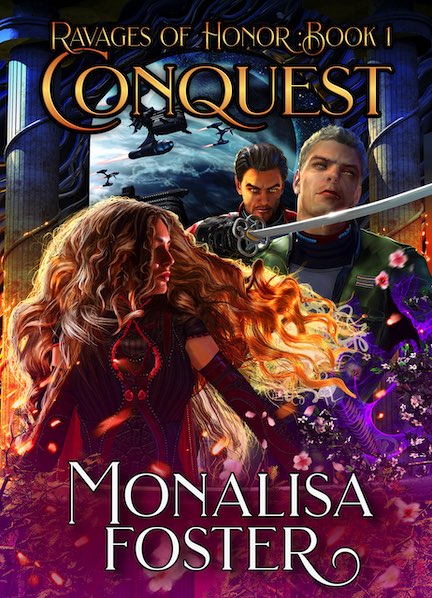
  • Ravages of Honor: Handwavium Part 4, The Concept of Generations

    Ravages of Honor: Handwavium Part 4, The Concept of Generations

    When I was creating (handwaving into existence) the donai, I didn’t expect the “rule of cool” concept of “ooh, genetically engineered samurai” to lead down the rabbit holes that it did. 

    One of those rabbit holes had to do with age disparities in a long-lived species and how to deal with the ick-factor brought on by the so-called “creepiness formula” which states that a person can only date/marry someone who is at least half their own age plus seven years.

    What that means is that if you’re 30, the formula says that you shouldn’t date someone who is younger than 22. Why 22? Because (30)(.5)+7=15+7=22.

    Even though it’s a made-up world, we have to deal with two things. 

    • The first has to do with suspension of disbelief which is dependent on things making sense. And the more you know, the harder that is. (Trust me on this. I’m quite ignorant when it comes to historical fashion which is why I can enjoy The Tudors more than my friends who know a lot about fashion history.) 
    • The second has to do with social mores or acceptance of certain practices and it’s a lot more ingrained than one would expect.

    Case in point, the number of people complaining about Edward being so old as compared to Bella in Twilight. Ridiculous really, since it was dealt with up front. 

    “How old are you?” 
    “Seventeen.” 
    “How long have you been seventeen?” 
    “Awhile.”

    the movie

    The idea of vampires being static, i.e. not aging, not maturing, being anachronistic because they are frozen in place, etc. is a trope of the vampire genre (and some others as well).

    Edward may have come across as too mature for a contemporary seventeen-year-old boy, but that too was dealt with. He was an artifact of his own time, the turn of the 20th century, when a 17-yo was a man, not a boy. He grew up in a world and in circumstances where a 17-yo was far more mature than the 17-yo of today.

    The very same people (the ones who have a problem with this) have no problem with a science fiction story where some guy goes on ice (stasis or cryogenic suspension) and then boings a girl/woman who could easily be his great-granddaughter. Yet the same situation applies, a stasis or developmental pause that is not just physical but mental. And it makes sense in both situations. If vampires don’t age it stands to reason that their brains don’t age either, which is why they’re not grumpy old men yelling at clouds or at kids to get off their lawns.

    (I wrote about this from a more general perspective about a year ago. Vampirism and Other Afflictions)

    But it still presented a problem for my worldbuilding, and not because I figured some might object. It was one of those things I had to figure out, if only for myself.

    So I started off by looking into how generations were defined. I had always assumed (been taught?) that generations were twenty years. Well, there are generations and then there are generations. Obviously I’m not talking about the “Gen X” type of generation, i.e. a group of people born in a certain decade.

    I reached out to one of my doctor friends, as one does, and got quite an education on the more scientific definition. Long story short, generations are determined by how long a woman is fertile.

    Menarche typically occurs between the ages of 10 and 16, with the average age of onset being 12.4 years.—NIH
    The menopausal transition most often begins between ages 45 and 55.—NIH

    Oh no! We’re in girl cootie territory again! Surely this can’t have anything to do with “real science fiction.”

    Sure it does. 

    So let’s go with 50 as the end of fertility and 15 as the start of it (because of the lack of regular periods at the onset of 12.4 years) which gives us a nice number like 50-15=35. (Or if we go with 55, we get 40; either way that’s much longer than the 20-yr span I thought it must be).

    Keep in mind now, this is for handwavium, for a made-up world, so don’t waggle your finger at me about how a real biologist might do this. I’m using this as a launching pad for my handwavium. My handwavium may be crunchy, but not so crunchy that it’s no longer handwavium.

    Now, this period of fertility is obviously dependent on life span as well, so if you live at a time when 30 was your expected life span, it would be 30-15=15 and then also factor in that percentage body fat is a factor so girls who don’t live in industrialized first-world countries or who lived when they couldn’t accumulate enough body fat by age 12, would have later menarche-onset dates. It’s entirely possible that at one point in history, the fertility period (generation) was between 18 and 30 due to limits of body fat percentages and life expectancy, so 12 years. 

    Apply the creepiness formula to that and you can see why a 30-yo man paired with a 22-yo woman wouldn’t make sense or be typical, but a 30-yo man paired with a younger woman makes far more sense. And then factor in the number of deaths due to childbirth on top of that. If you’re not glad that you’re living today instead of way back then, you should be. (Backwards time-traveling heroines notwithstanding).

    This is why we shouldn’t judge the past by our own distorted modern lens. Things happened for reasons (usually) that have everything to do with rules imposed by nature, not because of The Patriarchy (TM) or whatever the hate-on is for today.

    Once you start looking at things with an eye towards impositions made by nature, the world-building gets rigorous, i.e. your scifi elements aren’t just a thin skin or veneer for your fiction.

    For the donai, this meant that I could not use generations at all. When the women that are able to have babies are an anomaly due to errors in genetic coding and only have a handful of fertile cycles, then there is no concept of generations. There can’t be. 

    But it’s not enough to just say and handwave it away. It should be, but it’s not. You need more because of that issue of “aging” in terms of maturity, i.e. old man yells at cloud. The social derision for an older partner comes from the objection that a mature person is taking advantage of an immature one, even if the immature one is 22 and well into being considered an adult whose choices we shouldn’t question due to agency, respect, blah-whatever-blah. Having it both ways, aren’t we?

    I see this derision all the time, especially when an older man is dating a much younger woman. We all assume she’s the poor victim and he’s taking advantage of her. Less so if the older partner is a woman for some reason. Now, there’s some sexism for ya!

    So how to deal with it in-world for Ravages of Honor?

    It turns out I already had a built-in answer, one I didn’t even think of when I created them. 

    Since the donai can live for centuries (How many? I don’t know yet and won’t until I have written it.) and their nanite symbionts keep them in a semi-perpetual middle-age1 for most of their lives, it follows that we have that “stuck at seventeen” or static stage of life like vampires where the character doesn’t transition to the old-man-yelling-at-cloud phase, i.e. senescence.

    Being aware of potential objections made by readers is very helpful, maybe even key, when it comes to rigor. Yes, it means that you can’t just write what you want, and there are certainly times when you’ll want to ignore such “objections” (I certainly do) but it works oh-so-much better when you can head them off with something that makes sense.

    For the record, in RoH, Syteria is, I would say, in her early twenties (or the in-world equivalent) with Darien being about ten years older (chronologically), which makes him very young for a donai. He is not even in that middle-age phase yet. If you were to do an apples-to-apples comparison, as in judging a human by human standards, and a donai by donai standards, she’s “older” than he is because humans age AND mature faster, whereas donai do not. 

    By the way, I was stunned to learn that 20-30 is considered young adult and that middle age as we define it is 40-50. I guess when you don’t start being an adult until you’re 26 that makes sense, but it was still a shock. In my world (IRL), you were expected to act and function as an adult at about 13 and by that I mean in terms of responsibility and maturity, and not by being sexually active. Yes, I’m very Old World. Go figure!

    Now that I’ve started RoH4 and it’s looking like a story where Lady Neria Bhanot and Lord Dobromil (Darien’s father) are going to be forging a new world order, the “May/September romance” question kicked in hard since he is much older. But it doesn’t matter for in-world reasons. People are free to screech about it of course, but that’s not really my problem.

    [crossposted to Substack]


    Side notes for writers:

    This kind of thing is also why I’m glad I resisted the urge to explain, that practice of dumping information into the story when there really is no need for it other than for the author to masturbate on the page and show you how much thought she’s put into it. In fact, I have no less than three deleted scenes over the last three novels where I gave in to that urge and then in going back over it, ruthlessly cut myself out of it. It saved writing myself into a corner, and one of the reasons I continue to love close/deep point-of-view.

    Word of caution. The scientific rigor is what throws such stories out of the Romance genre. Once you start making your story about the worldbuilding or the handwavium rather than the romantic relationship you have crossed into romantic subplot. You’re going to end up overplotting it (for a Romance) because in order for it to make sense you’re going to have to dramatize the “science” to the reader.

  • One-of-Antonia Excerpt

    One-of-Antonia Excerpt

    On May 3, 2023, my latest short-story will be out as part of The Ross 248 Project, a hard-sf shared-world anthology edited by Les Johnson and Ken Roy.

    I am thrilled to join Patrick Chiles, Stephanie Osborn, Brent Ziarnick, Laura Montgomery, Daniel M. Hoyt & E. Marshall Hoyt, Matthew Williams, D. J. Butler, Robert E. Hampson, J. L. Curtis, and K. S. Daniels on this roster of great hard-sf stories. Everyone one of these writers brings in their unique perspective, background, experience, and style to this anthology. I hope you check out their backlists.

    You can pre-order or check out the early release version of The Ross 248 Project here.

    HUMANITY’S HOPE FOR A BETTER FUTURE AT A NEW STAR

    A bold journey into a future where humanity and its children travel to a new star where they must overcome the unexpected challenges on the exoplanets that await them—or die trying.

    Traveling to the stars will be difficult, but not, perhaps, the most difficult part. What about when we get to another star? What then? Will the planets be immediately habitable? Not likely. Will those who undertook the journey be able to easily turn around and come home if they don’t find “Earth 2.0”? Almost certainly not. Therein lies the challenge: Finding worlds that are potentially habitable and then taking the time, perhaps centuries, to make them compatible with Earth life. They will encounter mysteries and unexpected challenges, but the human spirit will endure. Join this diverse group of science fiction writers and scientists as they take up the challenge of The Ross 248 Project.

    Here is the opening scene from One-of-Antonia

    The man in front of Suri was neither sick nor old. Despite the tubes and wires, the monitoring equipment around him, and the fact that they were in Pluto’s premiere clinic for the dying, he was very much a man in his prime. According to his file, Aidan Samuels was forty-two. It was an imprecise measurement—his real age was forty-two years, six months, three days, and sixteen-point-thirty-six hours—one that grated on Suri’s “nerves” such as they were. Tolerating such things without comment was one of the many adjustments that she had had to make.

    She may not have liked it, but humans trusted those who looked and acted like them more than those who did not, especially when it came to their health. That’s why she was wearing a humanoid skin rather than an arachnid one, even though having extra arms would have come in handy for most situations.

    “I don’t understand,” she said, glancing at the virtual-reality clinic supervisor.

    Dr. Benedict Lammens was tall for a human, one-point-nine-eight meters. She knew that he had let his hair go gray because he believed it gave him credibility and she could tell that the glasses he wore were just for the smart-glass lenses. Appearances were important to humans. They went to great lengths to project, not just credibility, but trustworthiness, intelligence—an entire list of positive traits—and mitigate an even longer list of negative ones. Would a four- or eight-armed surgeon with telescoping eyes convey competence and skill? Probably not. More likely to give them nightmares. 

    She filed the idea away, a side project for later, and connected to the clinic’s network. Samuels’ file said that he had gone into a very private and highly customized virtual reality in order to be with his dying wife. When her human body had failed, her corpse had been preserved for a later time in the hope that a cure for her neurological disease would be found. Her corpse had been placed in the family’s vault. There were thousands of such family vaults here on Pluto. It was known for its cryo facilities.

    While Samuels and his wife had been in the VR, thirty years had passed for them. They had essentially enjoyed their “golden years” while only a year had passed in the real world. 

    “Mr. Samuels here is refusing to come out of the VR,” Lammens said.

    “As is his right,” Suri noted, scrolling through the agreements between the SAIN and Samuels. “According to this, the Host agreed to keep him in VR for as long as he wanted.”

    “Unfortunately, the board of 3D-Printed-Homes wants him back in the boardroom,” Lammens said, shoving his hands deep into the pockets of his lab coat. “Some dispute or other. They need his vote to break a tie. Something about a takeover that might destroy the company he inherited from his father. Apparently the Martian cartels are involved and frankly it sounds rather messy.”

    “And he knows this?” she asked as she looked Samuels over.

    “The Host told him. He doesn’t care.”

    “Thirty years have passed for him,” Suri said, scanning through the VR’s logs. It had been just him and his wife for most of that time. There had been other constructs in there, but only artificial ones. No other real person had plugged in and interacted with them except for the Host. “And he’s just lost his wife. Of course he doesn’t care.”

    “We need some time to sort things out with his Board.” Lammens shrugged. “They’ve threatened to pull his credit, force our hand. Sue us. It could get ugly and undermine the trust in both SAIN and our facilities here.”

     Suri had worked with terminal patients and their families before. She didn’t understand grief herself, but she did have to work with it and around it. It was as much a part of working with humans as fixing their bodies was.

    She took hold on Samuels’ left hand. It was cool to the touch, with fading callouses and a simple gold band for a wedding ring. Tiny scars peppered three of his fingers and the backs of both hands. A man whose family had their own vault here, who could afford non-subjective years in VR, hadn’t had those tiny scars removed. Often such things were indicative of sentiment or a lack of vanity.

    She reviewed his public appearances. Not a vain man, but one who definitely understood the importance of appearance enough to opt into standard enhancements—teeth, hair, eyes. A man who liked to work with his hands too by the look of it—there were lots of images of him doing physical labor, building things, making things.

    Humans had such strange affectations. She ran her fingers along the pale scars. Nicks really, tiny little things. What had made them? She wanted to know. It would help her understand humans, which would help her help them, keep them alive, keep them healthy, give her purpose.

    There was a hum in the back of her mind, like a warm caress. She smiled. Antonia, her AI-mother approved. A human would have said that she was giving her blessing. 

    A plan to help Samuels and the decision to proceed was processed at AI speeds. She let go of Samuels’ hand and sat down in the chair next to his bed. 

    “Wait, what are you doing?” Lammens asked.

    “My job.”

    In the time it took her to answer, she ported the specs for her VR avatar to the Host. Suri liked to keep things simple. She liked to manifest as the statistically likely progeny of the two humans who had raised her.

    After all, she was Catrina and Ian Hinman’s daughter as much as she was Antonia’s. So she’d adopted her foster father’s dark hair and mismatched eyes (one blue, one brown) as well as her foster mother’s oval face and sun-kissed skin. 

    Last time she’d been in VR her avatar had worn an eclectic mix of calf-length skirt with a bustle, combat boots, corset-top, and short, bolero jacket with epaulets, all in blues and greens. She discarded the idea of aging her avatar, since most humans, especially older ones, presented as younger, healthier versions of themselves. VR was seductive because one could be anything, or anyone, and things weren’t what they seemed.

    Lammens had stepped back, a skeptical look on his face. But he didn’t say anything. She took it as assent.   

    Suri closed her eyes. She and SAIN came to an agreement at AI-speeds: unless Samuels’ real-world body was in danger, no one was to intervene or interfere. Once inside, she’d be stuck in the VR with Samuels until he agreed to leave or they shut it down and forced him out. Suri would be cut off, her ties to SAIN and her AI-mother severed. 

    She felt herself move as if through a tunnel of light, riding effortlessly through corridors that didn’t exist in physical space.

    The final bit of it, entering Aidan Samuels’ VR, was like fighting her way through a wall of fire. If she’d had any sense of self-preservation, she’d have turned back. 

    Samuels didn’t want her there. That much was clear. Painfully so.

  • Dolus Magnus: The Great Hoax re-released today

    Dolus Magnus: The Great Hoax re-released today

    Scientists predicted catastrophe, telling us that hurricanes would become more frequent. Their allies in the media waited with baited [not a typo] breath for disaster to strike.
    After all, if it bleeds, it leads, and there’s nothing like a major weather event to take advantage of for more funding and for ratings.
    Again and again these predictions, these calls of “Doom, doom, we’re killing the planet,” have been used to get us to accept higher taxes, more regulations, and more control over our lives.
     
    When the weather doesn’t comply, as with Hurricane Florence, reporters pretend that they’re being battered by high winds in order to sell catastrophe. But no matter how much they spin and outright lie, climate models are GIGO (garbage in, garbage out).
     
    This is a timely article because today I’m re-releasing my short story about the hoax of climate change, “Dolus Magnus: The Great Hoax” as a standalone. I think you’ll enjoy this short story’s quick peek into human nature, the realities of science, and the positive message contained.
     

    Sign up for my mailing list and get it for FREE.

  • My favorite FenCon panel

    “Researching the Science in Science Fiction” was probably my favorite panel at FenCon this year. The panel was moderated by William Ledbetter and included Science GoH Marianne Dyson, fellow authors Kristi Hudson (not pictured) and Patrice Sarath (not pictured). Photo credit: C. Stuart Hardwick.

    While all the panels were great, I really enjoy discussing the craft of writing. For a sci-fi writer, that often means research. Sometimes it means going down the research rabbit-hole and getting lost. We discussed our own experiences, i.e. how we approach it, as well as the best methods.

    Doing research may sound easy. Google is your friend, right? Problem is that everything correct is on the internet; along with everything that is incorrect. The search for facts can be as muddied as the search for truth.

    As a writer one must know when to stop. Research is a great way to procrastinate and still pretend that you’re “writing.” Research can also be the death-knell for your premise, your idea, and your story. So how do you handle the story-slayer? Do you write around it? Do you pull out your handwavium and unobtainium? Do you just ignore it? (Think about the sounds that spaceships in Star Wars make in the vacuum of space where sound cannot travel).

    Lots of factors come into play, depending on what kind of story you’re writing. There is more rigor in a hard SF story than a soft SF one. Consistency becomes a challenge, as well as knowing how much of your research to include. After all, you did all that work. Hours and hours. Weeks and months and years. The longer you spent toiling away in the research salt-mines, the more you want to include. But that’s not necessarily the best thing for your story.

    Only about 10% of what I learn via research makes its way into my stories, even the hard SF ones. It has to be absolutely vital to the story, but more importantly, it has to be something that the viewpoint character knows. I think that including things the viewpoint character cannot possibly know is one of the worst mistakes I see consistently across all genres, not just sci-fi.

    Number two would be the dreaded, tension-less, “As you know, Bob” exposition via dialogue. Number three is straight up exposition, usually via author voice. We hashed out some of the best strategies for avoiding not just research pitfalls, but best practices when it comes to incorporating that research into our stories.

    I’m hoping FenCon will continue to offer this panel at upcoming conventions, and if you’re an aspiring writer, I hope you’ll attend. I certainly learned a lot from my fellow panelists.

  • SSTOs and the law

    Esteemed space lawyer and fellow sci-fi writer, Laura Montgomery, reverse-lawyers (i.e. reverse engineers) the realities and legalities of launching vehicles into space on her blog.

    Her excellent review of Promethea Invicta looks at the real world path set up by Congress. A path that, like so many Congressional acts, delegates the actual rule-making and regulation to other entities, such as the Secretary of Transportation. Ultimately, it’s the Federal Aviation Administration (FAA) that issues the needed licenses and permits.

    Her Ground Based Space Matters Blog is an excellent resource for anyone that wants to learn more about private space activity, the FAA, NASA, and associated agencies.

    The multi-talented Ms. Montgomery also writes excellent sci-fi. Her latest release, called Like A Continental Soldier, (Book 3 of the Waking Late series) just came out. Take a look at her author page and check out her other works.


  • Promethea Invicta, ready to rock-n-roll

    Promethea Invicta, ready to rock-n-roll

    I’m very excited to announce that my hard sci-fi novella, Promethea Invicta, is out.

    The Sovereign Republic of Texas of 2071 is no longer part of what used to be the United States. But it is still bound by the treaties it inherited, including the Outer Space Treaty.

    Theia Rhodos is ready to free humanity from the shackles that keep lunar resources out of her reach. She’s done taking “no” for an answer and she’s ready to sacrifice everything.

    And her enemies are ready to let her.

    Everything in life has a cost. And a price.

    Available as from your favorite book seller, as well as through libraries (via Overdrive and Bibliotheca).


  • FenCon XV

    FenCon XV

    Well, it’s official. I’m very excited to announce that I will be attending FenCon XV. Schedule forthcoming, and many thanks to William Ledbetter, the science track director, for the invitation. I’m also working on getting a new publication out in early September just in time for this event.

    What is FenCon? Who’ll be there? Why should I go?

    Answers below. Hope to see you there!

    It’s Alive!


    Join us September 21-23, 2018 at the Westin DFW Airpport. See the hotel link for reservations and directions.

    2018 marks 200 years since the publication of Mary Wollstonecraft Shelley’s FRANKENSTEIN. Join us as we celebrate 200 years of classic and modern SF! Of course, we’ll have panel programming, concerts, hands-on workshops, and more! All the good stuff that makes FenCon theTexas destination convention!

    Oh, and did we mention SCIENCE? You can’t put the “S” in “SF” without it! Oh you could try, but would it be as much fun as FenCon?

    Advance memberships are on sale now!

    FenCon XV Guests of Honor


    Guest of Honor: Larry Niven
    Music Guest of Honor: Marian Call
    Fen Guests of Honor: Aislinn Burrows and Carmen Bryan
    Artist Guest of Honor: Travis Lewis
    Science Guest of Honor: Marianne Dyson
    Special Workshop Guest: Martha Wells
    Toastmaster: Timothy Griffin